Best boutique hotels worldwide: Milan,The Yard

I just had an absolutely wonderful experience in Milan at boutique hotel The Yard, run by Alessandro and Stefanie. The Yard Suite & Dependance is nestled in a courtyard (duh) behind the Piazza XXIV Maggio, with a bio organic restaurant downstairs.

20130219-090314.jpg

As many of you know, finding a great hotel in Milan is not the easiest task, despite it being the fashion capital of the world.

Yes, there is the four seasons, the grand hotel et di Milan, the Westin, or the Principe di Savoia (where I ran into Mary J Blige and David Beckham last year at breakfast), but they are huge, in need of renovations, and have some of the old five star anachronisms like charging per device for Internet that drive me nuts.

20130219-090147.jpg

The whole place has a focus on architecture, family, and, this being Italy, race cars. As you enter the Yard, you see peculiar and unique architectural gems left and right in the sitting area – which, during the day is open air with heaters, and at night closed.

Let’s assume it’s nighttime already. Just relax in the reception area with a single malt and some Picasso adventures.

20130219-090226.jpg

This being a family affair – they give you the keys to the gate, front doors and main entrance, because the family retires after midnight – there has to be a dog chilling on a pillow, which might or might not be your cup of tea. Find it on the right.

20130219-090256.jpg

Vogue models, Louis Vuitton, yachts, cigars and contemporary design are the major impressions you will get in the common area. And common, it is. There is a communal table for breakfast, which forces you to have conversations with people. You still have the option to bury your nose in your blackberry (I heard they are not dead yet with the revamp) or iPhone, but the guests are eccentric and worth spending time with.

20130219-091431.jpg

But, at the end of the day (literally), you are there to be in a comfortable room, and the Yard delivers. Espresso maker, free wifi, a designer shower that actually is functional and heavenly, along with great furniture and a comfy bed.

If you are looking for a home away from home, visual stimuli, and a family to cook breakfast for you, check it out.

20130219-092309.jpg

I invite you to follow me on twitter @danenskat

(c) Enskat Associates 2012

More details on the global M&A in the asset management industry can be found in EAQ, a quarterly asset management review featuring thought leaders globally.

Electronic flipbook

PDF for electronic book format

Posted in beauty, Brand, E&A, enskat associates, hotels, lifestyle | Tagged , , , , , , , | Leave a comment

Multiconvergence: Orix buys Robeco for distribution and global brand

I am finishing a week of CEO discussions in Europe and, before flying back to NY, Orix just announced the acquisition of 90.01% of Robeco equity from Rabobank for about two billion Euros (240 billion yen) to expand the global brand and distribution network.

20130219-083152.jpg

It’s another example of what Enskat & Associates calls the “era of multi-convergence”, aka E=MC2.

Local management will stay in place and report to Tokyo, in an effort to grow AUM by about 25% in the next two years, to roughly $300 billion by 2014. After acquiring US-based Mariner in 2010, Orix is focusing on building global brand via Europe, add to the distribution network and bulk up investment expertise.

Orix is also building a strategic alliance with Rabobank.

It thus ticks all four boxes of my multi-convergence framework: products, distribution, regulation and geographies.

CEO Yoshihiro Miyauchi will surely now look more into Asia, Latin America and the Middle East: “The financial market has drastically changed since the financial crisis and ORIX believes that it is necessary to pursue a new business model by combining finance with related services in a strategy called “Finance + Services.”

20130219-083707.jpg

Expect more… KKR/Schwab, GCS/Dexia, BTG Pactual/Celfin, Franklin Templeton/K2, Legg/Permal/Fauchier, Schroders/STW, Credit Suisse/Qatar, Carlyle/Vermilion.

The Era of Multi-Convergence is upon us, maybe the blockbuster win.

I invite you to follow me on twitter @danenskat

(c) Enskat Associates 2012

More details on the global M&A in the asset management industry can be found in EAQ, a quarterly asset management review featuring thought leaders globally.

Electronic flipbook

PDF for electronic book format

Posted in alternatives, asia, Brand, cash flows, distribution, E&A, enskat associates, institutional investor, institutions, management, Middle East, multi-convergence, pension funds, private banking, professional fund buyers, SWFs, UCITS, wealth management | Tagged , , , , , , , , , | Leave a comment

BAILA Society Annual Report 2012

As every year, below you will find the annual report for BAILA Society, highlighting master classes, performances, travel, charity events and the dancers of the company.

Download it here on iTunes or Issuu.

20130102-095011.jpg

Posted in apps, beauty, hotels, LatAm, multi-convergence | Tagged , , , , , , , , , , , , | Leave a comment

Schroders increases US assets to $35b with STW acquisition

Global boutique investment specialist Schroders is continuing to build out business away from its UK home – today the firm announced the acquisition of STW Fixed Income Management in the US.

20121217-180959.jpg

STW is a US investment grade bond manager with a value tilt and $12 billion in institutional assets from some 100 clients. According to Schroders CEO Michael Dobson, the move is increasing the firm’s US AUM to $35 billion, along with new product and service capabilities for the institutional client base.

20121217-180753.jpg

The acquisition shows a number of key trends:

– fixed income strategies continue to rank high for clients, as institutions in the US and globally reassess asset allocation in a risk-on/risk-off market environment.

– Schroders globally has had tremendous success with various fixed and multi-asset income focused solutions. The broader product and service platforms will help solidify gains.

– as discussed in analyses in October, despite being London headquartered, Schroders in the last decade flipped its asset mix from 30% international and 70% UK-based to the opposite today (for a total of $305 billion).

– Schroders Vice chairman Massimo Tosato highlighted the US with only 10% of global AUM as a key growth region, alongside Asia.

20121217-181036.jpg

– lastly, the purchase shows the trend towards industry consolidation and multi-convergence. As the needs of institutional and wholesale clients are converging, investment managers are increasingly restructuring platforms, client teams and sales approaches, both for local silos as well as within global expansion strategies.

I invite you to follow me on twitter @danenskat

(c) Enskat Associates 2012

More details on the global M&A in the asset management industry can be found in EAQ, a quarterly asset management review featuring thought leaders globally.

Electronic flipbook

PDF for electronic book format

Posted in alternatives, asia, black swans, Brand, cash flows, distribution, E&A, enskat associates, information delivery, institutional investor, management, multi-convergence, pension funds, professional fund buyers, wealth management | Tagged , , , , , , , , , , , , , , | Leave a comment

Multi-Convergence: HK PE firm GCS buys Dexia Asset Management

That was fast.

20121212-220204.jpg

Less than ten days after entering exclusive acquisition talks with Dexia, HK-based private equity firm GCS Capital is buying the asset management arm from the Dexia group, a case of #East2West and #Multi-Convergence.

The price was set at about half a billion, but that is subject to further adjustments upon completion of the deal some time in the first quarter off 2013.

20121212-220642.jpg

Recently we have seen KKR announce a partnership with Schwab to offer two funds (high yield and distressed opps) for $2,500 minimum investment, American Funds raising multi-billions in an EM PE fund, and many more examples of convergence between alternative and traditional asset management – Newcits et al.

Still, this acquisition has the added component of an Asia PE firm buying a European household name to deliver global distribution of product. GCS, run by two former HSBC investment bankers, is backed by various institutions in the region and intends to keep Dexia AM as a center of excellence in Europe.

Culturally this will be an interesting story to follow, especially since GCS signed a partnership agreement with ICBC, opening distribution pathways into China and beyond. As a strategic partner to ICBC, Dexia can now access distribution in China, and vice versa, GCS can offer Asia expertise in Europe.

Huan Guocang, GCS’ CEO, commented on the deal: “GCS Capital is delighted to partner with DAM’s experienced management team and together with our strategic partner, ICBC, broaden the franchise across emerging markets to capture capital flows.”

As we are entering an era of multi convergence and multipolarity, let the games begin.

I invite you to follow me on twitter @danenskat

(c) Enskat Associates 2012

More details on the global asset management industry can be found in EAQ, a quarterly asset management review featuring thought leaders globally.

Electronic flipbook

PDF for electronic book format

Posted in alternatives, asia, black swans, Brazil, cash flows, consulting, distribution, E&A, enskat associates, institutional investor, investment banking, multi-convergence, private equity | Tagged , , , , , , , , | Leave a comment

Global Trends 2030 – Welcome to the Future

The sad thing about the comprehensive work of the National Intelligence Council looking at future global trends is that it only is published every four years, and the speed of change has been increasing dramatically.

20121211-163647.jpg

To that end, #GT2030 has commissioned a blog and social media to more frequently update its work and incorporate thoughts from experts around the world. I also think the commission of a “track record of the global trend studies” is a helpful indicator, reviewing prior predictions and adjusting methodologies and frameworks as needed.

20121211-163848.jpg

A first important finding thus: “… a comprehensive reading of the four reports leaves a strong impression that [we] tend toward underestimation of the rates of change.”

One of the suggested solutions: more wargaming and simulation exercises among various actors. Of course, this is something the investment management industry needs much more of as well. As the rate of change is multiplying along with global complexities, CEOs should engage in more strategic exercises, simulations and, probably a first, wargaming.

So far very few firms are doing this, almost none is doing it on a global basis.

The interplay of megatrends, game-changers and potential worlds: GT2030 provides a “framework for thinking about possible futures and their implications” as it differentiates between megatrends, game-changers and possible worlds and outcomes.

A global middle class: The first megatrend is the growth of a true global middle class, described as a tectonic shift by the authors as for the first time a majority of the population worldwide will not be considered impoverished.

This trend is especially close to my heart. The mutual fund and asset management industry’s backbone is the growth of the middle class and greater participation in capital markets, with a sustainable shift from savings to investments and long-term financial goals. The US industry only started to reach its current size once the 401k market and, with it, household mutual fund penetrations started to grow.

Our research found that the current global middle class of about 500 million people will quadruple in the next 10-15 years, to 2 billion, mostly in fast-growth emerging markets.

Diffusion of power, driven by emerging economies: Global power will be more influenced by China, Brazil, India, Colombia, Indonesia, Nigeria, South Africa and Turkey, than by Europe, Japan or Russia. Big changes ahead and actually already under way, and we are going to rely more on the East and South than the West. However, communication technology will change the nature of power as well.

20121211-170642.jpg

My travels to each of these high impact markets of the future equally convinced me of the necessary focus for leading asset managers to think through how to address each of them – if they want to survive and flourish, that is. Much of the emphasis for it should be on the appropriate message to go along with the complexity of investment strategies.

For instance, South Africa-based Investec was the leading investment boutique in terms of global cash flows last year, with now $100 billion in AUM – and a first-class four minute video about the firm. Similarly, my visits with Brazil powerhouses last week, such as BTG Pactual, indicates greater participation of these regional specialists in global asset holders’ beauty contests around in demand themes and regional exposures. And the top cash flow product in the US this year, DoubleLine’s flagship MBS fund, gains visibility from Jeff Gundlach’s popular podcasts.

20121211-170729.jpg

Shifts in demographic patterns: aging, migration and urbanization will alter demographic patterns most, with impact on food and water, as well as energy overall.

Now let’s get to the game changers: the fragile global economy (collapse or multiple resilient growth centers), the governance gap (an ever more diverse set of state and non-state actors), intra- and interstate conflicts with various risk baskets, wider scope of regional instability, the impact of new technologies (information technology entering an era of big data, new manufacturing and automation technologies, technologies for the security of vital resources, and new health technologies), and the future role of the US in the world.

The most unpredictable black swans listed include a global pandemic, more rapid climate change, Euro or China collapse, a reformed Iran, nuclear war/cyberattack, solar geomagnetic storms or a US disengagement.

20121212-130628.jpg

Thus, the asset management industry is entering E=MC, an era of multi convergence, with the equivalent of what the study calls multipolarity: multiple silos and centers of growth around the world, acting in isolation from but under the impact of global trends.

A lot of fun for those firms that are flexible enough to deal with the added layers of complexities, uncertainties and volatility. But for the many firms tied down by compliance and bureaucratic obstacles, good night and good luck.

I invite you to follow me on twitter @danenskat

(c) Enskat Associates 2012

More details on the global asset management industry can be found in EAQ, a quarterly asset management review featuring thought leaders globally.

Electronic flipbook

PDF for electronic book format

Posted in alternatives, apps, asia, black swans, cash flows, Chile, consulting, distribution, E&A, enskat associates, information delivery, institutional investor, LatAm, Latin America, lifestyle, multi-convergence, pension funds, private banking, private equity, professional fund buyers, wealth management | Tagged , , , , , , , , , , , , , , , , , , , , | Leave a comment

LatAm keynote and client meetings: 2013 trends for Brazil and Latin America

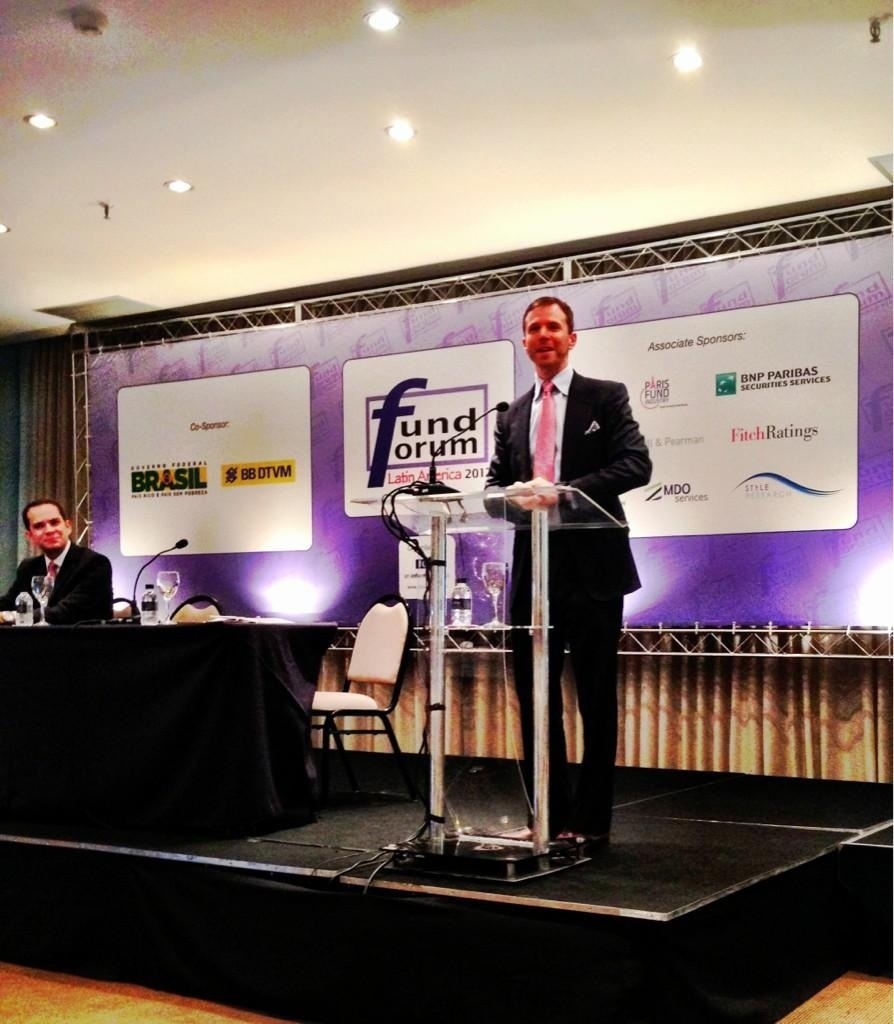
Just touched down in New York after a week of meetings and speeches in Latin America around the annual Fund Forum. With the Selic rate down 525 bps to 7.25%, the industry for the first time in years is seeing an inflection point that is likely to open up Brazil to greater global participation, alongside product proliferation and innovation.

20121130-144416.jpg

Some of the major themes from discussions with and overviews from the CEOs of the largest LatAm distributors and banks including Santander, HSBC, BBDTVM, Bradesco, and Itau:

All distributors are preparing investors for a shift in investment products. A number of CEOs think the old adage of “this time is different” does apply, with clients according to many of them in the first stage of grief: denial (about interest rates).

Thus, Brazil is likely to see demand for new investment themes across sophistication levels, including more risk, illiquidity, alternatives, real estate and more. Where in the past investors comfortably earned 8% in ultra low vol stable products, which account for some 70% of products, those returns now stand at less than 80bps.

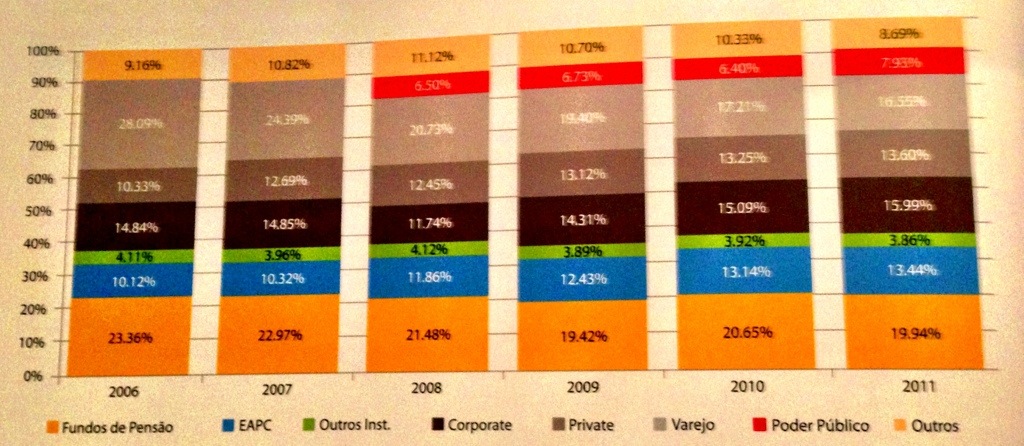
Industry AUM according to Anbima stood at R$1.9 trillion last year, making Brazil the sixth largest fund industry in the world. Net cash flows in the last three years exceeded R$325 billion. Notably, R$18 billion of new cash contributions last year went to the fast growing EAPC (Entidades Abertas de Previdência Complementar (open private pension funds)).

20121201-123352.jpg

I detailed many of the opportunities in the region last year in Strategic Insight’s State of the Industry – Latin America, as we developed a database for the local and global products available in the market.

The interest rate is now at the lowest level in Brazil’s history, and the higher risk appetite has spurred growth in areas like real estate, which has grown over one third this year alone. Those products used to be the terrain of HNW investors via private banks, but are now rapidly moving downward into the retail segments.

Similarly, the whole palette of alternative themes is gaining traction. I assume strong growth in coming years for private equity and other alternative vehicles based on client discussions and market analysis.

The interest rate drop de facto forces distributors’ hands down the road of product proliferation and innovation. Part of the challenge will be to change investor mindset, away from 1% return per month as a God given right.

2013 will be a litmus test in that regard. As product innovation takes off, investors already have a hard time understanding what they are buying, as visible with some of the complexity in the real estate products that have been gobbled up.

In all likelihood, this will help the advisory business and the provision of holistic investment solutions, as wealth management is picking up speed. We have seen Julius Baer buying a stake in GPS and other local advisory firms being acquired. And with BTG Pactual just having moved into a brand new powerhouse office on Faria Lima, their focus post acquisition spree has gone from local to regional and global.

Of course, speculation runs high for exactly when foreign investors will be able to get a larger share of the business in Brazil. The equity market will become much more important in coming years, along with greater participation in a true alternative segment of the markets, away from the inhouse managed multi mercado businesses of firms like Petrobras.

Products are shifting away from passive to total return themes with a gradual increase in risk exposure. The middle class is growing stronger and they are now starting to diversify their holdings. Pension funds, although already able to invest ten percent of holdings abroad, in reality still do much less than that, but it is slowly changing.

Regulation and industry associations are also increasingly looking globally to learn, influence and participate in the globalization of the industry. Anbima has new project in the pipeline and the CVM is readying the market for new vehicles.

As I have written in recent entries, CIC invested directly in BTG Pactual and there are a ton of agriculture, infrastructure and other co-investments being developed by a variety of institutional investors. Firms like Itau in Japan or Europe are expanding globally, and the other large domestic brands are following in those footsteps.

Notably, while the rest of the world is going passive, active management and diversification is becoming more important in Brazil, away from index Bovespa to total return and thematic approaches. And the fixed income world is ripe for a wave of innovation along the credit, market and risk spectrum as well.

20121201-120517.jpg

Aside from my keynote speech at the Fund Forum LatAm, I conducted a masterclass on local and global distribution with executives from BTG Pactual and Afina: Ricardo Kaufmann and David Godfrey-Thomas. A large group of firms is assessing market entry strategies or, vice versa, global expansion.

With this boom of managers in Brazil, the question will be which one of the thousands of local (and offshore) products will become the next local or regional blockbuster fund. Whether equity as an alpha play, development of a true third party multi mercado business, or macro hedge funds and private equity propositions, an emphasis has to be on protection of the industry and its growth by producing simple products for Brazilian investors across income levels, despite an increasing level of complexity.

This dichotomy should not be too far a stretch for Brazil, where six-lane multi-hour traffic delays go hand in hand with Brazilian style pizza on the rooftop of the Skye bar featuring a breathtaking panorama of the São Paulo skyline.

20121201-120404.jpg

Goodbye SP, hello NY.

I invite you to follow me on twitter @danenskat

(c) Enskat Associates 2012

More details on Latin America and the global asset management industry can be found in EAQ, a quarterly asset management magazine featuring thought leaders globally:

20121201-121344.jpg

Posted in alternatives, black swans, Brand, Brazil, cash flows, Chile, consulting, E&A, enskat associates, information delivery, institutional investor, LatAm, Latin America, multi-convergence, pension funds, private banking, professional fund buyers, wealth management | Tagged , , , , , , , , , , , , , , , , , , , , , , , | Leave a comment

LatAm saves Santander and BBVA in Europe: reverse engineering of success

Last week, Spanish prime minister Mariano Rajoy used a LatAm summit to ask business leaders to invest more in Spain as a platform for growth in Europe, Asia, and Africa – “Spain receives Latin America investments with open arms.”

20121123-154830.jpg

Cool.

Also quite a turnaround from a historical perspective. In turn, LatAm executives now think that Spain, Portugal and others have a lot more to learn from the success recipes in LatAm than the other way around. I commented on examples such as the multi-mercado lessons for Newcits and the Chilean La Polar-Dublin investment fund scandal in a recent book.

And indeed, we have seen many US and European firms aggressively expand in the region, such as Principal Group with multiple cross country acquisitions, Julius Baer with GPS, Credit Suisse with HG, or, very recently, the CIC with direct investments into BTG Pactual.
20121123-155012.jpg

Conversely, the banking, pension and insurance businesses in Mexico and South America are hugely important indicators for Spanish groups such as BBVA or Santander.

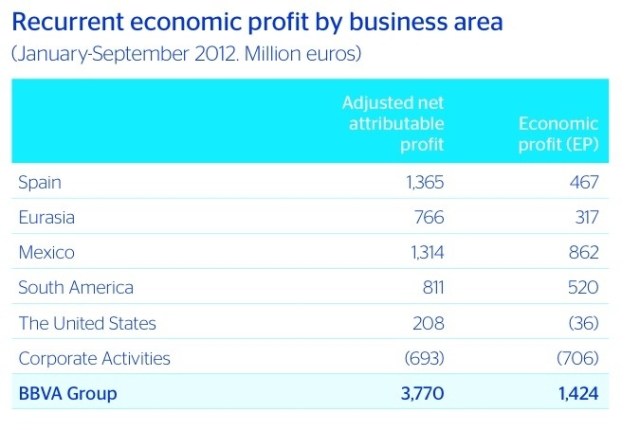
For example, BBVA as per Q3/2012 earnings saw Eur3.8 billion in adjusted net attributable profit, and Eur1.4 billion in economic profit, shown below. Of that total, Mexico alone accounted for almost twice as much in economic profit as Spain.

Mexico combined with the rest of South America overall totaled more than 100% of economic profit for the group (side note, Eurasia is catching up fast with Spain from a profit perspective as well).
20121123-135159.jpg

What about some of the other indicators?

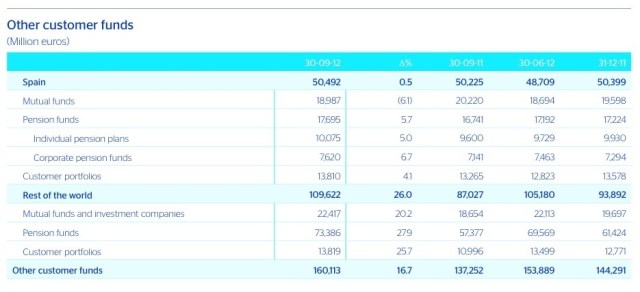
Away from balance sheet funds, Eur110 billion of the Eur160 billion in customer funds come from outside of the domestic market. Importantly, pension fund assets of Eur18 billion in Spain compare with Eur74 billion non-domestically.
20121123-135637.jpg

Mexico stands out because of strong retail activities, double-digit growth for retail deposits, positive insurance performance, sustained recurring revenues and multiple strong issues of capital notes on international markets.

Customer funds, including on-balance sheet deposits, repos, mutual funds and investment companies, and pension funds, grew 7.2% year-on-year to Eur76 billion in September 2012. Through Q3, the pensions and insurance unit generated Eur275 million in net attributable profit, up 14% over Q3/2011. Those numbers were partially due to strong earnings from the ILP, Creditón Nómina, VidaSegura, HogarSeguro and Transacción Segura products

Other highlights:

Dinero Móvil BBVA Bancomer, launched in September 2012, is a service that allows the ability to send money to any part of Mexico via Internet, ATMs or cell phones. The recipient of the deposit receives a message with a password giving access to the cash through ATMs in the BBVA Bancomer network, without the need for a debit card or a bank account.

– BBVA Bancomer in July issued 10-year additional capital notes for $1 billion on the international markets, 3.5 times oversubscribed. A $500 million renewed issue in September was three times oversubscribed.

Investors are confident.

– The Mexican Center for Philanthropy (Cemefi), Alliance for Social Responsibility in Mexico (AliaRSE) and Forum Empresa granted BBVA Bancomer the “Best Corporate Social Responsibility Practice” award in the “Community engagement” category for the mutual fund B+Educa, the first of its kind created by Mexico to support the “Por los que se quedan” (For those left behind) social integration scholarship program.

This is one of the areas that hopefully will grow strongly in the future, as asset management firms, institutional investors and distributors are becoming more aware of their social responsibilities and the long-term investment provisions they create and provide.

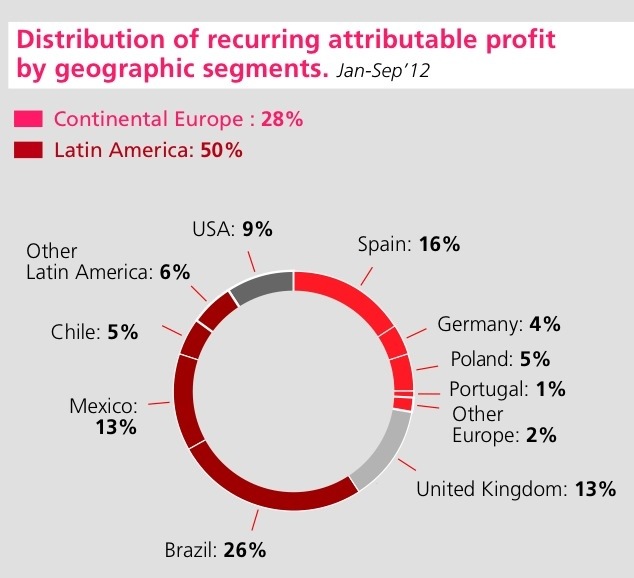
For Santander, 50% of profits come from Latin America, led by Brazil and Mexico, compared to 28% from continental Europe.
20121123-142223.jpg

Continental Europe had attributable profit of Eur1.8 billion, or over 10% lower year-on-year. The decrease was mostly due to provisions made in retail units in Spain and Portugal. The UK, on the other hand, grew by 4% to GBP700 million.

The profit center for the group through Q3 was Latin America, with Eur3.3 billion, about twice as much as Europe. In local currency terms, gross income increased by 14% and net operating income rose almost 18%. Yet, profits shrank by 4% because of higher provisions, taxes and the perimeter effect. Excluding the latter, attributable profit rose 4%.

Santander Asset Management is still in the process of creating a global business model based on management capacities at the Group level and on the knowledge of local managers. During the quarter, as part of a reorganization of the business around a holding company for all fund management entities, Spain, Argentina, the UK and Luxembourg were integrated, and the structure of the management teams for Latin American mandates and for the global European mandates have been finished – all of which facilitating entrance into the institutional market.

A few highlights:

– profit for the Group (profit before tax plus fees paid to the networks) was Eur 775 million, 4.5% down year on year.

– overall assets stand at Eur140 billion, unchanged from 2011, with Eur100 billion in mutual and pension funds, Eur7 billion in client portfolios other than funds, and some Eur30 billion in institutional mandates. Of that total, 86% comes from Brazil, the UK, Spain and Mexico.

– Brazil has Eur45 billion in AUM, up 4% excluding exchange rates. A weakness in retail funds (-10% from 12/2011) was offset by growth in institutional mandates, both from third parties and the Group.

– UK managed funds increased 9% to Eur27 billion. Mutual funds were stable: good acceptance of multimanager funds offset market declines.

– Spain was in net outflows. Santander got out of money market and focused on profiled funds. Including pension plans and mandates, fund assets decreased by 3% to Eur36 billion. One bright note were new mandates from institutional German clients.

– Mexico continued to launch new risk profile funds and guaranteed products, which helped to improve the asset mix: Eur 11 billion, up 3% from last year in pesos.

– Argentina and Poland grew 13% and 15%, respectively, from a lower base. In Portugal, liquidity driven deposit switching activity produced a 10% decline in mutual and pension fund assets.

– non-traditional assets (real estate, alternative management and private equity funds) hovered around Eur3 billion.

By and large, we see an increasing trend towards what I dub “emerging market bridges”, more direct activities between fast growth, emerging markets. At the same time, developed markets are shifting more resources and talent towards developing Latin America and Asia. Lastly, multi-convergence benefits those firms that are able to build a global business model with local expertise and brand silos.

I invite you to follow me on twitter @danenskat

(c) Enskat Associates 2012

Posted in alternatives, black swans, Brand, Brazil, cash flows, Chile, consulting, E&A, Enskat, enskat associates, institutional investor, investment banking, LatAm, Latin America, multi-convergence, pension funds | Tagged , , , , , , , , , , , , , | Leave a comment

Asia Society CEO luncheon, HK

We picked the Asia Society for Asset International’s CEO luncheon in HK for numerous reasons. First, John Rockefeller III founded the Asia Society in New York on Park Avenue in 1956 to foster exchange and collaboration across the arts, business, culture, education and policy. Also, the first international offshoot (there are 11) was the Asia Society Hong Kong Center (ASHK) in 1990 by a group of Hong Kong community leaders, led by Sir Quo-Wei Lee, then chairman of Hang Seng Bank.

20121121-182207.jpg

It is a gorgeous space right in central, yet removed as an oasis with nothing but green surrounding the private houses.

20121121-152219.jpg

Rockefeller’s vision has come full circle with Hillary Clinton’s recent piece in Foreign Policy on the US and her need to “pivot to Asia” in the 21st century: “America’s Pacific Century

20121121-151046.jpg

While 97% of the events at the society are public, the CEO luncheon was an off the record private event to exchange views on the globalization of the asset management industry and the respective roles of the US and Asia.

20121121-151818.jpg

Asset International chairman Jim Casella hosted the event, introducing additions to Strategic Insight’s HK team beyond the existing group of analysts. He also pointed towards the large existing business in Australia with Plan for Life and how it ties into the region at large. Other expansion efforts for Asia include aiCIO (where I write a global analyst column), and Philanthropy Management.

20121121-152903.jpg

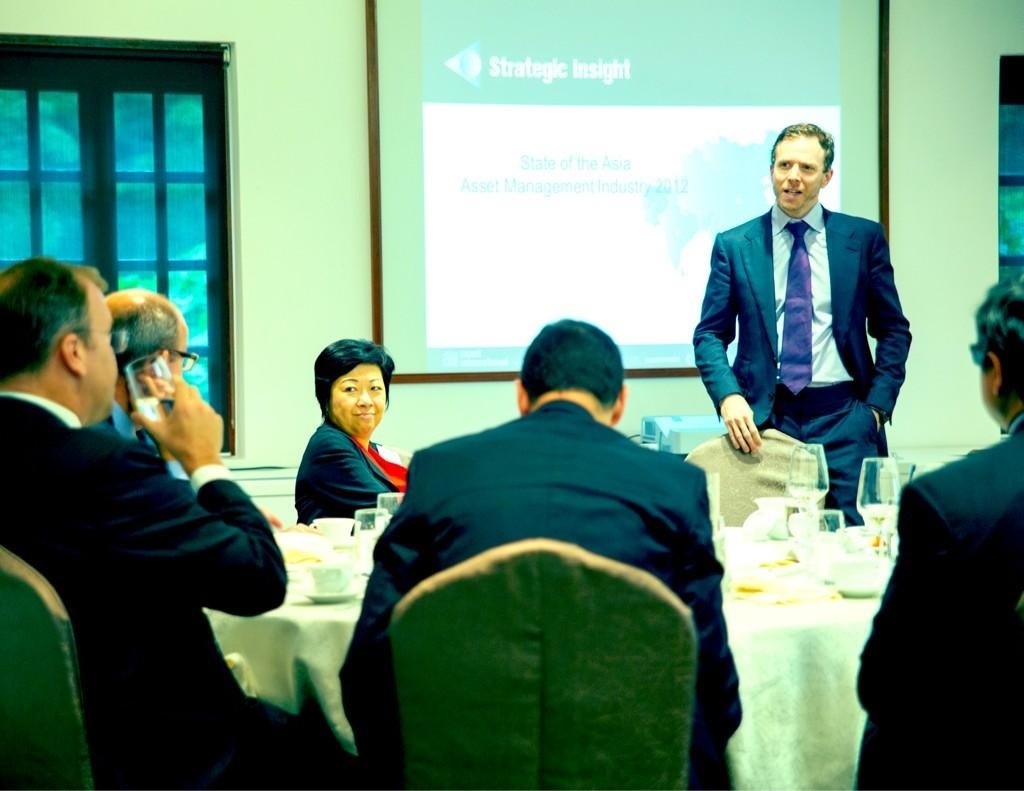
Jim gave an overview of how the company has developed more global initiatives in 2012, followed by my State of the Asia Asset Management industry and an informal lunch discussion with the CEOs on key challenges and opportunities for 2013 and beyond.

20121121-153425.jpg

I invite you to follow me on twitter @danenskat

(c) Enskat Associates 2012

Posted in alternatives, Brand, China, E&A, enskat associates, information delivery, multi-convergence, professional fund buyers | Tagged , , , , , , , , , , , , , , , , , | Leave a comment

Earnings: BTG Pactual moves forward – acquisitions, investment funds, record numbers … and a lower Selic rate

When writing about Latin America, one cannot avoid looking at the example of Brazil. When writing about Brazil, one cannot avoid looking at the example of BTG Pactual. I have clearly written a lot about the firm in recent months (M&A, IPO, business celebrities, and more), but for good reasons.

Record growth for BTG Pactual

In its third quarter release, BTG reported an increase in AUM to over R$160 billion, up some 18% year on year, with the acquisition of Brazilian Capital adding R$11 billion in real estate fund assets.

Year to date revenues of R$4.9 billion and net income of R$2.4 billion represented growth of 120% and 176%, respectively in comparison to Q3/2011.

20121120-214708.jpg

CEO Andre Esteves pointed to the focus on regional expansion as the driver for being awarded the 1st position in Latam research by Institutional Investor, the first time a Latin-American institution received the award.

Macro picture in Brazil appealing for asset and wealth management

On the monetary policy front, the Selic rate was cut by 100bps in Q3/2012 and again by 25bps – to 7.25% – at the latest Monetary Policy Committee meeting in early October, a total of 525bps for the monetary easing cycle. The committee clearly stated its intention to remain at current levels for a while. Still, 12.5% Selic vs. now 7.25% shows greater opportunities for the asset management industry going forward, both from a diversification and return perspective.

But back to the details for BTG.

20121120-212111.jpg

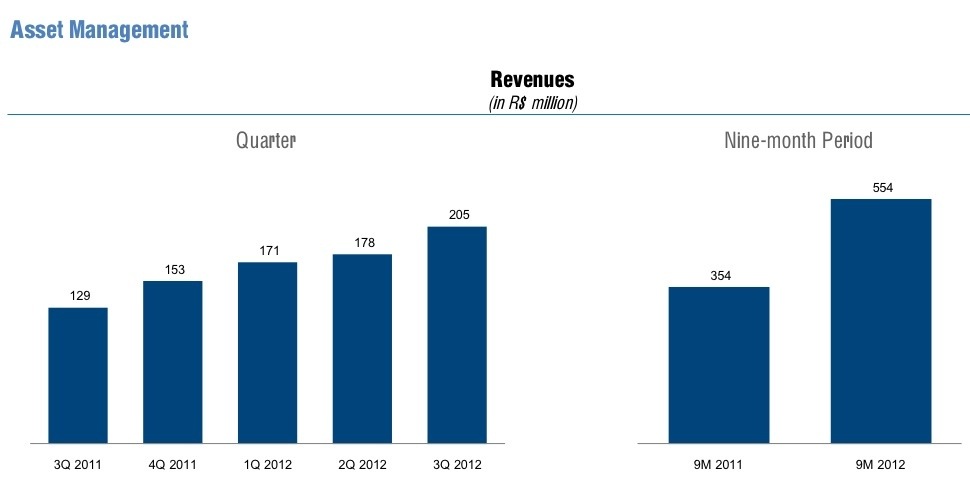
Asset management revenues grew 15% to R$205 million, in line with a 14% AuM/AuA increase – this includes R$11 billion in new assets as a result of the August acquisition of Brazilian Capital -, to R$151 billion.

Pockets of excellence: Global hedge, Brazil bond and Brazil equity funds

Year on year, the asset management business benefited from an increase especially in performance fees, specifically for global hedge, Brazil Fixed Income & Brazil Equity Funds. Net flows reached R$4.3 billion on the strength of the strategies mentioned before, while fund services were a drag.

The themes are interesting, indicating on the one hand continued local fixed income strength, but also a pickup for equity themes in Brazil. Interestingly, while hedge funds globally have had a difficult time post-crisis, the multi mercado business in Brazil and the global hedging theme continue to be appealing. Indeed, other firms such as Blackstone (recently discussed) also have been able to add cash net new flows to hedge strategies.

20121120-212209.jpg

A closer look at client distribution reveals a stable picture year on year, but with a greater trend towards multi-convergence and client diversification, “other” clients increased by 6% to now 23% of the total.

20121120-212747.jpg

Wealth management shows growing revenues via investment funds

The third quarter was one of the best in recent history, with R$55 million in revenues. Importantly, much of those revenues came from the growing proportion of investment funds in client portfolios, shown below.

20121120-213235.jpg

Investment funds have grown from R$22 billion last year to R$26 billion in Q3/2012, an increase of almost 20%. Revenues from wealth management shot up 55%, to R$55 million, following an increase in WuM from R$41 billion to R$44 billion. The increase in WuM is mostly attributable to some R$1 billion in cash contributions and a positive mark-to-market of the assets under custody.

20121120-215819.jpg

Separately, BTG in September increased its liquidity profile through the issuance of two Banco BTG Pactual bonds: US$800 million in subordinated notes totaling at a fixed coupon of 5.75%, priced at 98.14% and maturing in September 2022; and US$200 million in principal amount of senior notes, denominated in Colombian pesos, at a fixed coupon of 7.00% and maturing in September 2017, marketed primarily to investors in Latin America.

BACEN at the end of October authorized BTG’s acquisition of Celfin Capital, with the transacton anticipated to be concluded in the fourth quarter.

In sum, BTG:

– has been on a buying spree with Celfin, Brazilian Capital, and other local acquisition
– is now the top brand for Latin America by a growing number of measures
– is posting strong growth for investment banking, asset and wealth management
– competes with large global firms for EM and regional mandates at top institutions
– shows strong revenue growth via investment funds
– global hedge funds as well as Brazil bond/equity funds are in demand
– sees a diversifying client base

And, the much lower Selic rate overall is changing business dynamics within and outside of the country. Interesting times for Latin America and the world of investment management, as the convergence of geographies, products, clients and regulation is creating both greater complexities as well as remarkable opportunities.

I invite you to follow me on twitter @danenskat

(c) Enskat Associates 2012

Posted in alternatives, Brazil, cash flows, Chile, distribution, E&A, Enskat, enskat associates, institutional investor, institutions, investment banking, LatAm, Latin America, multi-convergence, professional fund buyers, wealth management | Tagged , , , , , , , , , , , , , , , , , | Leave a comment