iPad marketing lessons, brand and communication

Whether Steve Jobs again turns an industry upside down with the iPad remains to be seen, but he clearly showcased management leadership and basic marketing lessons today at the Yerba Buena Center for the Arts (side note – interesting choice of venue/words: Enamorado con la yerba buena, comida cubana y las nalgas morenas (Cypress Hill). Well, Steve?).

But I digress. Not a single announcement was posted by Apple, but the media and tech industry speculated wildly about the potential implications of a potential product. Newspapers like the NY Times or WSJ are ready to push content to the product (before they knew it existed), as did many others and developers are getting ready to feed the app store with customized programs.

Good luck beating that tonight, Obama.

Some of the lessons of how Apple managed the campaign?

– Jump in: As industry observers have pointed out, apple prefers to not beta test anything and just come out with a product when it feels good and ready and have the world see for itself. Buyers waited 5 hours at the Apple cube on Fifth Avenue when the iPhone first came out and will do it again for this pet.

– Simplicity of One: A friend of mine over lunch last week told me it took his one year old son less than one minute to unlock his iPhone… first he turned it around, then he mouth-tested it for good measure, then he found the one and only button and pressed it. Then he followed the blinking arrow and started moving his finger with it until he had unlocked it. The Blackberry business generation has problems figuring out how to use one button, babies don’t – also one of the reasons by the way why the simplicity of Google’s search box helped it achieve $6.5 billion in 2009 profits, one of the worst years in business, period (picking a fight with China, less ideal).

– Communication/cult: Yes, Apple is a bit of a cult, but the consistency of its message and quality of its staff from top to bottom make it consistent across the board. First hand experience: although my MacBook Pro died this past weekend (along with key documents) I somehow don’t hold it against them to a degree to which I would scream and raise hell with my Lenovo laptop and Microsoft.

– Brand/risks: Apple has taken risks throughout its corporate history and the ups and downs of Steve Jobs are a testament to those risks (and single-mindedness). Yet, aside from Warren Buffett he is one of the few untarnished, popular and widely respected business leaders worldwide – Tiger won’t stop falling from grace, Lloyd Blankfein is trying to save the family name and Obama is involuntarily competing with a “former nude centrefold”.

Side note, #2: the whole issue of leadership, brand and driving a coherent message in the financial services industry is becoming paramount as well as the distribution landscape post-crisis is changing dramatically: Bill Gross collected $85 billion in net flows in the last five years influencing markets publicly with themes like the “new normal” and in my roughly 75 conference calls with CIOs, CEOs and heads of distribution networks across Europe in the last few weeks while writing a book it became clear that, in addition to performance (good, not stellar), senior commitment, visibility, and other qualitative aspects are becoming the key driver of success.

Brand as the sum of experiences: The jury is out on how good and influential the iPad will be, but I for one will definitely trash my Kindle DX with gusto and verve (and leave my laptop at home when going on business trips). I commented on the highly frustrating device a few weeks back from the Cathay lounge in Hong Kong and since then have been using the iPhone Kindle app as a better alternative to the Kindle.

The only reason why I still look at the damn thing once a week is the New Yorker (create an app already, David Remnick).  Its funeral can’t come soon enough – yesterday it froze three times in five minutes while I was trying to highlight a few paragraphs in the FT and NYT. When I go to my clippings I have to painstakingly click through each page to get to the end (go to location seems just a placeholder in the menu) and it doesn’t cease to surprise me how the “whispernet” can’t connect to the server in the middle of Manhattan.

Lastly, a few weeks ago I dropped my Kindle (with protective sleeve) from a low chair and it died immediately. In comparison, when a friend of mine first showed me his iPhone (without protective sleeve) in a cafe a few years back a waitress  by accident flicked it all across the room onto a marble floor and into a wall. My friend was close to a heart attack, the device was fine.

Back-to-basics.

P.S. I just came home and had the iPad announcement in my inbox… and watched Steve Job’s iPad presentation. There is no doubt in my mind that it will, just like the iPhone in 2007 (250million sold in three years, along with 3 billion application downloads), revolutionize the industry. Watch for yourself: http://events.apple.com.edgesuite.net/1001q3f8hhr/event/index.html

Posted in management, Uncategorized | Tagged , , , , , , , , | 2 Comments

The Decade in Asset Management

Not exactly a relaxed decade for the world – a very partial alphabetical list includes:

Abu Ghraib, American Idol, Anthrax, Arthur Anderson (see Enron, see Tiger), Bear Stearns, Blackout in NY, Bali bombs, Bernie Ebbers, Burma
cyclone, Bush (43), China earthquake, Color-coded terror alerts, Credit crisis, Dennis Kozlowski, Enron, Galleon Group, Grasso (Richard), Iraq war, H1N1, Hurricane Katrina, Jerome Kiervel, Joe the Plumber, Kashmir earthquake, Lehman, Madoff, Martha Stewart, Mumbai terror, 9/11, Palin (Sarah, lipstick), Pension pay-to-play (NY), SARS, Satyam, Sir Stanford, Swiftboats, Tech bubble, Thain (John, carpet), 3/11, Tiger Woods, Tsunami, Work of God (GS), …

But of course there were also a few bright lights – Avatar, Borat, Barack Obama, Green Revolution, Tech Revolution, and, surprise, the mutual fund industry.

Especially with all the financial scandals and the tech bubble and credit crisis, in a decade where stocks ended lower than they started
one would assume the mutual fund as a boring long-term retirement savings vehicle would not attract much aggregate attention. Wrong.

Are you sitting down?

The global mutual fund industry in the last ten years attracted net cash contributions of $7.3 trillion. That means the industry on
average added almost $750 billion in net flows every year. More importantly, $5.2 trillion of that total went to long-term funds, with $2.9 trillion to equities. Thus, despite the “year of fixed-income” and the ongoing discussion around the validity of the equity risk premium, 40% of all flows in the last decade went to equity funds, well ahead of bond funds ($1.6 trillion) and even money funds ($2.1 trillion).

Now, add to this the following secular trends for the next decade:

  • Emerging market growth potential (GDP growth, low penetration of funds, higher incomes and high savings rates)
  • Metatrends West-to-East and Back-to-Basics
  • Possible comeback of equities vis-a-vis fixed income

and mix it with these business basics:

  • Continuously high profit margins
  • High turnover ratio for industry leaders
  • Global Themes
  • Fragmented industries, high complexity

Asset management continues to be one of the most exciting industries to be in.

Of course, not for everyone. We are seeing a greater concentration of flows to fewer companies and products and, at the same time, greater
turnover of league tables.

For instance, two-thirds of the top 50 managers that led the industry 10 years ago in terms of AUM are not on the list any more (conversely, 70% of leading companies today are new club members). Yet, it is a sustainable business with sticky money. Remarkably, 50 products globally in the last five years were able to get more than $10 billion in combined net flows each, i.e. two billion in new money each year.

Selected global blockbusters for 2005-2009 flows:

  • US: Pimco Total Return ($83 billion) (#1)
  • Japan: Pictet Global Income Equity ($19 bil) (#15)
  • Fixed-Income: Templeton Global Bond ($19 bil) (#16)
  • Asset-Allocation: Carmignac Patrimoine ($18 bil) (#19)
  • Thematic: BGF Global Allocation ($12 bil) (#32)

Happy new year, happy decade.

Posted in Uncategorized | Tagged , , , , , , , | Leave a comment

INVESCO PUSHES INDEPENDENCE ON ITALY TOUR

Invesco hopes its independent status will help it gather assets in Italy, where the US house recently participated in a joint promotional tour with Fidelity, BlackRock and Schroders.

Sergio Trezzi, managing director and Italian country head at Invesco, says the fund company participated in the month-long “road show” because executives liked “the concept of having a road show dedicated only to independent asset management”.

“It makes sense to go on a road show with just independent asset managers,” Mr Trezzi says. “We do not have any conflict of interest. We think this is a very important element.”

He says Invesco believes the time is right for an Italian tour because flows are beginning to recover after a difficult couple of years.

“We strongly believe that flows will come back again into funds,” Mr Trezzi observes. “And we strongly believe that more and more people are going to choose independent asset managers. That’s why we believe there are opportunities for companies like ours.”

Investors could be driven back to funds in part by the quest for alpha. Mr Trezzi says the equity market will be more complex in 2010 as the economy continues to strengthen, making professional stock-picking all the more important.

As investors in Italy return to funds, they will choose to invest by the brand of the company and not only by the individual fund, he predicts.

Invesco and other independent asset managers could benefit from distributors trying to win back the trust of cautious Italian investors, says Daniel Enskat, global head of consulting at Strategic Insight.

Fund distributors are looking for organisational stability and a “back to basics” investment process, he explains.

“A lot of the big European distributors lost a lot of the goodwill and trust of the investors,” Mr Enskat says. “They lost their bread-and-butter business and now need something to re-connect with clients. Italy is a good example.”

He adds, “If you have an independent asset manager that can help you rebuild credibility, then that’s a great thing, and some distributors are embracing that and trying to sell based on that.”

Italy’s investors are largely focused on safety first, studies show. Capital security is the main concern of 72 per cent of Italian investors, according to a survey conducted in June on behalf of Italy’s national asset management association, Assogestioni. That compares with 60 per cent before the subprime crisis and 53 per cent prior to 2001.

Reputation is a prized asset for money managers, but success ultimately depends on a company’s investment record and performance, says industry consultant Burt Greenwald of Philadelphia-based BJ Greenwald Associates.

By Marc Hogan
To read the full article, go here.

Posted in Uncategorized | Leave a comment

BLOCKBUSTER FUNDS DOMINATE ASIAN ASSET ACCUMULATION

Strategic Insight, the New York-based research firm, says 29 funds from Asia-Pacific have made it this year into its annual ‘billionaires fund club’, which tracks those mutual funds that reach over $1 billion of flows.

Together, 14 bond funds enjoyed inflows of $29.1 billion and 10 equity funds raised $17.4 billion. Including balanced and ‘other’ funds, the 29 from the region saw a combined haul of $54.2 billion. (These are funds raised in Asia; the investments include both local and global exposures.)

Strategic Insight’s data goes to end September, so there’s still room for more to join the club; for example, SMBC Nikko’s New World bond and equity funds raised over $2 billion in October, which isn’t reflected in the consultancy’s figures.

Volatility was high, however, with 10 funds from the region experiencing huge outflows to the tune of -$19.2 billion, of which most (8 funds, -$14.4 billion) came from fixed income.

Daniel Enskat, senior managing director at Strategic Insight, notes the bigger firms are winning the biggest slices of net inflows. To see consolidation in action, see the December edition of AsianInvestor magazine, which tracks those fund management companies receiving assets from clients based in Asia-Pacific.

The biggest winner from Asia this year has been, hands down, Nomura Asset Management. Its series of US high-yield bond funds with various currency tranches, including the popular Brazilian real, has raised a total of $9 billion (for details, see AsianInvestor magazine, July 2009). The first version raised $1.2 billion in January. JP Morgan Asset Management was sub-advised to manage a second version of the fund; launched in May, this proved to be the true blockbuster, raising $4.5 billion as of September.

Nomura also launched the top-selling global bond fund, the Nomura Pimco US High Yield fund, which topped $1 billion in September.

Although the Asia business is often driven by new product launches, there were quite a few existing funds that enjoyed strong sales in 2009. These include the Birla Sunlife Savings Fund ($4.2 billion), the HDFC Cash Management Fund ($2.8 billion) and the Diam World Reit ($2.2 billion).
The top new launches, aside from Nomura’s high-yield triumph, have been exchange-traded funds, including the ChinaAMC CSI 300 Index Fund (which raised $4.1 billion) and the E Fund CSI 300 Index Fund ($2.5 billion). Overall Asia fund sales were surprisingly strong.

Globally, including Asia, 170 long-term funds made Strategic Insight’s billionaires’ fund club in 2009, gathering over $450 billion in net new money, while 60 funds suffered a combined $120 billion of net outflows.

The biggest swings have been in fixed income, with 85 bond funds reaching nearly $280 billion in cash contributions, with the majority in the United States.

The biggest gainers were Pimco’s Total Return fund (over $40 billion of inflows so far this year), Carmignac Patrimoine ($12 billion) and Nomura’s high-yield series ($9 billion).
In Asia, money flowed to high-yield bond funds and Asian equity funds, with sizeable flows also to real estate funds. It has exited global bond funds and balanced funds. In other words, Asian investors continue to chase yield.

This is very different to Europe, where the major product launches have been in guaranteed or protected funds, in European bonds, and in balanced products.
Strategic Insight calculates there is now close to $1.5 trillion invested in Asian bond funds and over $700 billion in Asian equity funds, sourced from investors globally. Net inflows were up in 2008 but it was the worst year in a long while, with total flows in 2009 nearly $30 billion, or triple what was achieved in 2008.

The research firm estimates 2010 should see net flows to Asia funds rise to $350 billion.

by Jame DiBiasio

For the full article, go to Asian Investor Magazine.

Posted in Uncategorized | Leave a comment

RETAIL SRI INFLOWS BEAT INDUSTRY AVERAGE

Socially responsible investments (SRI) account for only a tiny sliver of the European fund industry, but they are selling proportionally faster than funds overall, according to Strategic Insight data.

European SRI funds have gathered net inflows at roughly three times the rate of the industry as a whole, relative to assets, says Daniel Enskat, global head of consulting at Strategic Insight.

Investors have poured some $10bn (€6.7bn) into European-domiciled SRI funds year-to-date, although such funds represent only $146bn in assets under management. By comparison, investors have shifted $148bn into European funds overall, but the industry as a whole has about $7 trillion in assets under management.

Firms have launched 100 new SRI share classes and funds in Europe this year, by Strategic Insight’s count. Those funds have seen about $1bn in net inflows, Mr Enskat says.

The European SRI industry is also growing faster than the US marketplace. Net inflows into US SRI funds, across all categories, amount to little more than zero, Mr Enskat says.

Still, SRI as a general concept continues to make more sense for institutional investors than for individuals, he says. Institutional investors can pick and choose where to invest, but a mutual fund must satisfy investors who have potentially wide-ranging preferences when it comes to tobacco, climate and other SRI concerns.

To that end, firms have been launching SRI funds with more finely tuned definitions in recent years.

“The methodology and the definitions are becoming more segmented,” Mr Enskat says. “If you have a more clearly defined climate change product, then investors can more associate with that and say: ‘Climate change, I get it.’ SRI doesn’t mean much to people. That has always been the crux of it.”

A small but growing proportion of retail investors are becoming interested in SRI and other themed funds, agrees Amin Rajan, CEO of Create Research. But the future success of such funds may depend on their performance.

“The track record of these funds is not long enough to deliver a convincing story as yet,” Mr Rajan says. “If and when the record gets better, SRI could become very appealing to theme investors.” He adds: “It’s worth emphasising that performance is the product: the theme is only the icing on the cake for those who value it.”

A growing body of research shows certain environmental, social and corporate governance factors can have a positive effect on portfolio returns, according to a new report by human resources consulting firm Mercer.

Of 16 recent academic studies, 10 show a positive relationship between such factors and companies’ financial performance, while four show a neutral relationship and two show a neutral-to-negative relationship, Mercer finds.

“The report’s really about trying to move the debate from ‘SRI or RI always underperforms’ to ‘it can provide competitive performance or outperformance,'” says Craig Metrick, US head of responsible investment within Mercer’s investment consulting practice. “Let’s focus the debate on how to do it right.”

20 November 2009, for the full article, click here.
By Marc Hogan

Posted in Uncategorized | Leave a comment

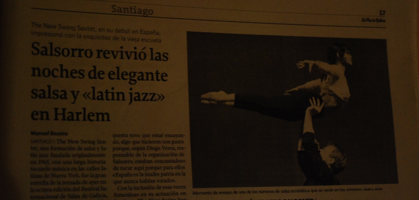
BAILA SOCIETY ON SPANISH TELEVISION WITH OPENING SHOWCASE

BASo spent an amazing weekend in Santiago de Compostela, Spain and Porto, Portugal, to perform at Salsorro 2009.

In addition to our Friday and Saturday repertory company showcases, BASo choreographed a piece with our friends Dave and Zoe (Paradizo Dance) to live Spanish folk music of Paloma Suanzes.

The showcase ended up in the newspapers and on Television – check out the vlog/blog for more details, including the video footage of the opening ceremony.

Posted in Uncategorized | Leave a comment

Zurich, Andy Warhol & the Widder

The Widder hotel in the Augustiner quarter of Zurich for me is one of the best hotels in the world – a hidden gem boutique hotel with only 42 rooms, each of them with a unique history and design.

Aside from all the standard 5-star services, what makes the Widder stand out are its history, architecture and art collection – and, yes, liquor and jazz.

History & Future: the hotel combines nine different buildings, with the inner square dating back to 1200 (sic!). All original structures for the 42 unique rooms were refurbished and remain intact, but top notch technology and design was added to combine history and future. I have been going to the Widder for over a decade on business, and each time I find new details to admire.

Art & Architecture: The hotel is a small museum as well, with art all over the place – Andy Warhol’s Widder, hand-made staircases, sculptures, paintings, tapestry, fresci, terracotta floors, designs, flowers and much more. Whether at breakfast, in meetings or in the rooms, one is surrounded by art – and smoky jazz.

Liquor & Jazz: The Widder bar features over 250 whiskeys and has live jazz each evening. Over the years I have started or ended many Zurich nights there – a rare single malt in my hand and jazz in my ear.

When in Zurich, check out the Widder: http://www.widderhotel.ch
Jazz concerts at the Widder: http://www.galledev.co.uk/widder/v11/site/pdf/Widderplakat.2.2009.pdf

My last Widder visit:

Posted in Uncategorized | Tagged , , , , , , , , , | Leave a comment

Global metatrends in the asset management industry – vlog

I just flew into Zurich from the Middle East from and for speaking engagements at industry conferences and management board offsites.

The most meaningful observations for the industry going forward are meta-trends that will fundamentally change how companies take advantage of opportunities in new markets while defending market share in domestic and developed markets – they include “west to east” and a growing global middle class, driven by youthful countries.

Metatrends in the asset management industry, take a look.

Posted in asia, Uncategorized | Tagged , , , , , , , , , , , , , | Leave a comment

GULF ARAB FUND INDUSTRY HINGES ON RETAIL INVESTORS

MANAMA, Oct 19 (Reuters) – The Gulf Arab region is struggling to develop a local fund industry as it lacks a strong retail investor base, executives and experts said on Monday.

The region has provided a portion of its oil wealth to international fund managers but is yet to develop its own fund industry, which would help provide the depth regional capital markets need to better absorb economic shocks.

Most mutual funds in the region only manage $10 million to $15 million and the industry is highly fragmented.

“The mutual fund industry is driven by middle-income investors and you don’t have that (market segment) here in the Middle East,” Daniel Enskat, senior managing director at Strategic Insight, a mutual funds consultancy, told Reuters during an industry event in Manama.

He said about $150 billion was invested in mutual funds in the region, only 5 to 10 percent of which came from retail investors.

Enskat said the region’s assets were highly concentrated with its sovereign wealth funds and a few rich individual investors, forcing asset managers to accept low fees.

“International fund managers are coming here just to have established relationships when that retail market begins to grow,” he said.

By Frederik Richter

Full article and other related articles can be found at:

Reuters

Forbes

Finanznachrichten

Yahoo Business Singapore

Posted in Uncategorized | Leave a comment

Middle East Asset Management Opportunities

With $2 trillion in investable assets, a young population and low household penetration of mutual funds, what are the key criteria for a more sustainable Middle East asset management business post-crisis?

Today I gave a keynote speech at the Fund Forum Middle East in Bahrain on “Back to Basics: a new model required?”, followed by a CEO global thought leaders panel including European banks, local hedge funds, global multi-managers and global custodians.

A few of the main points during my presentation (go to http://www.globalfunddistribution.com for data slides and full commentary) included:

-Back to basics with a focus on organizational stability, investment processes and brand has benefited numerous global fund managers and boutiques in 2009 (Pimco, Carmignac, Schroder, BlueBay, HDFC, China AMC, iShares, Nomura, E Fund, Aberdeen and others).

-85% of flows continue to go to local products; thus, despite the absolute growth of offshore fund flows, global business expansion cannot solely rely on the latter.

-While not decoupling – for now – Asia, Latin America and the Middle East are building regional hubs that have partially insulated them from the crisis in the US and Europe.

-The global middle class will grow from 450 million to 1.2 billion in the next 15 years, with most growth in China and India. Traditionally, mutual funds have been the main vehicle for retail investors to achieve long-term retirement goals.

-The GCC has underperformed its broader emerging market peers in the last 12 months, but selected MENA funds have been able to gather meaningful assets.

-Emerging markets including Asia, Latin America and the Middle East will drive growth for the mutual fund industry worldwide in the next 3-5 years. For instance, HNW investors in Asia-Pac will surpass North America by 2013.

-However, product demand and asset allocation views for advisors and investors in those “emerging” markets are fundamentally different from its “developed” market peers and international fund managers will have to realign headquarter-centered thinking to build a sustainable brand and business there.

The panel discussion afterwards and throughout the day touched on the following themes:

-Concentrated marketplace: For most international fund managers, the majority of AUM come from a handful of institutional and family office.

-Churning and lessons learnt: The fast money has left the region and some HNW investors are recognizing the value of professional money management post-crisis.

-Coordinated efforts needed: Unlike Asia and Latin America, stimulus packages in the region have been small and not coordinated.

-Transparency, communication and international managers: Part of the reason why GCC/MENA has not gathered similar assets as other emerging markets is due to the lack of transparency and disclosure. While adding competition, local managers hope that the arrival of international fund managers will improve business conditions.

-Resource- vs. people rich: While Asia and Latin America are people-rich, the Middle East is resource-rich, leading to a different set of challenges and opportunities for growth.

-Oil, the gift and the curse: Asset management flows depend heavily on the price of oil – yet, the very young industry has developed faster than many other regions and regulators are slowly paving the way towards long-term retirement savings.

Posted in asia, black swans, China, consulting, Latin America, management, Middle East, money, SWFs, Uncategorized | Tagged , , , , , , , , , , , , , , | Leave a comment