Content, speed AND style of the message: The Secrets of Success for Franklin Templeton and Pimco/Allianz

When it comes to information delivery, the size of the global asset management industry ($30 trillion in total AUM) stands in stark contrast to the outdated ways to deliver information – both in terms of speed (compliance issues) and content (think Apple versus RIM) of the message.

As long as your core business is stable and your product performs well, who cares about the perceived non-essential elements of your business?

Well, the times are a-changing – Bob Dylan is touring China, Vietnam and the rest of Asia with a censored playlist, and institutions and intermediaries around the world post-crisis very much care about the content, speed AND style of fund managers’ marketing and information delivery efforts.

Strategic Insight in the last six months interviewed close to 300 leading intermediary and institutional investors across Asia-Pacific and the world about their evolving selection criteria, brand and product preferences and what matters most to them post-crisis in regard to marketing and information delivery (we are currently writing a book about it, available in May 2011).

Below are a few summary quotes from our discussions:

– “Information delivery is not only about the content anymore, but also about the form. Are there more innovative ways to deliver information than a pfd document?”

– “From a marketing standpoint, we are borrowing the brands of the fund managers we are using.”

– “In fact the digital space is high on our agenda. We have our own iPhone app and as an organization feel the digital space is important across all business lines.”

– “Very few houses are doing a good job on general topics or timely updates and unique market views.”

So how important are information delivery and holistic marketing for the bottom line?

Let’s look at the information delivery secrets for the two best-selling fund firms since the crisis, Franklin Templeton and Pimco/Allianz.

Franklin Templeton was the best selling cross-border fund house globally last year, and Pimco with Bill Gross post-crisis had the best selling (and now biggest) mutual fund in the world.

1. Franklin Templeton

A few weeks ago in Hong Kong I interviewed Dr. Michael Hasenstab, manager of the global bond fund and head of the fixed income department for Franklin Templeton, at the Asia Fund Forum’s thought leader fireside chat.
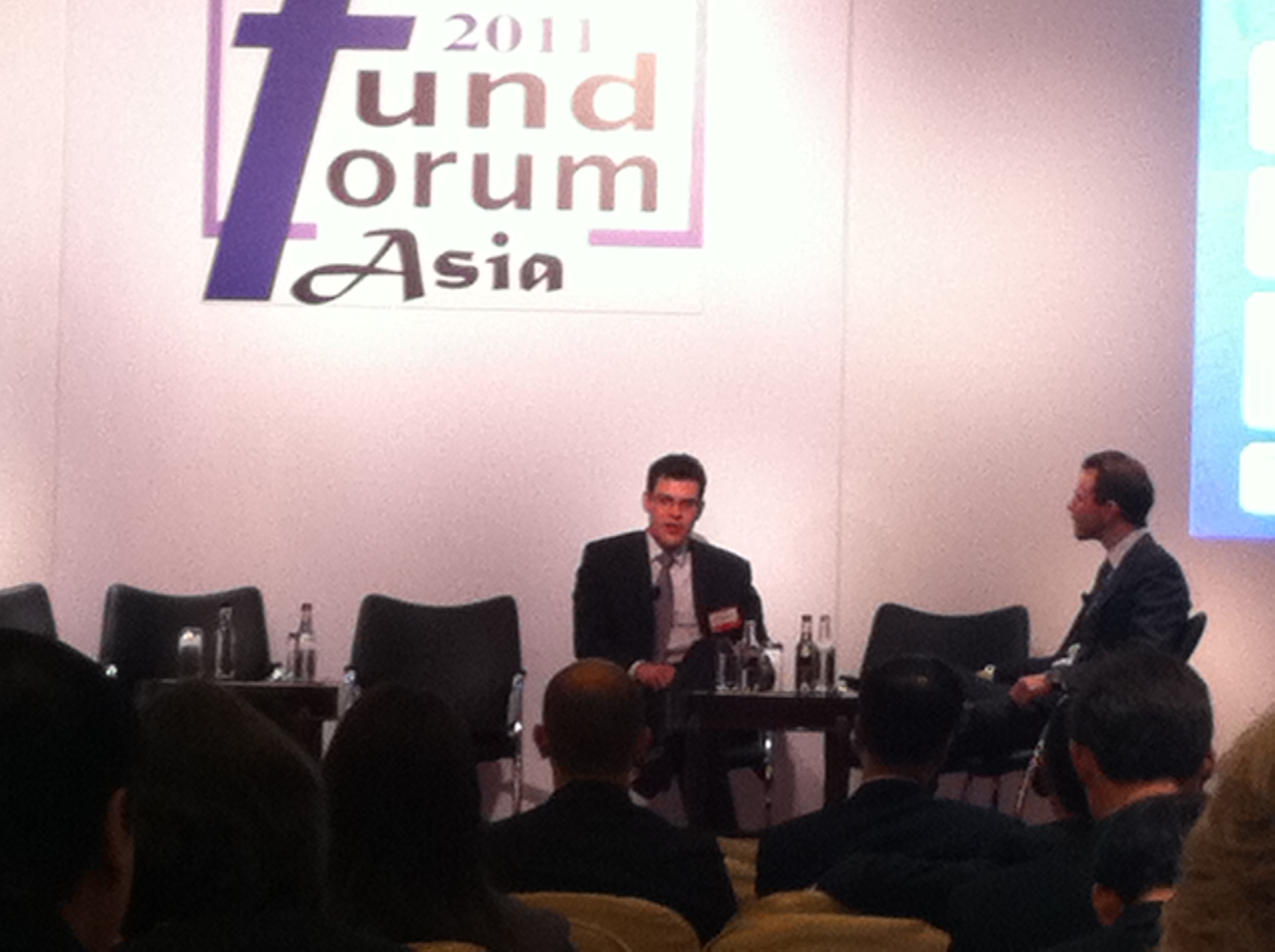
Michael oversees in excess of $100 billion in assets and the firm’s non-US UCITS products in the last few quarters have outsold their US-domiciled 40 act fund brethren. In addition to the appeal of the non-benchmark oriented product away from developed markets, Michael has been instrumental in strategic and tactical information delivery for clients, especially with short videos and bullet points for example on developments in Japan or the Middle East, as well as with long-term portfolio construction and strategic market views for the next decade.

Michael Hasenstab on the crisis in Japan

Dr. Michael Hasenstab on the crisis in Japan

The latter also ties in with the firm’s global thought leadership campaign around a “case for equities”, which has helped establish certain flagship equity products in parallel to Franklin Templeton’s fixed income blockbusters. We discussed the “case for equity” campaign in detail in our recent book on “the seven secrets of distribution”.

2. Pimco/Allianz

Bill Gross has always been a thought leader and early adopter of new technologies to deliver his market and portfolio views (his IO was the first to appear on the Kindle and in Spanish, years ago) – in fact, he considers marketing as important as performance since “even the best performance in the world is meaningless if nobody knows about it”.

Bill Gross April 2011 Investment Outlook, featuring Pepe Le Pew

Bill Gross' Investment Outlook April 2011, Skunked

This week Allianz was one of the first global money manager to release its Allianz Group Annual Report 2010 as an interactive iPad app.

Allianz Group iPad App

And it is one stylish application: aside from easy access to all key data points for the group globally, it features the “One” campaign, with images of public ads for the global campaign in iconic places around the world.

A few other highlights:

– an in-depth visual look at the international executive committee.
– interactive graphs, tables and footnotes embedded in the executive summary.
– links to appendix tables to jump back and forth between commentary and data.
– a sharing function in the menu selection that let’s you email portions of the report.

The bottom line:

1. Institutional investors are looking for a knowledge exchange with asset managers.

2. Distributors are borrowing the brand of strategic partners.

3. Effectively linking brand, client service, product, and support via marketing/information delivery 2.0 impacts the bottom line.

4. Industry leaders have always been thought leaders.

5. The concentration of flows to a few managers and products raises the stakes for the industry: blockbuster or blacklisted.

6. The digital space is moving front and center for global financial institutions as they are rebuilding client trust post crisis.

7. Quality, speed AND style of your messages determine your success.

A more detailed discussion of these themes with Strategic Insight data can be found at http://www.globalfunddistribution.com.

Posted in asia, black swans, Brand, consulting, distribution, institutions, management, money, professional fund buyers, SWFs | Tagged , , , , , , , , , , , , , , , , , , , , , , | 1 Comment

Hong Kong throws the gauntlet at London and New York.

We have observed the metatrend “west-to-east” for a while – US and European firms targeting business growth across Asia and other emerging markets, both from an investment and distribution standpoint.

We also have observed that, post-crisis, the latter markets are looking much more like the former, and with a newfound pride and confidence have decided to take the battle to the developed market’s home turf and start competing for business in the west. In other words, the logical extension of the metatrend, now “east-to-west”. We offered many examples and case studies in our recent book, “the 7 secrets of distribution“.

Hong Kong, throwing the gauntlet with “HK: China’s Global Financial Center“, is organizing roadshows in Europe and the US to showcase the advantages of its hub in the heart of London and, earlier today, New York.

Positioning itself as a local gateway into China and the Renminbi future, as well as an international hub for the region and the world, the event brings together the government, academia, the regulator and industry practicioners to discuss the future of both the region and HK.

Martin Wheatley in his last appearance as SFC head before heading back to the UK to head a new consumer protection agency walked the audience through the crisis and the regulator’s approach to bridge local demands and global trends and business practices during and post crisis.

Asia industry luminary Blair Pickerell talked about the pros and cons of HK as a marketplace and Stephen Roach over lunch walked the audience through his thoughts on China’s 12th Five-Year Plan and the imminent changes in the country’s model to sustain future growth, and why the US consumer is toast.

Where do you go to show New York that you mean business? The Plaza Hotel, Central Park South and Fifth Avenue.

Three points to remember:

– Asian institutions in 2011 are mostly interested in understanding investments in Europe and the US, not Emerging Markets. International firms should leverage their global expertise.

– Slowly but surely Asian firms are registering products in Luxembourg and the US to distribute amongst and compete in the Asia-Pac and Emerging Markets space. And, they are starting to eye potential acquisition targets. In five years competitive and benchmark analyses will include Asia and EM firms at the top.

While Europe is discussing traditional UCITS and alternative Newcits and the future of its asset management business, Asia is discussing the potential for a local or Asia passport (HK passport, Australia PWC study et al). Yes, none of this will materialize over night or maybe not at all, but when HK is coming to London and New York to flex its muscle it is time to realize that the one-way of west-to-east is turning into a two-way street.

Posted in asia, black swans, Brand, China, distribution, institutions, management, Middle East, money, pension funds, politics, professional fund buyers, SWFs | Tagged , , , , , , , , , , , , , , , , , , , , , , , , | Leave a comment

State of the Union

President Obama on Tuesday in his State of the Union address will touch on five “pillars” to ensure the competitiveness and growth of the US: innovation, education, infrastructure, deficit reduction, reforming government.

Preparing for meetings in the Philippines, Thailand, Brunei and Singapore this week – before heading to Miami for two days and then back to Hong Kong – I contemplated the state of the global mutual fund union and its pillars.

Over the last few months I have continued my global meetings with governments, institutional investors and intermediary professional fund buyers and some of the pillars they outlined to me match President Obama’s.

Education: Distributors and institutions all emphasize their need for help in educating investors. While hot themes and great short-term performance are often in the limelight (and a key success factor for quarterly product placement), effective service and creative ways to ensure long-term education of the industry and its investors are the determining factors for developing strategic partnerships (of which there are fewer post-crisis).

Innovation: Not just on the all important product front, but in all aspects of doing business – the use of mobile technologies, tailored information delivery, creative and fast market updates, thought leadership around memorable stories, or marketing campaigns.

Infrastructure: For the fund industry, the biggest infrastructure components of business success are streamlining internal decision making globally and allowing business development teams room to build complex multi-regional and multi-business unit relationships over multi-year time periods (discussed in-depth as headquarter centricity, speed of response time in an age of compliance paranoia, lost in translation and CDA teams in “the Seven Secrets of Distribution”).

Deficit reduction: While counterintuitive, there is a parallel for the fund industry as well. The leading fund firms during the crisis quickly increased their resources to hire the key people that were let go by firms downsizing to reduce fixed costs. This turned out to be a double-whammy, because the firms that invested during the crisis not only got great deals for talented people (that are grateful for the job), but they also showed commitment to their clients when others pulled back. Thus, getting back to the theme of deficits, these firms responded swiftly with major investments in the downturn and are now reaping the rewards as their products reach blockbuster status. The virtues of foresight and patience.

Reforming government: The fund industry is in the midst of their own meaningful reform process. Within the European Union, UCITS are at a crossroads as the discussion between traditional and alternative investment vehicles heats up. While all absorbing within Europe, the industry should not forget that here in Asia regulators, associations, fund buyers and asset managers alike are closely observing the discussion. Moreover, as the metatrends of a growing global middle class in the region and a trend West-to-East and East-to-West take shape, Asia is thinking strategically where the developed world is thinking short-term. Following the discussions of a variety of Asia passports and China gateways, Asia is going on the offensive.

HK Invest in March is holding a seminar on the advantages of Hong Kong as the regional financial services hub and gateway into China with participation by the government, the regulator, and the industry. Where? In the heart of New York.

The asset management’s state of the union does look brighter than that of the US, but the pillars are essentially the same.

Tune in on Tuesday and listen to President Obama’s advice for the fund industry.

Posted in asia, Brand, China, distribution, institutions, management, money, pension funds, politics, professional fund buyers, SWFs | Tagged , , , , , , , , , , , , , , | Leave a comment

How to succeed in a world of growing complexities: “P.S.”, people and stories

Today: listening to “A Felicidade” at a Starbucks on Taipei‘s Minsheng East Rd (Taiwan’s Wall Street) after meeting local government institutions; on a Japanese wireless network.

Yesterday: meeting with the Chinese government in Beijing and afterwards looking for a quick bite before leaving for the airport in the diplomatic quarters of the city. Where do I end up? At a Bavarian Paulaner original with Muenchener Leberkaes at the Lufthansa Kempinski, watching my Chinese counterparts sipping Hefeweizen and eating Weisswurst; and being entertained by an Austrian host along with Chinese waitresses in Dirndls.

Last weekend: reading about the innovation drive coming from Emerging Markets (Replicators no more – how emerging markets are delivering innovation)) and then seeing the Chinese Patent office publish tremendous innovation goals on the patent front for 2015 (when innovation, too, is made in China).

Tomorrow: a quick lunch and ristretto at Isola in Hong Kong before flying to Australia to meet the execs of our new research company and to see the response to the flood in Brisbane.

In sum: the world is getting smaller, fast.

Wherever within an urban context you look, you see the same brands, aspirations and behavioral patterns, albeit with distinctly local overlays and undercurrents.

From a business perspective – judging from this week’s meetings with governments, institutional investors and financial intermediaries – this translates into:

Finding the right people to reframe fast-growing complexities into easy-to-understand simplicities.
Examples:

People (Industry Leaders) = Success (Mutual fund vehicle brand recognition)

People (Investment Leaders) = Success (Product brand recognition)

People (Sales Leaders) = Success (Client trust and confidence)

People (Product Leaders) / Success (Unique investment themes)

The right people = Hundreds of billions gained since the crisis (blockbusters)
The wrong people = Hundreds of billions lost since the crisis (blacklisted)

In other words, 21st century success hinges on: people and stories (P.S.)

Find them, wherever you can.

P.S. the biggest winners in 2010 were those firms that hired the people that their competitors fired in the first rounds of cost cutting during the 2008 crisis. Data on that can be found in the 2010 review/2011 outlook.

Posted in asia, black swans, Brand, China, distribution, institutions, management, money, pension funds, professional fund buyers, SWFs | Tagged | Leave a comment

Busy Q1 2011…

This year will continue the way 2010 ended – busy.

In January, my travel schedule includes Hong Kong, Singapore, Australia, Beijing, Taipei, multiple countries in Southeast Asia (Brunei, Manila, et al), and then Los Angeles and Miami (strictly business!) before heading back to HK via New York.

My body does not look forward to it, but the intellectual payoff makes it worth it.

Stay tuned for Asia-Pacific analysis and case studies from my discussions and presentations from the region.

Doesn’t leave much time for Yoga or meditation, unfortunately.

Posted in Uncategorized | Leave a comment

News release and article on “global fund review 2010 and outlook 2011”

Article on our global review in Ignites Asia today.

News released just went out:

FOR IMMEDIATE RELEASE
Daniel Enskat, Head of Global Consulting, Senior Managing Director
HK +852 2251 8248, NY +1-212-217-6859, daniel@sionline.com

$900 billion in 2010 stock and bond fund flows, mostly around risk aversion and income needs; top five 2011 themes from strategic insight survey of key institutions and distributors

Hong Kong – January 3, 2011 – 2010 net flows to stock and bond funds amounted to over $900 billion worldwide, according to Strategic Insight’s 2010 Global Asset Management Review/2011 Outlook, mostly around risk aversion and income needs, and a business focus back-to-basics.

Among the best selling investment categories were Global, Emerging Market, Asia Pacific, ‘balanced’, and absolute return. “The top five 2011 focus areas for institutions and global distributors based on a proprietary Strategic Insight survey are investment solutions, absolute return, client service, thought leadership and better digital information delivery,” according to Daniel Enskat, Head of Global Consulting for Strategic Insight.

“Three quarters of all global net flows since the crisis benefited fixed income products, a complete reversal from 2005-2007, where equity funds accounted for three quarters of flows on aggregate globally,” says Enskat. “While the size and scope of bond flows going forward is a debate in the industry, we anticipate continued demand around flexible ‘safety & income’ solutions, alongside a cautious return to equity funds in 2011.”

Many of the forces that influenced investor behavior and choices in 2010 are likely to remain in place for at least part of 2011. Financial uncertainty, very low cash yields (in some developed capital markets), a secularly depreciating US Dollar, quantitative easing the sequel, the debt crisis in Europe, lackluster aggregate demand for funds across Asia, regulatory changes and uncertainties, convergence of multiple parts of the industry and investor compartmentalization between “safety & income” and “risk capital” in an overall context of risk aversion.

“From a flow perspective, three meta-trends – future asset class/investment category demand, regional flow potential (developed vs. emerging) and concentration of leadership via selected blockbuster products – will be part of the conceptual framework for fund managers as they are mapping out brand positioning and growth strategies for the coming years,” added Enskat.

While themes and simplicity currently dominate the product landscape, institutions and distributors around the world going forward expect a gradual shift towards “bridge” products, leading towards investment solutions and absolute return themes, albeit with geographical nuances.

The crisis also sharply delineated outcomes for fund managers. Companies that “wasted the crisis” by not doing enough to reach out to clients, that cut back on resource and geographic commitments, and that did not innovate and adapt, experienced very different outcomes compared to those who followed a more committed strategy.

The decision by distributors to reduce the number of managers and funds that they work with has led to a distinct “winner takes all” phenomenon over the past few years and the concentration of flows in the last two years to a few key managers and flagship funds around the world has been accelerating.

Explains Enskat: “Over $900 billion in net flows went to long-term funds worldwide in 2010. With around 60,000 long-term mutual funds worldwide, $800 billion in cash flows went to only 350 products – in other words, one half of one percent of products accounted for 94% of 2010 industry flows to long-term products –marking an acceleration of leadership turnover and concentration of success among fewer managers and products.”

“Products such as PIMCO Total Return, Templeton Global Bond, Carmignac Patrimoine, Pictet Local Emerging Market, or Schroders ISF Euro Corporate Bond reached blockbuster status as the above mentioned themes were implemented by distributors: back to basics, sexy but simple products, independent brands and thematic product appeal. At the same time, some distributors might seek to reverse such extreme concentration going forward, opening new relationship opportunities.”

For more information on this report, please visit: http://www.strategicinsightglobal.com/

About Strategic Insight
Strategic Insight is a research and consulting firm that supports over 250 companies around the world with analysis, perspective, and data on the fund industry; its Simfund databases, the world’s analytical source for mutual fund business intelligence, track flows, assets, performance, ratings, and other intelligence on more than 65,000 portfolios and many more fund share classes globally.

STRATEGIC INSIGHT, an Asset International Company
Level 19 Two International Finance Centre, 8 Finance Street, Central, Hong Kong
http://www.StrategicInsightGlobal.com

Posted in asia, Brand, China, distribution, institutions, management, Middle East, money, movement, pension funds, professional fund buyers | Tagged , , , , , , , , , , , , , | Leave a comment

2010 Global Asset Management Review & 2011 Outlook

Happy New Year. Below are a few of the key trends from last year and our outlook for 2011 and beyond.
Strategic Insight clients of course can access the full report online.

Strategic Insight’s 25th Anniversary: looking back at two and a half decades of fund research and looking forward to 2011 and beyond.

Vote of confidence: over $900 billion in net flows to bond and stock funds globally in 2010, mostly around risk aversion and income needs, and a business focus back-to-basics.

Seismic shifts between asset classes and regions since the crisis; for 2011, equity growth vs. bond challenges, asset allocation solutions around a more diversified “core”.

Top ten investment categories in 2010 included Global, Emerging Markets, Asia Pacific, “balanced” and absolute return themes.

Globalization of asset allocation, investment management and distribution partnerships – thought leadership around “metatrends”, the re-evaluation of asset management brands.

Acceleration of leadership turnover: 0.5% of funds accounted for 95% of 2010 long-term net flows worldwide. Changing business models for blockbuster products to accommodate a changing distribution landscape.

Multi-convergence: between traditional funds and alternatives, between individual and institutional, between East and West.

Top five 2011 focus areas for institutions and global distributors based on proprietary Strategic Insight surveys: investment solutions, absolute return, client service, thought leadership and better digital information delivery.

Mutual funds gained, but wasted the crisis by not focusing more on their competitive advantages; multi-convergence and regulatory changes are both threat and opportunity.

Posted in asia, black swans, Brand, distribution, institutions, management, money, pension funds, professional fund buyers, SWFs | Tagged , , , , , , , , , , , | Leave a comment

The future of brand(s), part 2… how bad weather can kill a brand.

Last week I wrote about the future/importance of brand in asset management – well, travel experiences over the holidays are almost always a wonderful opportunity to point out the past, present and future of brands, in this case “developed” vs. “developing” countries.

Funny choice of words. When it comes to travel and customer service, the opposite is true; Europe and the US are haplessly behind (old, 19th century, anachronistic, developing, pick your favorite word), while Asia is leading the way.

Let me tell you a little story to make my point.

Location: HK, Central. I am leaving HK to write our annual research review on a beach in the Pacific. Twenty-four hours before the flight(s), I take the elevator from our office in Two IFC to the city express check-in:

– Estimated time from office to check-in counter: less than five minutes.
– People in front of me: Zero.
– Estimated time to check luggage and receive boarding passes: less than two minutes.

I head out to dinner. My flight is the next day at 3pm. At 2pm I am sitting on the patio of my favorite Italian restaurant in Central, Isola, sipping on a doppio ristretto.

– 2:05pm: I get on the airport express to the airport.
– 2:29pm: I get out at the airport and go through security and immigration.
– 2:36pm: I head to the gate.
– 2:40pm: I board the plane to Japan.
– 3:05pm: My flight leaves.

Thus, it took me, overall, about one hour to get onto an international flight from a major airport in Asia the day before Christmas.

Compare to this the experiences for Thomas Friedman, Tyler Brule, or any other prominent frequent flier.

Brule this weekend in the FT, referring to how Heathrow has handled the holiday traffic and the bad weather, called it “the wrong kind of airport”, Philip Stephens went further and entitled his latest column: “Britain shamed by Heathrow’s terminal misery”.

A few excerpts:

Tyler Brule: “Why isn’t the UK able to deal with this and what does it do for the nation’s brand? … The UK’s inability to cope doesn’t have so much to do with the fall in mercury as it does with a fall in service standards… an international airport in a country that does, in fact, get snow, should be able to field enough de-icing trucks, ploughs, gritting vehicles, and staff to deal with a winter storm… there was some miserable weather about but much of it wasn’t the stuff that should be bringing a G8 economy to a grinding halt.”

Philip Stephens: “To fly from Istanbul to London is to travel from the first to the third world. Ataturk international airport sparkles with steel and glass modernity – a monument to Turkey’s status as a rising power. Heathrow’s Terminal 3, scarred by broken travelators, exposed ceiling voids and filthy carpeting has become an emblem of national decline.”

Thomas Friedman: “I took off from Hong Kong’s ultramodern airport after riding out there from downtown on a sleek high-speed train — with wireless connectivity that was so good I was able to surf the Web the whole way on my laptop. Landing at Kennedy Airport from Hong Kong was, as I’ve argued before, like going from the Jetsons to the Flintstones. The ugly, low-ceilinged arrival hall was cramped, and using a luggage cart cost $3. (Couldn’t we at least supply foreign visitors with a free luggage cart, like other major airports in the world?) As I looked around at this dingy room, it reminded of somewhere I had been before. Then I remembered: It was the luggage hall in the old Hong Kong Kai Tak Airport. It closed in 1998.”

Most “developing” countries still aspire to be like the US. I always wonder what people from those countries will think when they land in London or New York and take a cab or train into the city.

Conversely, most people in “developed” countries have no idea how far they are falling behind in terms of service quality and technology vis-a-vis the East.

For the time being, the “America” and “Europe” brands are still holding up (albeit often with a “how quaint” footnote), but the times are a-changin.

Time to wake up to a brand new world.

Posted in asia, Brand, movement | Tagged , , , , , , , , , , | Leave a comment

The issue of brand in asset management – perspectives from distributors and institutions

As part of “The Seven Secrets of Distribution”, our team surveyed, spoke and met with over 1,000 professional fund buyers around the world. The book was published last month, but of course we are continuing our discussions on a daily basis.

Clearly, the post-crisis trend for institutions and distributors to move back to a ‘guided architecture’ setting to work more strategically with selected fund firms and use fewer, blockbuster, products, has also forcefully brought back the issue of brand in asset management.

Our research teams at Strategic Insight have been looking at the issue of brand for decades.

For example, following the tech bubble we published a research paper on “branding challenges for asset managers” in late 2002, noting “deteriorating equity prices and diminishing assets over a two year period have weighed heavily on the brands of most investment companies” (sound familiar?). Among the challenges then:

difficulties of post-merger integration and re-branding of disparate units
and diverse financial services businesses, often with very different corporate and investment cultures, into one global brand;

dilemma of how to brand for regional or global distribution and still preserve relevance and optimize positioning in local markets;

how to brand new business lines outside of traditional areas of expertise, such as hedge fund units or HNW platforms – use the existing brand, create a “sub-brand”, or an entirely new brand?

Branding for multi-channel distribution: the limitations and risks to managing
individual brands within multi-management platforms, fund of funds, supermarkets, and other growing third party outlets.

It brings back memories of Les Guêpes – plus ça change, plus c’est la même chose.
But we are not here to bring back the Research of Christmas Past, you can review that study at your leisure over some Glühwein.

We are here to see what professional fund buyers today think about brand and how relevant it is in their selection of strategic partners and blockbuster products.

Brand matters – more than ever. Post-crisis and post-Madoff, the reputation of a fund manager’s brand is often more important than the performance itself (very relatively speaking).

Thus, if distributors or institutions do not perceive a brand as positive (throughout the organization), the firm is either disregarded (best-case) or blacklisted (worst-case). A harsh business reality, as quite a number of organizations are still sorting through the loss of trust by clients over the last few years, but not a surprising finding.

More interesting is the fact that professional fund buyers (PFBs) differentiate clearly between what we in our 2002 paper referred to as “name recognition vs. holistic brand experience”, with its attendant emotional and aspirational elements.

In other words, is your brand the result of newspaper and billboard ads or is it the result of, as Scott Bedsbury coined it, “the sum of the good, the bad, the ugly, and the off-strategy”.

You may not be surprised to hear that most industry executives refer to brand as the former, another example of “lost in translation” (one of the seven secrets).

A dilemma, indeed, since almost all successful brands are the product of the latter.

Apple, Google, Facebook, YouTube. Powerful brands, because customers equate it with a specific – daily – experience.

Yes, Apple has cool ad campaigns, but the brand is defined around the products (iPadiPodiMac) and people (the Genius Bar, staff in Apple stores, Steve Jobs).

In fact, when you reach the state of neologisms, such as “to google something” or “let me facebook you”, you know a brand is strong.

Investment management got there, but “Madoff” just doesn’t have the same ring to it.

The brand bottom line in asset management post-crisis:

Brand a key selection criterion: A strong brand is a key selection criterion for institutions and disributors post-crisis (definitely a force majeure, albeit not quite an act of God).

Competitive advantage for independent fund firms: Independent asset managers have a (temporary) competitive advantage as many larger groups are still dealing with the impact of the crisis (rebuilding client trust, restructuring, et al). Many PFBs specifically state that they prefer independent firms where possible.

Name recognition vs. holistic brand: Institutions and distributors prefer – by a wide margin – holistic brand (“I like the ‘grassroots’ element of their brand, calls, strong ongoing communication, direct access, …”) over name recognition (“yes, they have a strong brand, but mostly passively in newspapers, TV, billboards”), while industry execs often are still often measuring and focusing on the latter.

– The industry brand: Collectively, mutual funds with its key attributes (liquidity, accessability, diversification, transparency) enjoys a very strong brand in the financial services industry – for now.

The industry overall has missed an opportunity by not being more vocal about its competitive advantages and strengths – its brand. Instead of knocking out the opponent(s), they have been politely calling a time-out for them to recover; hedge funds, ‘newcits’, e.g. are now becoming a formidable threat, again.

As recently published in a Strategic Insight study for ALFI (“Alternative and Hedge Fund Ucits in the Next Decade”), these products now eclipse $160 billion within European Ucits Funds and are the subject of intense regulatory and industry discussion.

Newcits, Ucits, style, substance… brands all over again. PFBs are taking note. The Ghost of Christmas Past after all.

Happy holidays.

Posted in asia, black swans, Brand, distribution, institutions, management, money, pension funds, professional fund buyers, SWFs | Tagged , , , , , , , , , , , , , , | Leave a comment

Asia fund passport vs. cross-border Luxembourg funds – the potential future of fund distribution in Asia

Will global mutual fund flows in the next five years primarily benefit cross-border Luxembourg and/or Dublin fund domiciles or will the asset management industry see the emergence of an Asian passport and reduced interest in offshore products?

Traveling from Asia, Europe, Latin America and the US in the last few weeks, the topic of fund domiciles was part of each of my discussions with governments, regulators, associations and CEOs.

Before the crisis this questions would have been a joke, but now the prospect of an Asian fund passport is a possbility and the media is adding fuel to the fire.

A bit of background:

This year, cross-border fund flows in Europe accounted for almost 90% of all net flows, a massive shift from a local to an offshore business in the region over the last half decade.

Moreover, in 2007 (pre-crisis), the majority of those cross-border flows came from investors in Asia, prompting many international firms to ramp up their Asia distribution expansion plans by registering their Lux funds for sale in the region. While 80% of Asia assets were still held in local funds, the hope was that Asia would follow in Europe’s footprint and shift to a cross-border business around the global UCITS brand.

Then came the crisis.

First, the Lehman minibond and accumulator scandals brought fund sales to a screeching halt, then regulators started putting applications on hold to assess the damage to the vehicle and the UCITS brand.

Now, with the opportunity of RMB products and HK as a gateway into China, the HK government sees the “HK advantage” as a chance to knock out its frenemy Singapore and at the same time call for a local fund domicile to bring jobs and expertise into Hong Kong – Prof KC Chan is taking the “HK advantage” on the road to Europe (Q4/2010) and the US (Q1/2011).

Alfi decidedly was not happy to hear that message in HK (although the SFC was a bit more cautious and supportive), and pre-emptively positioned a local lobbyist to help save and maintain the Luxembourg and UCITS brand and business.

Still, nobody in the industry was really thinking that the fragmented region would be able to coordinate and implement a pan-regional Asia passport – at least not any time soon.

Last week brought a new twist to the story, from down under.

Australia’s Financial Services Council, eyeing an opportunity to go beyond bilateral agreements and to heat up the discussion, commissioned a report by PWC that concluded that an Asian fund passport is critical for the industry’s growth. The CEO of the FSC then went on to say that Asia should learn from the EU when they first launched UCITS. We might be five years away from the reality of an Asian passport, but its possibility is being discussed and pushed by multiple players with vested interests in the region.

Thus, the industry in Europe, dealing with potentially massive regulatory changes in the aftermath of the financial crisis involving an alphabet soup including UCITS IV, Prips, EAD, AIFMD, RDR – needs to add one more battle ground to its growing list: defending UCITS in Asia.

We have discussed this issue in greater detail in our recent book “the seven secrets of fund distribution”.

Posted in asia, black swans, Brand, distribution, management, money | Tagged , , , , , , , , , , , , , | Leave a comment