Spotlight on Colombia… Art, history, culture, dance, food and LatAm Asset Management

I just came back from a trip to Colombia. While almost all major sources of public information warn you about the country and especially Medellin and Cali, but also Bogota, this perception couldn’t be further from the truth.

Yes, the comunas are similar to the favelas in Rio or the banlieue in Paris, but while you do feel a physical sense of danger in Rio or Sao Paulo, I would argue that central Paris is probably more dangerous than Medellin – it definitely is dirtier.

Let’s address a few myths and realities, and then see how those relate to the financial service industry.

Drugs and crime: Medellin still is seen as one of the “most violent cities in the world”, due to the memories of Pablo Escobar’s Medellin Cartel of the 1980s. That, however, is akin to comparing New York circa 1981 to New York circa 2011.

Quality of life: Medellin today is among the cleanest and safest cities in the world. Giving master classes at the local universities, I saw something I had never seen before, an air quality monitoring station, displayed below (imagine such a station in Beijing – well, you wouldn’t be able to actually see it).
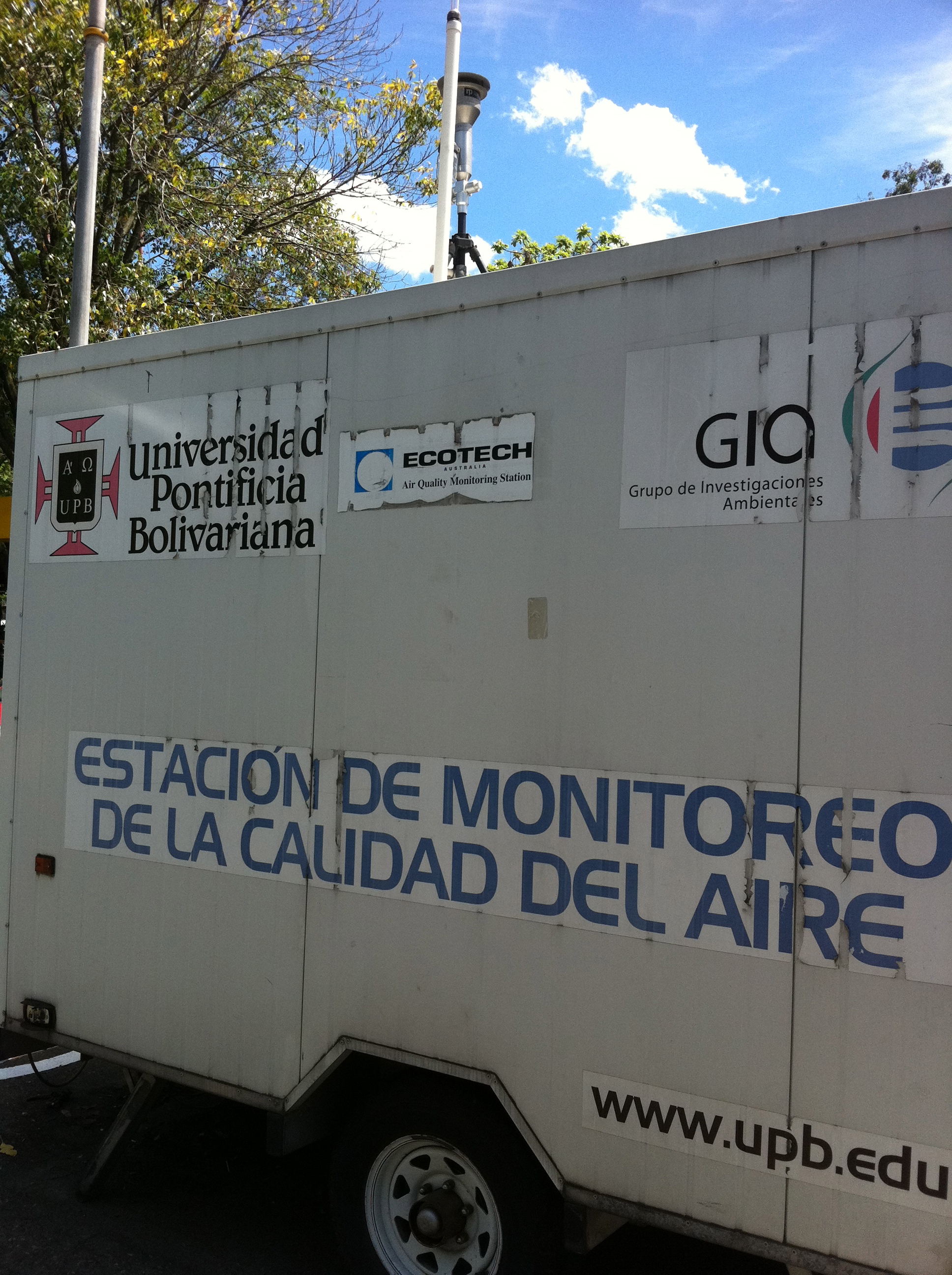
Unlike Singapore, where you cannot buy chewing gum (and get fines for littering), in Medellin public servants on weekends give little 4-year old kids their first lessons in recycling.

The people of Medellin keep the city clean because they are proud of their city and country, and they educate their children about recycling and taking care of their city, country, and planet. Below is a picture of such a demonstration in the “barefoot park”, where the happiest children in the world play each weekend with their parents, while enjoying grass, trees and fountains.

Work ethic. Colombians, in addition to a reputation of being home to the best looking women (and men) on the planet, work incredibly hard. After meetings during the week, I judged the national dance competition on the weekend, organized by Medellin- and Dubai-based BNF, and I have never seen a combination of passion, heart and hard work in my life (not even when I judged a similar competition in 2008 in Beijing).

Children from Cali that cannot even afford a pair of shoes, dance eight to ten hours a day on concrete with duct tape wrapped around their feet (because they also only own two pairs of socks), then sell candy to save money for the trip to Medellin with the family, and in the team competition take turns sharing the shoes that are donated to the dance studio. Out of 60 children couples competing, only 3 make it.

Combine the early childhood education on preserving the environment with the endurance, willpower and competitive streak of the youth and you can imagine the future for the country and the region.

Passion, pride and warmth: I also rarely have seen such a passionate and loving people. From conversations on the street, to students in classes, executives in meetings, and friends playing hosts throughout the weekend, each interaction took hospitality to a whole new level.

Art and history: You can also see it in the transformation of the city over the years. I spent my Sunday enjoying the “museo en la calle” with original Botero sculptures, shown below, and the numerous wonderful museums.

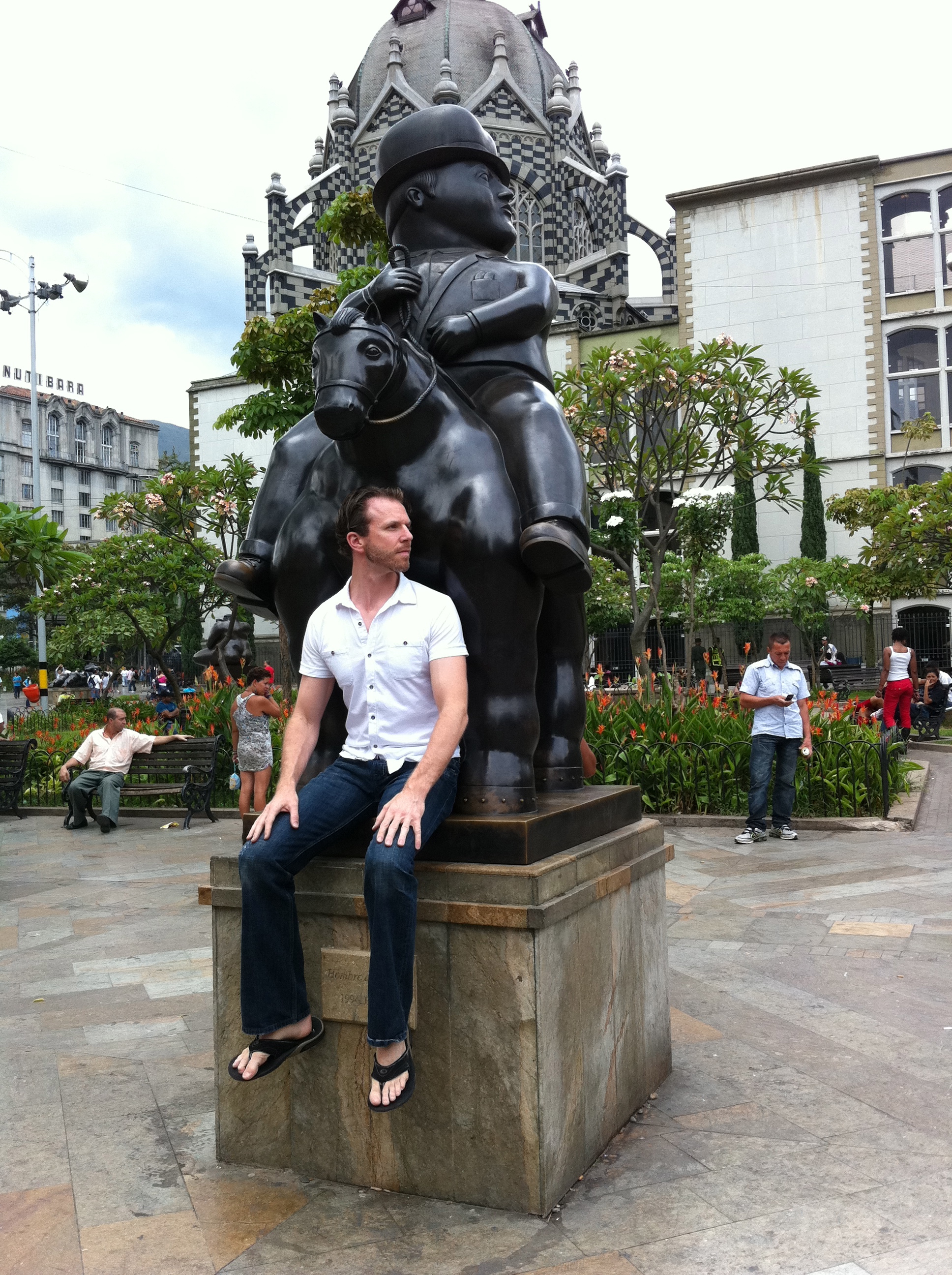
After that it was up to Pueblito Paisa to take in the replica of traditional villages and some traditional food. Let’s not even talk about the impressive architecture in Medellin or Bogota.

Technology: Notably, Medellin has excellent public free wireless, similar to Hong Kong. However, here, it works. Let’s compare this with two weeks ago, when I was in Monaco for the largest asset management conference in the world, the Fund Forum International, and one of the best hotels in Monte Carlo charged me EUR20 per device (sic!) and per day for a wireless connection with dial-up speeds circa 1990.

Welcome to the future.

A few other noteworthy facts to remember when it comes to Colombia:

• It is the only South American country with coastlines on both the North Pacific Ocean and the Caribbean Sea.

• It is rich in natural resources, including petroleum, gas, coal, iron, ore, nickel, gold, copper, emeralds and hydropower.

• Medellin is the city of eternal spring, i.e. perfect weather year round, which I think contributes to why the people are among the nicest in the world.

• After decades of violence, civil war and dysfunctional relationships with the government, the people of Colombia similar to China take their fate into their own hands to create a better future for their children.

• With about 45 million people, it has a perfect balance between men and women and close to 70% of the population are between 15 and 64 (only 7% are above 64), with a median age of 28.

• Colombia is the third largest exporter of oil to the U.S.

• Still, 45% of the population live below the poverty line.

Specifically on the investment side:

• Leading corporate governance practices have been in place in corporate law since 1971 with the Commercial Code, one of the most advanced in the region. The current model is based on the Codigo Pais from 2007.

• As an investment market, Colombia falls into the post-BRIC appeal of second and third-tier frontier markets.

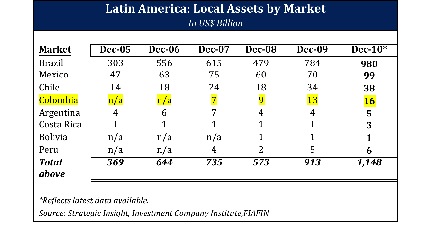
• As a mutual fund market, total assets are still relatively small, but have doubled since the financial crisis from about $7 billion to $16 billion.
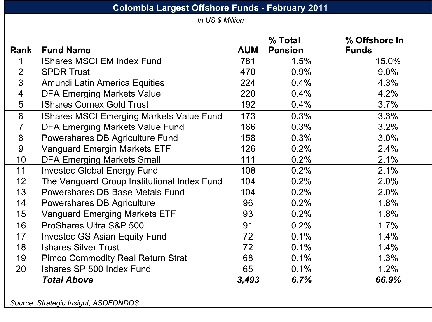
• Cross-border funds are growing in Colombia, Chile and Peru. Similar to Chile, which I addressed in a recent “spotlight” research piece, the country’s private-pension-fund industry is an opportunity for international fund managers. As shown in the table below, the offshore portion of Colombia’s pension fund asset allocation is growing quickly, following the lead of Chile and Peru. For now, 40% of investments for pension funds can be invested in offshore vehicles, while it is approaching 80% in Chile.
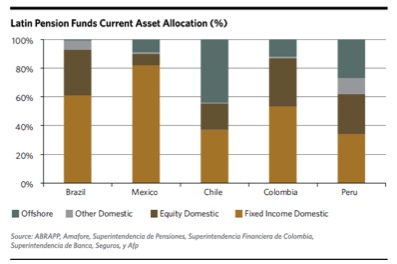
• It is thus entirely possible for the Colombian pension funds to grow to $150 billion in the next few years (Chile is there now), with allocations to crossborder vehicles rising quickly.

• Notably in the table below the top twenty cross-border products today have a bias towards ETF/index and boutique specialist names. Those include iShares, SPDR, Powershares and Vanguard, as well as DFA and Investec. Larger brands such as Amundi or Pimco also are on the list. The numbers for now are small, but selected managers have made strong inroads into the market and the numbers are likely to grow likely, via a combination of crossborder allocations, changes in asset allocation, a growing middle class and domestic growth.
Posted in beauty, black swans, Brand, Brazil, China, distribution, LatAm, Latin America, movement | Tagged , , , , , , , , , , , , , , , | 1 Comment

Daniel Enskat and Jean Baptiste de Franssu discuss UCITS at FundForum International 2011

Thank you, FundForumTV – #FFI11 is the largest asset management conference in the world.

Daniel Enskat, Senior Managing Director at Strategic Insight and Jean Baptiste de Franssu, CEO, Invesco met at FundForum International 2011 for a filmed discussion following the recent publication of their opinion piece to mark the 25th anniversary of UCITS.

Posted in apps, asia, black swans, Brand, consulting, distribution, EFAMA, information delivery, LatAm, Latin America, management, money, pension funds, private banking, professional fund buyers, UCITS | Tagged , , , , , , , , , , , , , , , , , , , , , , , , , | Leave a comment

Co-branded Standard Chartered/Apple Campaign: Regaining Client Trust with Mobile Apps

A few weeks ago at the Monaco Fund Forum International 2011 I conducted a fireside chat on “The View From Asia”, with the Vice-chair of Franklin Templeton, Vijay Advani, and the Chairman & CEO of Nikko Asset Management, Tim McCarthy.

One of the crucial elements of running a successful Asia-Pacific business (or any business, anywhere), revolved around regaining customer trust and confidence, with pro-active communication and simplicity.

My recent posts focused on asset managers and distributors introducing mobile apps to inform, update and educate customers, among them PIMCO, Franklin Templeton, Putnam, Fidelity and JP Morgan. Last week, Standard Chartered launched a co-branded campaign with Apple around “Multinational bank goes mobile”, with a featured video introducing a series of internal and external apps, for consumers, corporate customers and employees.

Mary Huen, head of consumer banking in Hong Kong, stated that post-crisis the number one priority for the firm was “to regain customer confidence”. The loss of client trust and a generally more emotional overall relationship in the last two years fundamentally changed how SC views relationship management, advice, and fiduciary responsibilities. For relationship management and the day-to-day front line work, everything changed post-crisis with a paramount need for simplicity.

In order to tap into the increasingly mobile world of investors, SC’s San Francisco team developed a set of custom apps for both internal and external needs, including an internal app store for employees to work with.

In Hong Kong, “iNeeds” helps relationship managers in bank branches create client profiles and offer more relevant and customized products for each client.

Corporate clients can use “Straight2Bank,” a platform with a mobile authorization app giving corporate treasurers better control of transactions.

Other apps center around trading (Trade Port), or forex (FX Rates), with more to come. Clearly, we are still in the dark ages of mobile investing and the use of digital and social media to connect with investors and provide advice.

Still, as discussed in my recent book on “Building Bridges”, the largest asset holders (institutions and distributors) worldwide post-crisis see proactive and creative information delivery as on par with investment performance, organizational stability, client service, and brand.

Better not to be late to this party.

Posted in apps, asia, beauty, Brand, consulting, distribution, information delivery, institutions, iPad, management, money, professional fund buyers | Tagged , , , , , , , , , , , , , , , , , , , , , , | Leave a comment

Strategic Insight Video Research Update – Switzerland: Funds, Flows, Wealth Management & West-to-East

A few weeks ago I published a research piece with my HK-based senior research analyst, Bryan Liu, called Spotlight on Switzerland.

Below is a video update with HK-based analyst Lise Carpenter, discussing the piece further.

The full report can be accessed here.

Other Strategic Insight Global Research Video Updates.

Posted in black swans, Brand, cash flows, consulting, distribution, information delivery, management, Middle East, money, private banking, SWFs, switzerland, Uncategorized, wealth management | Tagged , , , , , , , , , , , , , | Leave a comment

Monaco Fund Forum International 2011 – A Review

The Monaco Fund Forum International is always of major importance for the industry – in its 21st year, it is the world’s largest asset management event, and Julian Kirby, Jenny Adams, Ed Jones and team again outdid themselves.

It also was a major event for Strategic Insight and Asset International this year, since we came to Monaco with almost a dozen representatives, including our chairman and CEO, Jim Casella.

Jag, Rita, Mike, Jason, Jamie, Lise, Andreas, Ilaria and other colleagues from AI attended – at the same time, we had a big Strategic Insight event in NY on Monday/Tuesday as well, led by Avi Nachmany, Kevin and the US team, with close to 200 senior executives of the US fund industry – a big week all around.

SI booth - from left, Ilaria, Andreas, Lise, Jamie

Monday, Distribution Day

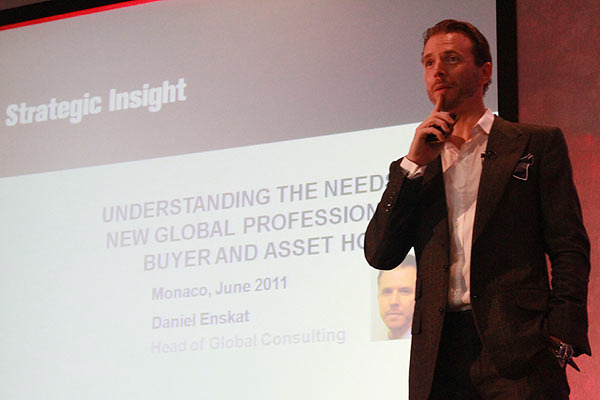
I always very much enjoy Monday’s distribution summit, as it brings together fund selectors, advisors, clients and asset managers. It was a pleasure to again see Alex Hoctor-Duncan of Blackrock host the day, and to give the opening speech on Monday on “Understanding the Needs of the New Global Professional Fund Buyer By Region and Sector” – stay tuned for a detailed writeup of the discussion and speech, including the Q&A with the audience.

Next up were two panels, “How Close Do You Need To Get To The End Customer?”, moderated by Mark Tennant, with an expert panel including Adrian Weiss (Citi), Roger Sanders (Lighthouse Group), Gary Shaughnessy (Fidelity), Carlo Gentili (Nextam), and Edward Troughton (Alliance Trust),

and “Platforms are Here to Stay, But 2,000+ Retail Funds Aren’t”, moderated by Edward S. Glyn (Swift), with Borja Largo (Allfunds), Laurent Auchlin (LODH), Holly Mackay (Platforum), David Bower (iShares), Jean-Paul Mazoyer (Amundi) and Charlotte Denery (Fundquest/BNP).

Of special interest to me, after having touched on brand and client service in addition to performance as key fund manager selection criteria post-crisis, was the pre-lunch guest speech by Rita Clifton, chair(wo)man of Interbrand, on the future of brands.

Rita quoted examples from Interbrand’s work on the top 100 global brands, conducted annually, along with case studies of Apple, Google and other fast growing brands. All of this of course tied in nicely with the blogs I have done on those firms in recent months, linking them to the asset management world.

Then it was off to a lunch meeting with clients and various other meetings mostly over coffee throughout the day, so I couldn’t listen to all afternoon discussions for Monday. But the team was present as I tried to drop in in between meetings as often as possible.

Highlights included: wholesale distribution strategies with Richard Romer-Lee (OBSR), Taylan Turan (HSBC), Koen Bougard (AXA Bank), Jean-Francois Hautemulle (Unicredit Private Bank), Pete Davis (Zurich Financial) and Roy Smale (Wellington); and a late afternoon multi-manager discussion chaired by Roland Meerdter (Propinquity), with Jamie MacLeod (Berry AM), Alan Durrant (National Bank of Abu Dhabi), Stephane Corsaletti (ABN Amro PB), Bernard Aybran (Invesco Europe), and Allan Lorentzen (Danske Bank).

After that it was off to an unforgettable evening hosted by Franklin Templeton’s Vijay Advani and Jamie Hammond, featuring Mark Mobius and his team at the Chateau de la chevre d’or in Eze, with a special seven-course tasting menu overlooking the cote d’azur. It was a great evening with many close friends and clients – Mark and team shared their views on emerging markets, and the discussions amongst the attendees covered the world many times over.

Tuesday, Main Conference Day One

KPMG’s Tom Brown hosted the first day of the main conference, and it started off with two bangs: first, John Micklethwait, Editor in Chief for the Economist, layed out his framework for the West and the Emerging Economies, followed by a CEO roundtable moderated by Mark Tennant, with Jamie Broderick (JP Morgan), Elizabeth Corley (AGI) and James Charrington (Blackrock) addressing issues around “Future-Proofing the Industry – Giants of Fund Management Respond”.

After the coffee break and a few informal meetings I went back to the auditorium to listen to another CEO panel moderated by Jose Benjamin Longree (Citi), with Willie Watt (Martin Currie), Rudolf Apenbrink (HSBC), Juan Alcaraz (Santander) and Hugh Willis (BlueBay).

Rudolf used to run HSBC in Asia and is now back in Europe, so he had a lot of important global views, Juan after heading up Allfunds was put in charge of Santander overall and has strong exposure in LatAm. I was especially interested as well in Hugh’s comments, after having written a piece on “David & Goliath in global asset management” a few weeks ago, including a case study of BlueBay.

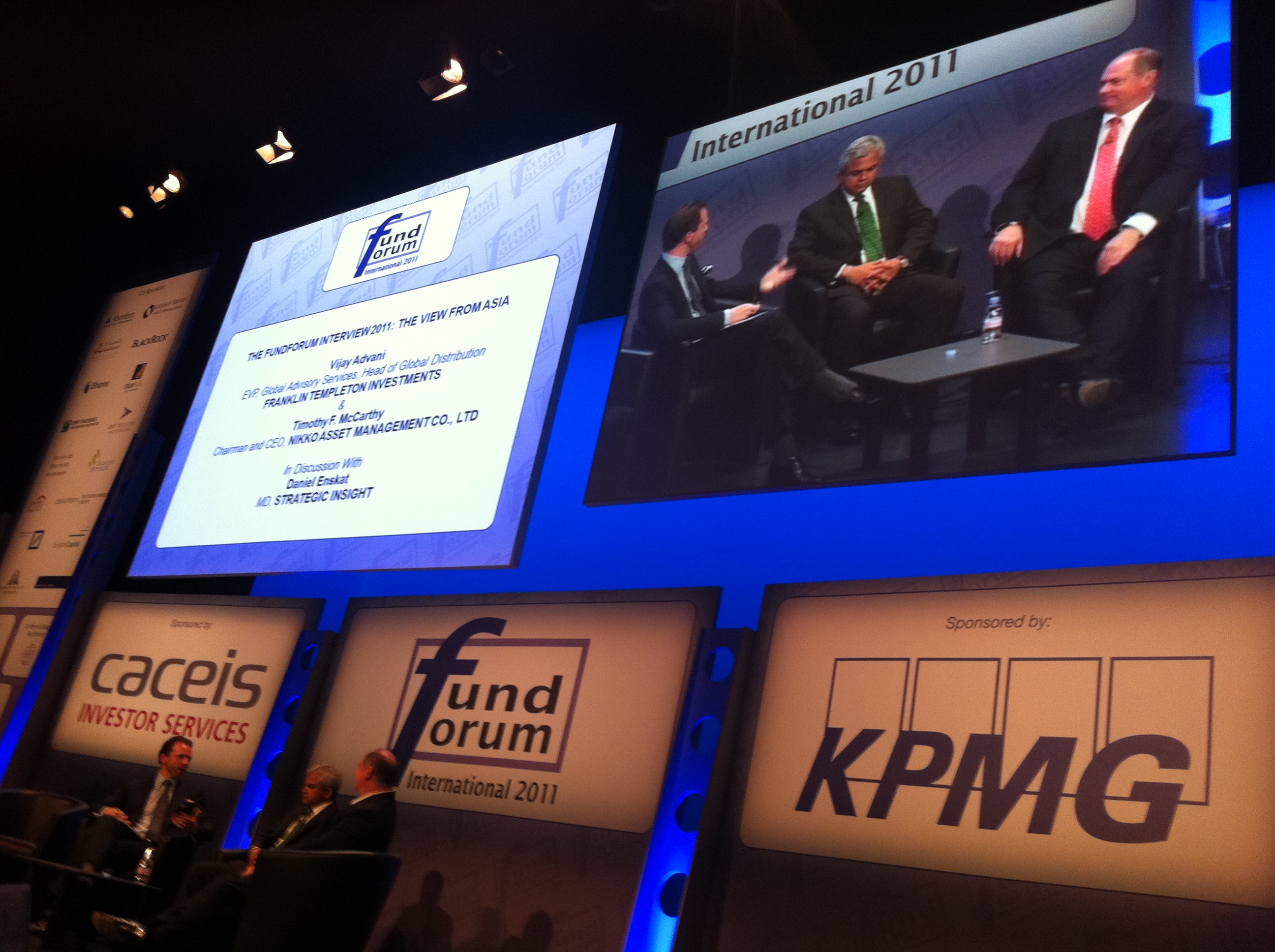
The Fund Forum Interview 2011: The View From Asia

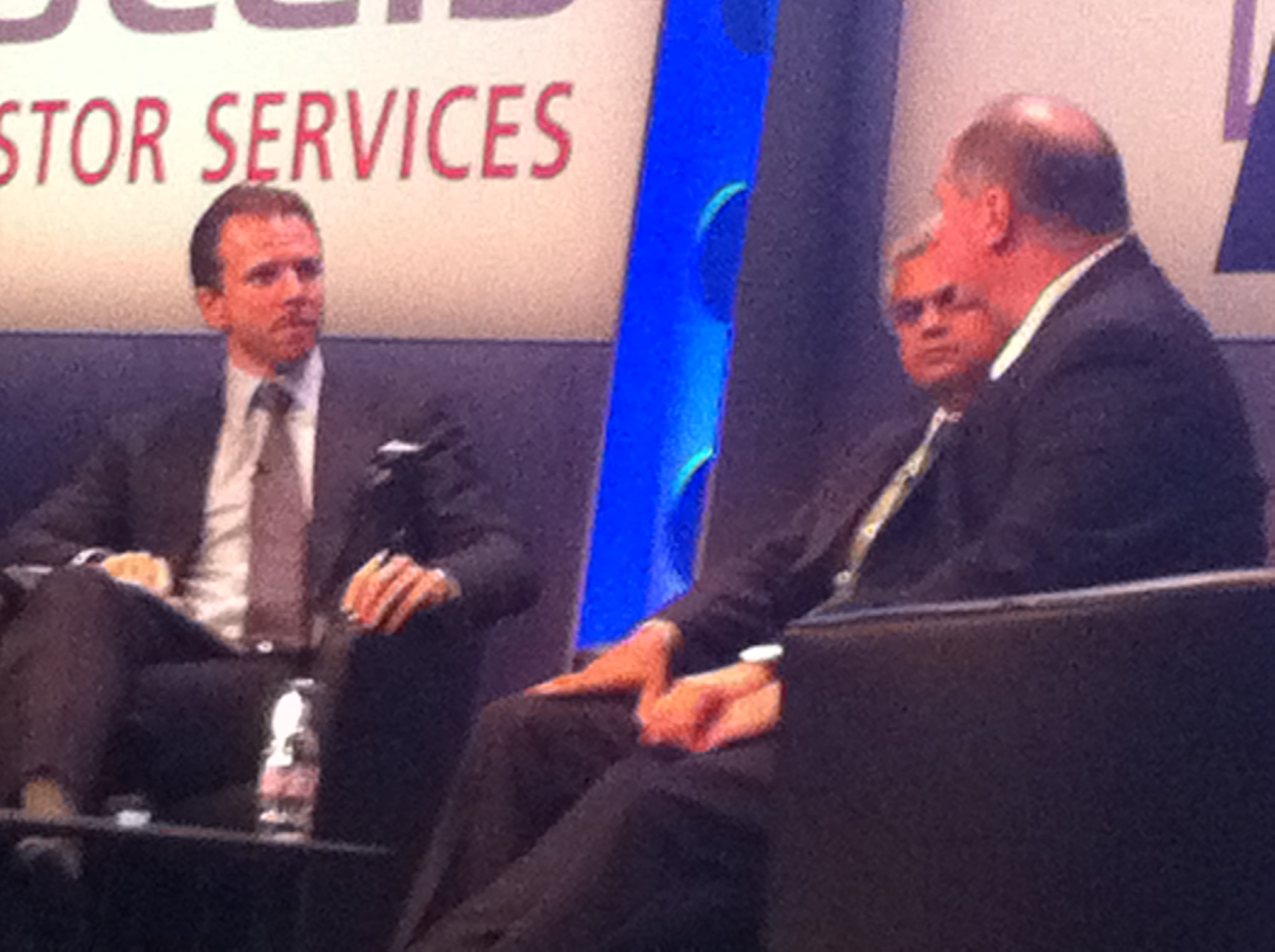
Up next was the “FundForum Interview 2011: The View From Asia”, where I had the pleasure to speak with Vijay Advani (Franklin Templeton) and Tim McCarthy (Nikko). Tim and Vijay are probably the most knowledgable executives on Asia and how the region links to the US, Europe and the rest of the world. Tim was a senior executive with Schwab and Fidelity in the US, and spent many years all over Asia before taking over the role of CEO & Chairman for Nikko Asset Management. Vijay now runs Franklin Templeton globally out of San Mateo, but in reality spent many years building the business for the firm in Asia as well and practically lives on a plane.

DSE in discussion with Vijay Advani & Tim McCarthy

I will publish a thought leadership piece with their views soon, including key observations on how to approach Asia, how it fits into a global organization, how to make it profitable and how important Asia will be in the next decade vis-a-vis other regions.

DSE in discussion with Vijay Advani & Tim McCarthy

The interview concluded the main morning session in the auditorium – after lunch it would continue with four different breakout streams on topics including UCITS, Product Development, Investment Strategy and Asset Allocation.

My afternoon was packed with client and prospect meetings, alongside media discussions, followed by dinner hosted by KPMG and Citi, one at Beaulieu-sur-Mer, the other one at the Hermitage. When deciding between two extremely appealing options, especially when friends such as Tom Brown and Jervis Smith are inviting, go for the third one: dinner with the whole team nearby, hosted by Jim – being able to spend quality time with the whole team of global analysts and client managers is a rare opportunity. We had great food and laughed a lot, the perfect finish to a busy first conference day (technically the second day).

Wednesday, Main Conference Day Two

Day two was chaired by Patrick Colle (BNP), and it featured a packed morning with many highlights, including Neeraj Sahai (Citi), a CEO panel moderated by Jervis Smith “towards the investment driven organisation” with Martin Gilbert (Aberdeen), Andrew Fisher (Towry), Katherine Garrett-Cox (Alliance Trust) and Jim McCaughan (Principal),

and then the Guest Asset Manager of the Year Interview by Ross Westgate (CNBC), with Larry Fink (Blackrock).

Among many other important comments, Larry most notably talked about the main focus for Blackrock in coming years being to build a powerful brand.

Indeed, Alex on Monday in his remarks had talked about Brand and Service Alpha in addition to Performance Alpha for Blackrock, and, curiously, Blackrock was the only manager at the forum that tweeted on all sessions throughout the week.

After a great client lunch at Avenue 31 with Roger Moore at the table next to us, I have to remind the waiters that I am not on French Riviera time and leave the table at 2:22pm to head over to my last speaking engagement for the week at 2:30pm, a panel and presentation on UCITS vs. Asia Fund Passport in the Emerging Markets Distribution stream. In recent weeks we had published numerous research pieces on emerging markets and especially Latin America, so I look forward to this more intimate panel.

I also have the pleasure of doing this stream with Camille Thommes, General Manager for Alfi. After polling the room on their specific interests, which include Asia Fund Passport, trends in Latin America, Dublin vs. Luxembourg and the potential of local passports for individual markets such as China, my senior HK-based research analyst Lise Carpenter gives a short overview of UCITS data, and then we get into the discussion.

The advantage of a smaller room with only one hundred or so people is that everyone is more specifically interested in the topic and has important views to share, so we turn it into a town hall style discussion with open Q&A.

Tomorrow we will publish an in-depth analysis of the topic, stay tuned.

After this last official engagement at the forum I continue with a few media interviews, a television appearance with EFAMA president JB de Franssu on UCITS, and then head over to the American Bar at the Hotel de Paris with Jim to meet one of our clients for a drink, before taking a taxi to the gala dinner by the pool at the Monte Carlo Beach Club.

A short but powerful thunderstorm wreaks havoc and puts the drinks in jeopardy, but this being the riviera, it is all over a few minutes later. At around 10pm we head back to the hotel and have a final round (or two) of mixed berry mojitos with the team.

We call it a night at about midnight.

I spend Thursday writing by the pool and on the phone, and then catch the Friday morning flight back to NY for a few days in the office, before being up in the air again on Thursday, this time to Colombia.

Good bye Monaco.

Posted in asia, beauty, black swans, Brand, cash flows, consulting, distribution, information delivery, institutions, LatAm, management, money, movement, pension funds, private banking, professional fund buyers, Uncategorized, wealth management | Tagged , , , , , , , , , , , , , , , , , , , , , , , , , , , , , , , , , , , , , , , , , , , , , , , , | Leave a comment

UCITS vs. Asia Fund Passport – Industry Expert Review at Monaco Fund Forum Intl 2011

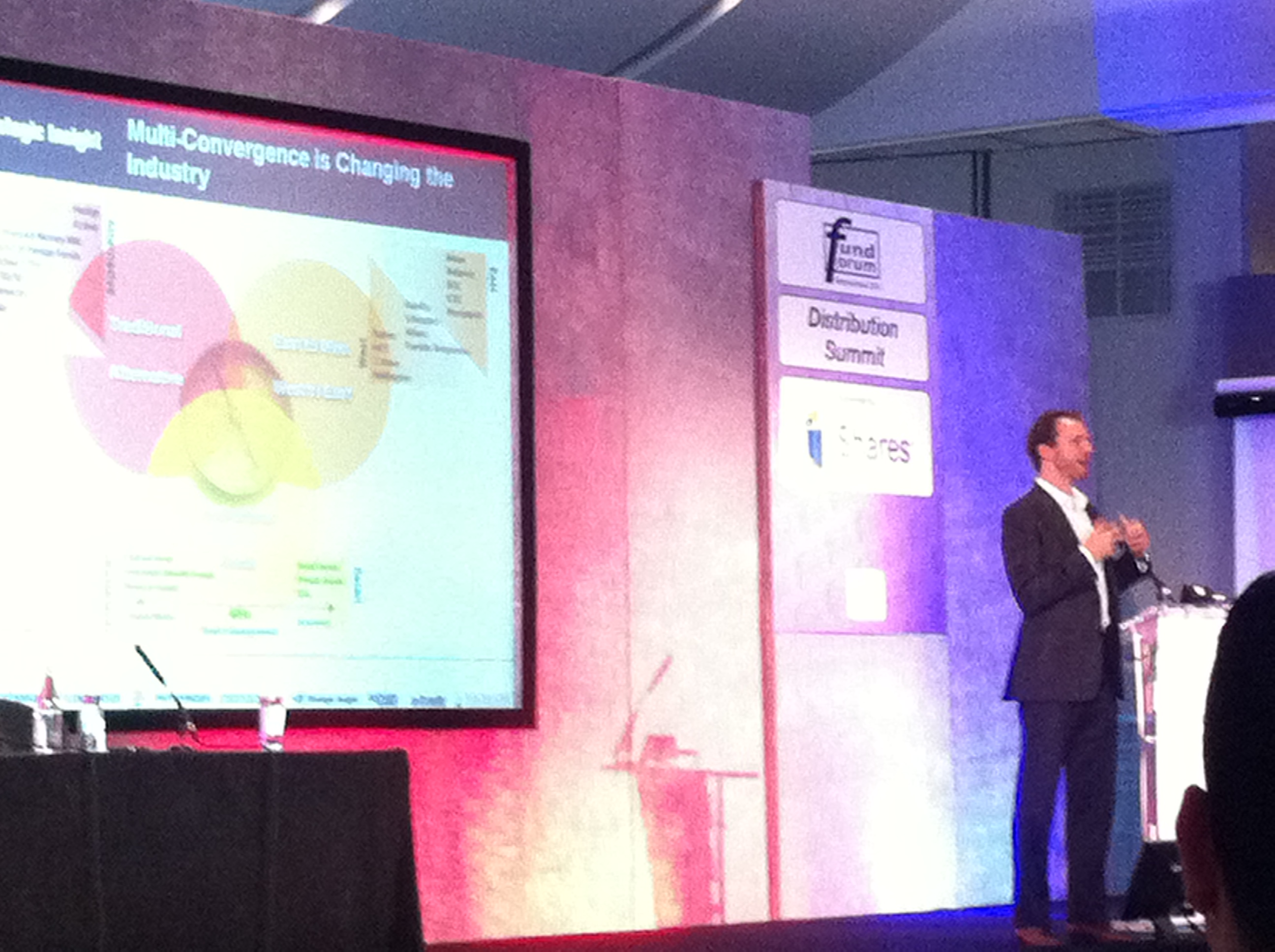
Today I gave a speech and conducted an industry expert review at the Monaco Fund Forum International 2011 on the “UCITS vs. Asia Fund Passport” issue, with the general manager of Alfi, Camille Thommes.

My senior research analyst Lise Carpenter walked us through the UCITS data and main challenges, followed by an overview of Alfi’s approach and strategy.

We then continued with an in-depth discussion around the questions from the audience, ranging from specific country details in Asia such as China, HK, Singapore or Australia, to the opportunities and challenges for UCITS in Europe or Latin America. Another main challenge and topic of discussion was our concept of multi-convergence for the industry (trad vs alt; east vs west and inst’l vs retail) and how it could impact the UCITS brand.

Below is a short research piece on “UCITS vs. Asia Fund Passport”, jointly written with Bryan Liu, my Hong Kong-based Senior Research Analyst.

UCITS vs. Asia Fund Passport

Introduced as a fund passport in Europe 25 years ago, the “Undertakings for Collective Investments in Transferable Securities”, commonly called UCITS, have grown from a European initiative into a powerful global brand with $8 trillion in total assets: $4.8 trillion in local UCITS in Europe and $3.2 trillion in cross-border UCITS worldwide .

The success of UCITS, especially in recent years, is highlighted by the reactions to it from around the world. Far from being sold only across borders in Europe, as originally intended, UCITS are also a major component of mutual fund-type investment products distributed in Asia, Latin America, Middle East and elsewhere – in Asia alone, UCITS assets exceed $500 billion across the region.

As of July 2011, there are nearly 7,000 UCITS funds and share classes registered for sale across Asia, the majority of them sold in three cross-border fund hubs: Hong Kong, Taiwan, and Singapore. There are a few restrictions on UCITS in each of them, but in general the vehicle is accepted by local authorities, distributors and investors.

• Taiwan, for instance, does not approve UCITS products using derivatives, and sometimes delays registration in response to the domestic fund market environment.

• Hong Kong regulators have recently added the requirement of investor characterizations prior to the sale of any product that uses derivatives.

On the other end of the spectrum, some Asia-Pacific markets including China, India, Indonesia, and Australia do not recognize UCITS.

The rest of Asia sits somewhere in between: Korean regulators in 2007 introduced tax disadvantages to offshore funds and favored locally domiciled funds investing overseas ; UCITS registration in Japan is slow and expensive with immense local paperwork, leading international managers to work with domestic distributors via FoFs platforms; in Malaysia and Thailand, UCITS are required to be wrapped within locally registered investment vehicles.

The Asia Fund Passport

Of late, Asia is exploring alternative ways for cross-border fund distribution, motivated by a variety of reasons.

Since the global financial crisis there have been numerous discussions among Asian fund industry participants and regulators about the possibility and the need for a regional “Asia Passport”, both as a defensive response to scandals with less-regulated, structured products like the “minibonds” and “accumulators” in markets like Hong Kong, and to competitively position the region and attract local revenues and talent.

The government in Hong Kong talks about the “Hong Kong Advantage” of being an international hub as well as a local gateway into China, and it being important for the market to have a local (and possibly regional) passport.

The Financial Services Council (FSC) in Australia stated “that the creation of an Asia Region Funds Passport presents a unique opportunity to facilitate cross-border investment within the region”, adding that “the region clearly is signaling that it is ready to embrace this exciting concept”.

The latest development and proposal is to create an “Asean Passport” for cross-border mutual fund products among members of the Association of Southeast Asian Nations (Asean) in 2012.

Given the very fragmented and compartmentalized state of mutual fund markets in Asia, and the lack of a supranational rule-making body similar to the European Union in the region, a pan-Asia fund passport is not likely to become a reality in the foreseeable future.

However, a limited passport focusing on small groups of Asian markets such as the proposed “Asean Passport” could be implemented in coming years.

Particularly interesting is the prospect of a “Greater China Passport” between Hong Kong and China that could potentially replace the mainland’s qualified domestic institutional investor (QDII) program and encourage more overseas investment for Chinese investors.

With a growing number of Chinese asset managers setting up subsidiaries in Hong Kong, and concurrent explosive growth for the offshore RMB market (for example, HSBC (Hong Kong) gathered $0.5 billion in a Cayman Island-based RMB bond fund ), a “Greater China Passport” could strengthen and accelerate Hong Kong as a gateway into China and as a local fund domicile center away from its longstanding competition with Singapore as an Asia hub.

Local, regional, or global, the issue of fund passporting remains high on the agenda of industry experts.

Posted in asia, black swans, Brand, cash flows, Chile, China, consulting, distribution, information delivery, institutions, LatAm, money | Tagged , , , , , , , , , , , , , , , | 1 Comment

Monaco Fund Forum International 2011 – Tuesday, Thought Leadership Interview – “The View From Asia”

Tuesday is the opening of the main conference. After the emerging market and distribution summits on Monday, the morning session on Tuesday typically brings together a selection of CEOs and other leaders.

I have the pleasure of doing this year’s thought leadership fireside chat with Tim McCarthy, CEO for Nikko Asset Management, and Vijay Advani, vice-chair of Franklin Templeton.

Before us is the Editor-in-Chief of the Economist, who sets the global stage politically. For the first time in Monaco, after 21 years, we provide a “View from Asia” and what it means for the developed world from an investment and distribution standpoint.

My afternoon consists of business luncheons, meetings, journalists and a team with the dinner.

Stay tuned for a research study on the view from Asia in the coming days.

Posted in asia, black swans, Brand, cash flows, consulting, distribution, information delivery, institutions, Latin America, management, money, movement, professional fund buyers, SWFs | Tagged , , , , , , , , , , , , , | Leave a comment

Monaco Fund Forum International 2011 – Monday, distribution summit

The Monaco Fund Forum is the largest European asset management gathering and always a place to catch up with clients, prospects and friends.

This year we are represented with a team of eleven in Monaco, including our chairman.

I opened the distribution summit on Monday with our new research study on the professional fund buyer landscape, “Building Bridges”, around the needs of the new global professional fund buyer and asset holder.

After me was the chairwoman of Interbrand, Rita Clifton, presenting her top global brands survey and case studies around the tangible importance of brand in any industry, asset management included.

It was followed by a number of panels throughout the morning with advisors and selectors, and then the discussion became more product specific in the afternoon.

Stay tuned for a research summary of the day and the most important themes on asset holders’ minds.

Posted in asia, black swans, Brand, consulting, distribution, information delivery, LatAm, Latin America, management, Middle East, money | Tagged , , , , , , , , , , | Leave a comment

Global Fund Flow Review April 2011: Top Selling Products and Managers

This week I published a new report on year to date flow observations worldwide, including top products and managers, with key contributions from analysts Bryan Liu, Miao Hu, and Lise Carpenter.

Release notes below:

Nearly $270 Billion in Global Long-Term Flows Through April 2011, industry on track for another year of RECORD CASH FLOWS; “DAVID & GOLIATH” FUND MANAGERS DOMINATE GLOBAL LEAGUE TABLES

Hong Kong and New York – June 22, 2011 – Year-to-date global long-term fund flows through April 2011 reached $270 billion, according to Strategic Insight’s Global Mutual Fund Review April 2011, New & Top Selling Funds, Leading Managers.

“This puts the industry on track for another year of $750 billion to $1 trillion in cash net flows in 2011,” stated Daniel Enskat, Head of Global Consulting at Strategic Insight. “April was the best month since October 2010, with close to $100 billion in flows, mostly from the US and cross-border vehicles,” Enskat added. “Equity funds are the main driver of flows thus far in 2011, accounting for half of the total.”

Among other highlights from the report:

Toward a True Cross-Border Mutual Fund Industry: “Cross-border funds in Europe and abroad have been driving net flows for mutual funds, and year-to-date accounted for 80% of cash flows ($77 billion) outside of the US (90% when only looking at Europe). Due to their flow dominance, cross-border UCITS’ share of total UCITS assets has risen from less than 10% a decade ago to nearly 40% today.”

David & Goliath – Leading Cross-Border Investment Managers: “Looking at the top cash flow cross-border managers thus far in 2011, Franklin Templeton continues to hold the top spot, followed by Blackrock and JP Morgan”, noted Enskat. “Just as importantly, boutique managers Investec and M&G entered the top 10 cross-border fund manager league table on the strengths of their flagship themes and products.”

Diversity of New Fund Themes Around the World: “The first few months of 2011 brought a wide range of interesting and diverse fund launches by region. In Asia, China’s top themes include SRI, capital protection, passive equity, and stable income. In Europe, the largest gains are around capital protection via bank distribution. On a cross-border basis, emerging market local currency debt, absolute return, lifecycle funds, and RMB bonds led the way for cash flows.”

In addition to a discussion of new funds, this report analyzes the top cash flow funds and managers so far this year by region.

For more information on this report, please visit: http://www.sionline.com

About Strategic Insight

Strategic Insight is a research and consulting firm that supports over 250 companies around the world with analysis, perspective, and data on the fund industry; its Simfund databases, the world’s analytical source for mutual fund business intelligence, track flows, assets, performance, ratings, and other intelligence on more than 65,000 portfolios and many more fund share classes globally.

——————————————————————————–
Asset International, Inc.
Strategic Insight / Simfund / SI Global / Annuity Insight / Simfund Filing
Global Custodian / PLANSPONSOR / PLANADVISER / aiTrade / ai5000
——————————————————————————–
http://www.StrategicInsightGlobal.com / http://www.GlobalFundDistribution.com

Posted in asia, black swans, cash flows, Chile, China, consulting, distribution, management, money, private banking, professional fund buyers, Uncategorized | Tagged , , , , , , , , | Leave a comment

Spotlight on Switzerland: Funds, Flows, Wealth Management, and West-to-East

I just published a new study with one of my HK-based Senior Research Analysts, Bryan Liu, on the Swiss Asset and Wealth Management industry.

Below is the press release… for additional details, click here

EQUITY FUNDS IN SWITZERLAND ATTRACT 57% OF FLOWS SINCE 2008, MOSTLY TO PASSIVE FUNDS; PRIVATE BANKS GROW MOSTLY IN ASIA; INSTITUTIONS ARE SWITCHING FROM MANAGED ACCOUNTS TO FUNDS

Hong Kong and New York – June 16, 2011

In a new research study, Spotlight on Switzerland: Funds, Flows, Wealth Management, and West-to-East, Daniel Enskat, Head of Global Consulting for Strategic Insight, states that “Switzerland, despite some unwanted public attention since the financial crisis, remains instrumental for the global asset management industry: as a private banking hub, for advisory and investment solutions, to identify upcoming product trends, and as a link between West and East.”

According to Strategic Insight data, total assets under management in Switzerland have grown by 30% since the height of the global financial crisis in December 2008. States Enskat: “Net flows to long-term funds in 2010 reached $25 billion, three times higher than in 2009, and 25% higher than pre-crisis in 2007, with equity funds in Switzerland attracting 57% of all long-term industry flows from 2008 through Q1/2011, mostly to passive funds.”

He added, “FATCA and the newly proposed Swiss banking rules could impact how and where Swiss private banks collect and manage client assets. The data shows most growth for Swiss private banks coming from Asia Pacific and emerging markets of late, along with opportunities in new client segments.”

Other key findings from the report include:

Institutions are Switching From Managed Accounts to Funds: Institutional mutual funds and share classes in Switzerland tripled in assets and number of products since 2005, reaching $200 billion in assets overall. Strategic Insight notes a growing trend of institutions using fund vehicles instead of managed accounts, both in Switzerland and industry-wide.

A Tactical Quest for Commodities, Absolute Return, and Back to Europe: Looking at best-selling investment categories in the last 12 months, commodity funds led the list with $6 billion in new money, followed by Bond Europe and Equity Europe with $4 billion and $3 billion, respectively, as well as selected Absolute Return themes. Commodities, on aggregate, held the top-selling category spot in Switzerland in the last two years, adding a combined $13 billion.

Concentration of Distribution Domestically, but Third-Parties in Private Banking: The Swiss fund industry, similar to other local markets in Europe, is highly concentrated with a market share of 83% for the top ten managers. However, increasing use of non-proprietary fund managers in private banking and wealth management channels has helped international firms raise significant assets through their cross-border fund offerings and institutional activities.

Stagnating in the West, Growing in Asia – West to East: Despite only marginal aggregate growth, outflows from developed markets have been met with strong growth for private banking across Asia. Swiss private banks are heavily targeting and investing in their business across Asia Pacific – we provide case studies for UBS, Credit Suisse and other firms.

For more information on this report, please visit: http://www.strategicinsightglobal.com/

About Strategic Insight

Strategic Insight is a research and consulting firm that supports over 250 companies around the world with analysis, perspective, and data on the fund industry; its Simfund databases, the world’s analytical source for mutual fund business intelligence, track flows, assets, performance, ratings, and other intelligence on more than 65,000 portfolios and many more fund share classes globally.

STRATEGIC INSIGHT, an Asset International Company
805 Third Avenue, New York, New York 10022
***
Level 19 Two International Finance Centre, 8 Finance Street, Central, Hong Kong
***
50 Borough High Street London SE1 1LB
***

Posted in black swans, Brand, consulting, distribution, information delivery, management, money, private banking, professional fund buyers, SWFs, switzerland, wealth management | Tagged , , , , , , , , , , , , , , , , , , , | 1 Comment