The Importance of Brand in Asset Management – Discussion with BNY Mellon Investment Management Asia CEO Alan Harden at Fund Forum Asia 2012

FUND FORUM ASIA INTERVIEW 2012 – BRAND VERSUS BOUTIQUE

Is There Space For Niche Players In A Brand-Conscious Market? 

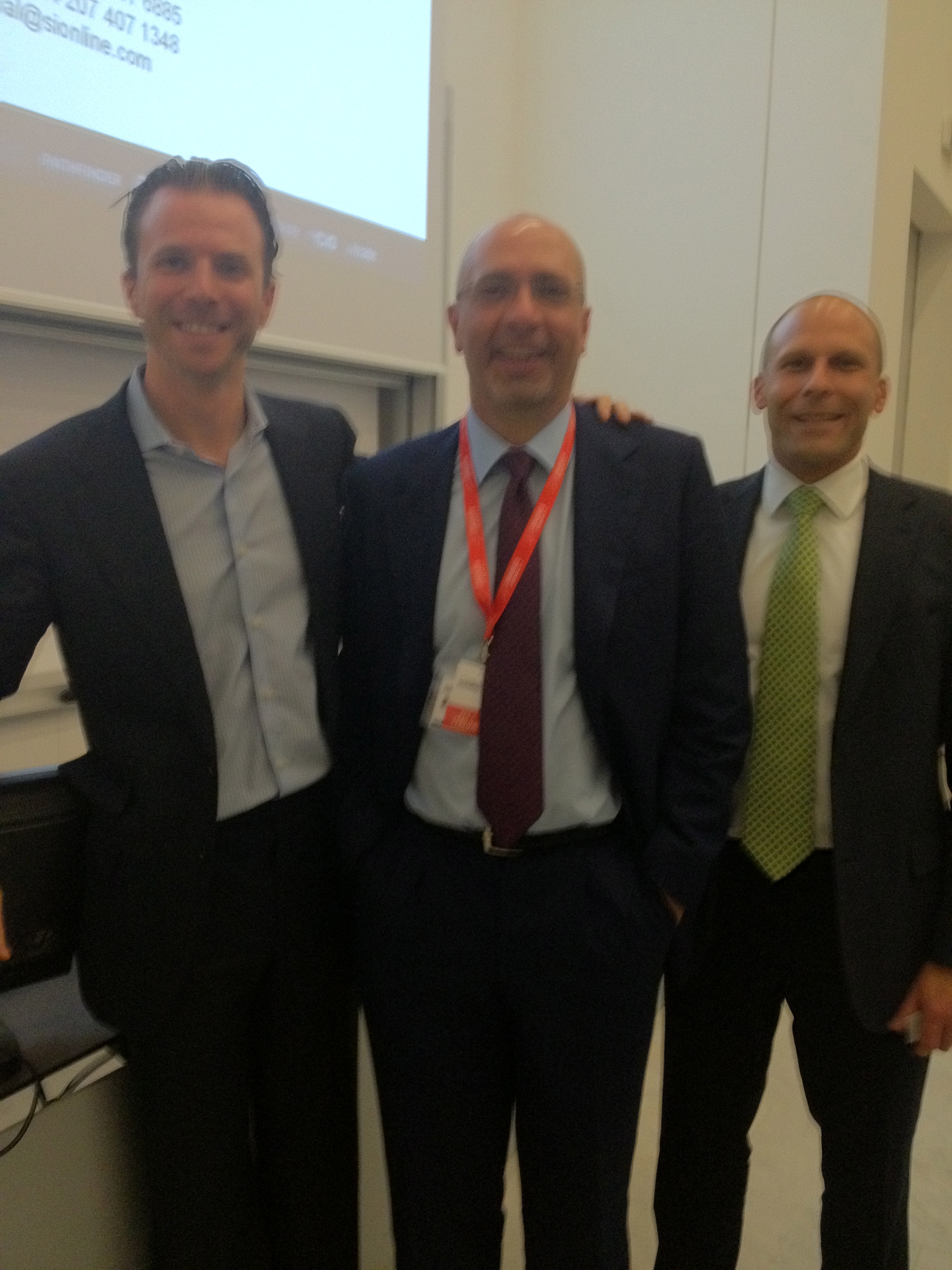
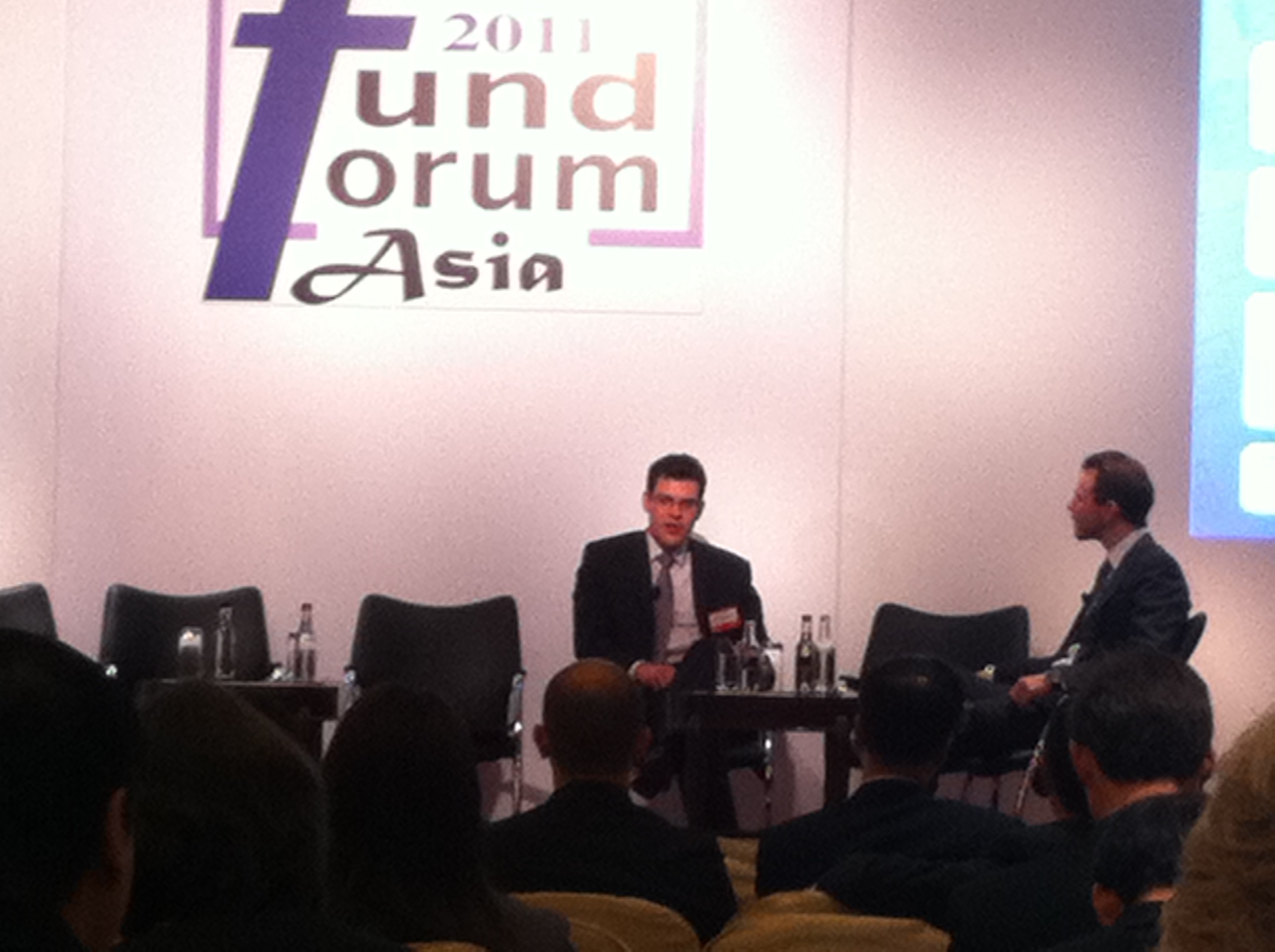
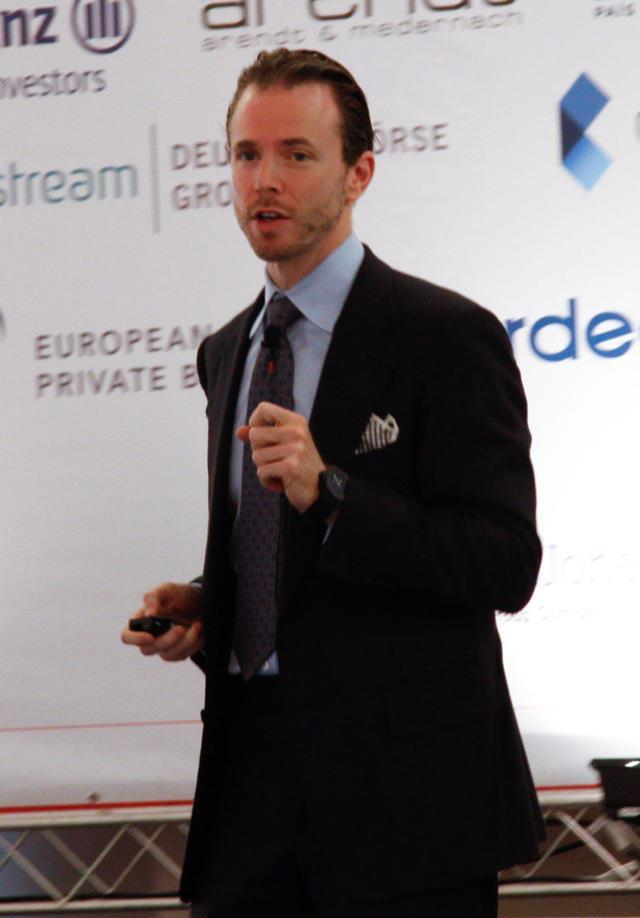
During the main conference of the Fund Forum Asia 2012 in Hong Kong, I had the pleasure of discussing brand in asset management with Alan Harden, a leader in the Asia asset management industry and CEO for BNY Mellon Investment Management in the region.  Below are the main points of our talk.

Brand in Global Asset Management – Harden/Enskat at Fund Forum Asia 2012

DEFINING BRAND:

Enskat: Let’s approach the topic of brand top-down and define it first.  Looking at the best 100 global brands worldwide, we see a few financial services firms represented, which is encouraging, especially compared to consumer brands.

For example, Apple now ranks as #8 globally and this morning announced almost $12 billion in quarterly profits (with revenue doubling in Asia).  Google is #4. In comparison, JP Morgan and Citi rank at #28 and #32 respectively. Not bad.

Interbrand: Best Global Brands 2011 – Ranking of the Top 100 Brands
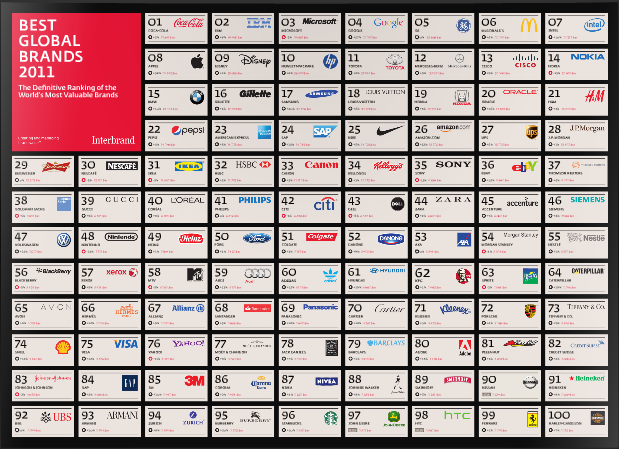
Best Global Brands 2011 – Asset Management, Quo Vadis?

However, the flipside of that coin is Apple’s brand value grew by #58 year on year, while JPM and Citi stood at 1% and -3%, respectively.

How do we define asset management brands and how do they stack up?

Harden: Beyond language and name recognition, you have to make your brand well-known holistically, especially in the retail space.  On the institutional side I would define brand around the quality of investment process and the information delivery experience.  Those two combined equal a promise towards what a company can do and thus supports brand.

At BNY Mellon Investment Management, we have specialist brands and BNY Mellon as an umbrella.   Having 16 boutique firms with their own distinct brand adds a certain degree of complexity to our business.
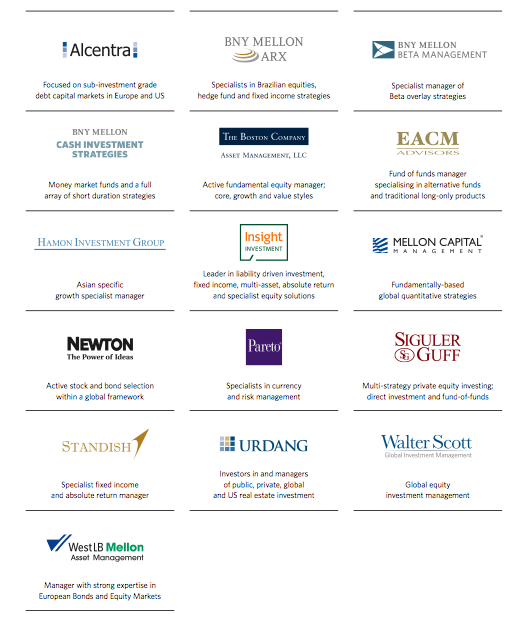
BNY Mellon Investment Management Brands

THE IMPORTANCE OF BRAND – RETAIL VS. INSTITUTIONAL

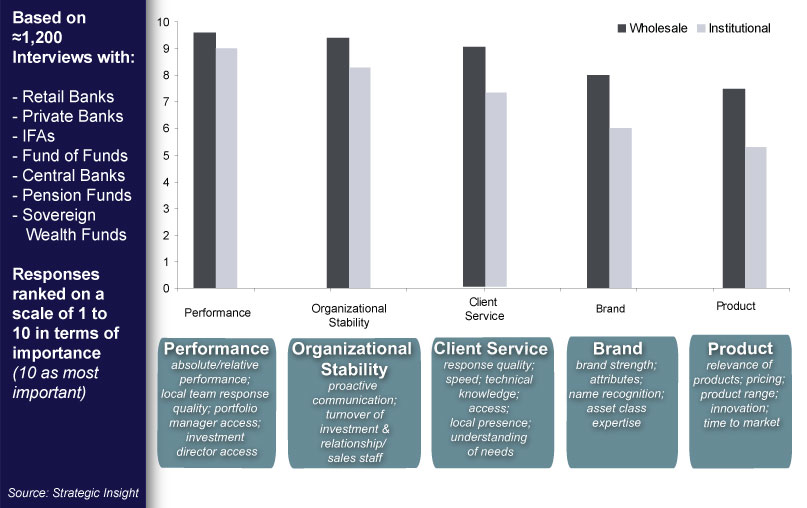
Enskat: Although it might sound like an oxymoron, our proprietary research for asset holders in Asia and globally suggests brand on the institutional side almost as important as on the retail side, for instance for institutions entering new strategies or rethinking their asset allocation and portfolio construction strategies in the context of investment solutions.  Some new institutional mandates for example for PIMCO or BlackRock especially post-crisis were partially triggered by brand – and organizational stability.
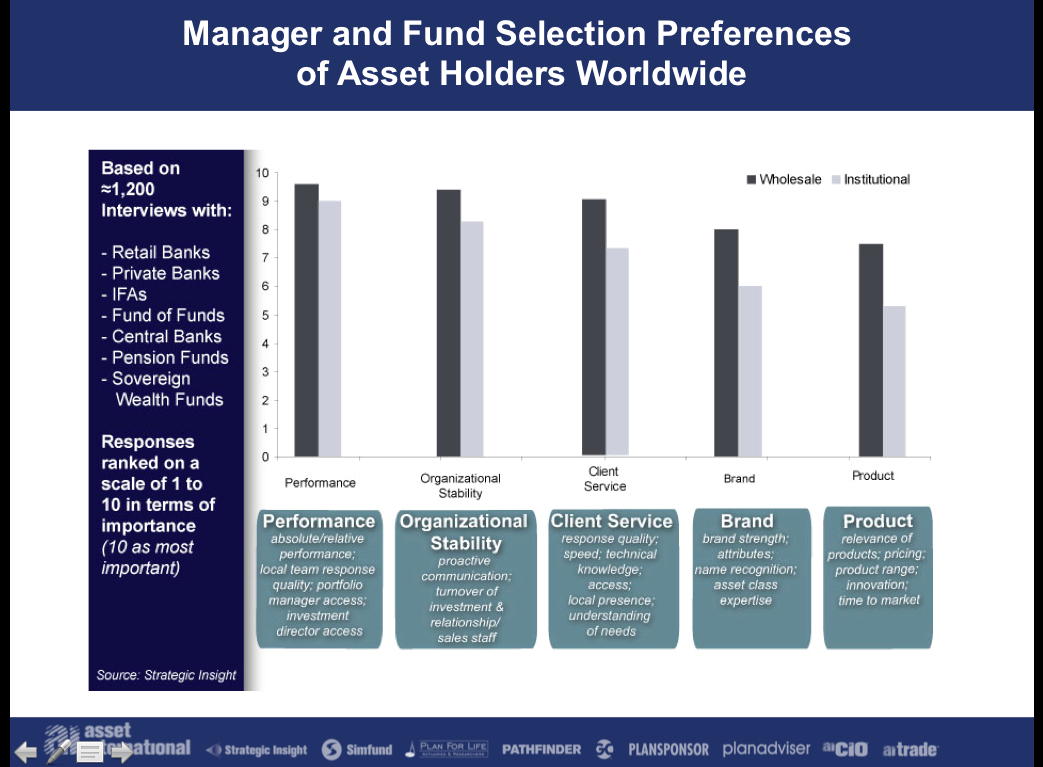
AI/SI Research: Manager Selection Preferences by Asset Holders Worldwide

Our research survey work with asset holders suggests that the key to being selected since 2008 has been to find the right mix between investment performance, service, brand and organizational stability – with growing importance of the last two as differentiating factors.

Especially in Asia both organizational stability and brand are moving up the ranks. Where do you see this mix at BNY Mellon?


Harden: The first thing I would like to do is change your question.

I think I would like to reposition the four criteria: the sum total of three of them, investment performance, organizational stability and service, i.e. the delivery of your promise, equals your brand.

Your examples, BlackRock and PIMCO, are superb companies inasmuch as they have always delivered what they promised to do.  Therefore, they have a strong brand.

The next conundrum is name awareness.  You can have a strong brand awareness in the institutional space by delivering on all of the above.

In the retail space, you need name recognition on top of it. That’s harder to achieve.

THE GLOBAL TREND TOWARDS BLOCKBUSTER PRODUCTS  – IS BRAND PORTABLE?

Enskat: What we are seeing globally across the industry for both retail and institutional channels is a trend towards blockbuster products.  Asset holders are asking asset managers for the one or two things they are really good at.  Firms that they have heard of and those they believe are best-in-class get the vast majority of industry cash flows. In 2011, while the industry globally collected $200 billion in new cash flows, the top 1% of blockbuster products combined gathered almost $1 trillion in new money – independent from investment theme or asset class.
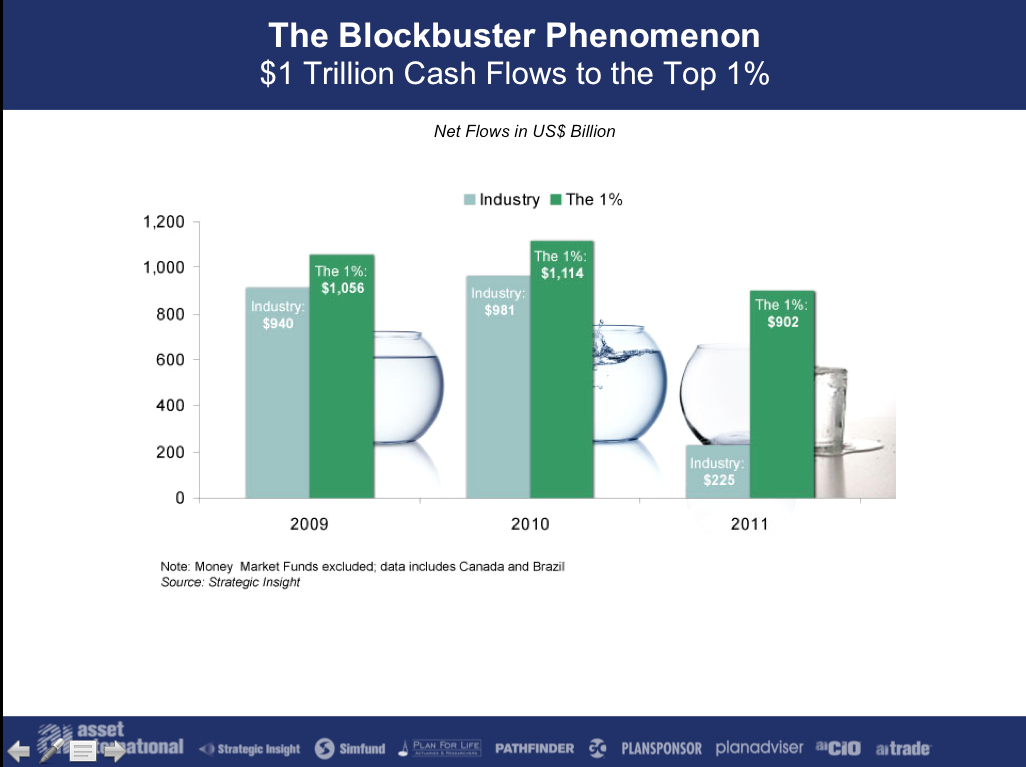
The Blockbuster Phenomenon

For example, for January and February 2012 we have seen a rebound in equity appetite.  Yet, the top five cross-border products worldwide year-to-date each highlight a completely different theme:  emerging market equities (Aberdeen Global EM Equity), income (M&G Global Dividend), Asia (Franklin Templeton; BNY Mellon/Newton), thematic investments (Morgan Stanley Global Brands) and asset allocation (Invesco Balanced Risk Allocation).

First, congratulations on being one of the five.  Second, leaving the pun of Morgan Stanley’s brand product aside, what do you make of these themes from a brand perspective?

Harden: Thank you.

I think all five companies and products you mentioned have delivered on their promises for years. Oftentimes the asset management industry is made out to be tremendously complicated.  It’s actually conceptually relatively simple.  Do what you said you were going to do, do it really well, and continue to do it in the future.

In order to do that, we are all very concerned about keeping the people and teams together to make sure we can continue to operate at the same high levels.  If you can deliver strong holistic performance and are able to repeat it, it will drive a lot of assets your way.

In the case of the five firms above, they were able to do just that across a number of different products.

Morgan Stanley Global Brand and Newton Absolute Return are interesting because those themes are slight deviations from what they are really known for.  

Thus, the question then becomes whether brand is portable across different strategies, i.e. can brand be extrapolated?

I would argue the answer is yes.  Brand ultimately is a continuation of our basic promise of performance excellence. You then deliver that to the customer in a way that she or he wants it delivered.

If we can do that, and if we can continue to do that – we can extrapolate new strategies and create new fund sales, i.e. broaden our brand.

Enskat/Harden Asia Fund Forum 2012

 
THE DAVID VS GOLIATH BLOCKBUSTER BATTLE – IS THERE ROOM FOR A MULTI-DAVID BRAND IN ASIA?

Enskat: So let’s take a closer look at who is actually able to do this best.

In my research I classify the blockbuster phenomenon as a battle of “David vs. Goliath”.  On the one end of the spectrum we have large global fund managers, such as BlackRock, Franklin Templeton, PIMCO, JP Morgan and others.

On the other end of the spectrum we see fast growth for boutique names such as Huashang or Value Partners in Asia, Investec in South Africa, Carmignac or BlueBay in Europe, and DoubleLine or DFA in US.

It is very hard to operate in the middle ground, juggling economies of scale and boutique approach.
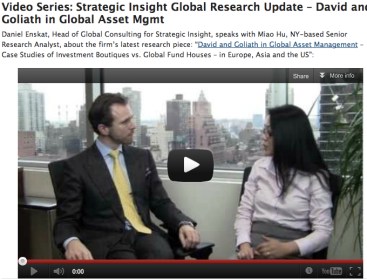
David & Goliath in Asset Mgmt

Yet, your firm represents a third approach, something that I would coin a “multi-David” structure.  Investment boutique brands under a larger global parent, such as BNY Mellon, Legg Mason, 0r Natixis.

Allianz would have been part of your group, but then PIMCO decided to leave the parent firm from a distribution/brand perspective.

Is there room for multi-Davids in Asia (and elsewhere)? How do you see it playing out in the blockbuster piece?


Harden: I actually quite like the idea of 16 Davids taking on a Goliath.

It’s an interesting issue for the industry and exactly why I think multi-boutique strategies to some extent have an advantage.

Multi-Davids on a distribution/parent company level are big enough to have economies of scale and leverage organizational capabilities.  We gain synergy wherever we can, across the continent and across the globe, but are nimble enough to react to markets and consumer demand, and fast enough to implement them because each boutique focuses on one thing and one thing only – investment excellence.

That leaves the parent company as the operating manager, adding value by allowing the boutiques to focus on investment performance and growing their capabilities, and supporting solutions through different distribution channels worldwide in an effective manner. This also helps as we focus on delivering client service excellence.

In my view, the middle ground is the “dead zone”.

Whenever a large organization is developing pseudo boutiques within it, or Davids reach a scale where they meet capacity constraints for their strategies, that’s when the middle ground becomes a real problem.
FROM DAVID TO GOLIATH

Enskat: Let’s take the example of Aberdeen.  They have the best-selling equity fund year-to-date 2012 and are known as a global equity manager with a strong brand in emerging market equities, especially here in Asia with Hugh Young, and globally with Martin Gilbert and his acquisitions in recent years.

Let’s then add the example of PIMCO.  From a brand perspective, PIMCO last year decided to build their own distribution efforts away from parent Allianz on the strength of their brand.

How does it affect your boutique brand name when you get so big that you de facto become a Goliath?  Or, closer to home for you, what happens when a multi-David boutique has such a strong brand that they don’t think they need you? 

Harden: Aberdeen is a superb example of a David turning into a Goliath.

I am a real fan of Martin’s leadership and what that business has done. If you go back ten years to 2002/2003, they had difficulty with the investment trust split issue in the UK, where their low share prices created a degree of concern in the marketplace. Ten years later he has bought a couple of businesses right in the eye of the storm of the crisis, and transformed the boutique David into a Goliath.

Enskat:  Admittedly, given the strong name recognition of the analogy for David, Multi-David, and Goliath, we conveniently downplayed that of course in the story David emerges as the winner.

Harden: That’s perfect.

Enskat: Maybe, but which David is it? In BNY Mellon, multiple boutiques run the same strategies and compete with each other.  Isn’t that confusing for the client or destructive for the group? 

Harden: I appreciate the opportunity to do some marketing for BNY Mellon.  There are many firms that don’t like competing strategies – we do.  For example, we run global equities in four different boutiques (Newton, Walter Scott, The Boston Company, Mellon Capital).  Each of the firms uses a different approach to global equities that suits different customers.  By understanding the nature of problems out there and the solutions needed to address them, we can put capabilities together accordingly.

Enskat:  You are in charge of Asia-Pacific, but you only have one local manager – Hamon.  At the same time, over 80% of the assets in Asia are locally manufactured.  With great(er) demand for local products and local expertise in Asia, how can you demonstrate brand strength for those clients? In other words, how are you going to build a brand from nothing?
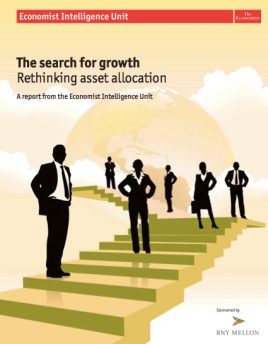
EIU BNY Mellon – Rethinking Asset Allocation

FINDING BOUTIQUE 17

Harden: From nothing comes the rise of the phoenix.  We have the world’s best opportunity and the necessary financial strength to capitalize on it.

Enskat: Arne (Lindman, Asia Pacific CEO for Fidelity) said yesterday that it took Fidelity 40 years and a few hundred million dollars to build their brand in Asia.

Harden: And we are as committed.

We run $1.3 trillion in assets under management globally, we have our boutique name here and our JV in China, and are ready to build that out alongside our other businesses.  My working name for it is “Boutique 17”, to help build out Asia Pacific equity and fixed income strategies alongside Hamon and others, and then to grow them to a considerable degree.  Profitability of course is a key issue.

Enskat:  In addition to the buildout of your institutional brand here, you are also tackling the retail side.  Do you consider this to be an uphill battle from a brand perspective?  

Harden: The retail brand awareness is definitely a challenge. On the institutional side the BNY Mellon boutique brands travel very well, but on the retail side this is not really the case.  Both BNY and other multi-David firms and boutique managers have work to do in that regard.

Enskat:  Asia has had a difficult time from an aggregate asset gathering perspective since the accumulator and minibond crises in 2008, with net cash flow numbers nowhere near pre-crisis levels.  The only market in Asia with sizable cash flow contributions post-crisis has been Japan.  Curiously, the blockbuster themes in Japan often are co-branded products.  For example, Nikko under Tim McCarthy in 2004 started the World Series platform and by 2007 had some 45 products by 30 external managers with $25 billion in assets.

On the one hand there is no common denominator across the region from a business perspective, with each local market having specific regulatory, cultural, product and distribution dynamics.  On the other hand, some themes such as high yield, multi-asset or global fixed income has seen regional appeal.

Is there anything you are doing in Japan from a branding perspective that can be extrapolated?  
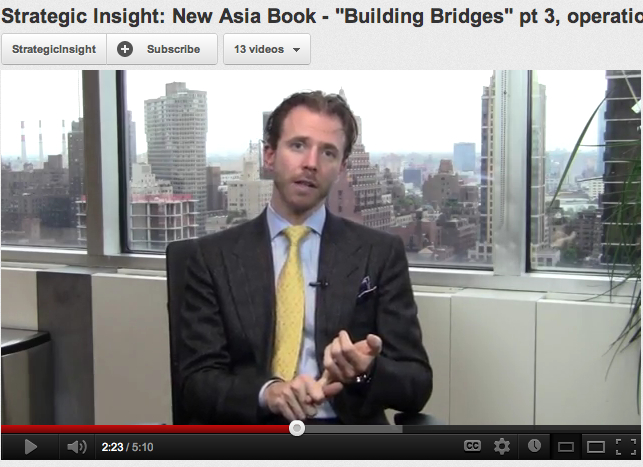
Harden: I think the asset management business in each country in Asia is markedly different, and it is critical to manage the business from a local perspective from every aspect, including branding, production, and investment capabilities.

For BNY Mellon Investment Management APAC, Japan is by far our largest business and we have raised assets managed within the group both with our European and US boutiques.

To create packages using some of our boutiques certainly is a good example of a way to perhaps hit the ground running in the region.

One of our recent launches – and rest assured it will be on the list of your blockbuster products when it is announced – is a combo product in Japan where we bundled Urdang and Insight for a REIT strategy with a covered call.  Such a high yield two-pronged strategy allows us to tap into the investment excellence of our different boutiques and at the same time develop the manufacturing side of the Asia business.

THOUGHT LEADERSHIP AND TAILORED INFORMATION DELIVERY AS BRAND EQUITY

Enskat: Let’s turn to an area of brand equity that many asset managers are struggling with.  When we look at the commonalities between successful David and Goliath firms worldwide, our surveys and research shows all of them are great at proactive and tailored information delivery and thought leadership.  A new key criterion for asset holders is the adaptation of a social media communication strategy, especially on the retail side.

What are you planning for your 16 boutiques, both for the institutional clients as well as for your retail development.
The Search for Growth – EIU:BNY Mellon

Harden:  All of our boutiques produce thought leadership around their investment philosophy, but the challenge is how do you get that to the client and consumer in a meaningful and thoughtful way.

Enskat:  Scorpio’s latest wealth management survey for the region stated that while asset managers view their relationship and communication with clients as 90% numerical and 10% emotional, HNW investors see it exactly the other way around. Does the industry have a massive communication challenge with its customers?

Harden: I think we communicate reasonably well with our institutional customers, whether in person or through other channels.  Clearly, we are always more into mathematics and numbers in some shape or form.  On the other hand many of the blockbusters you mentioned are thematic in nature.   I think that is because they are trying to provide a solution for a problem, and that is normal.

Enskat: Are thematic blockbusters and investment solutions a “new normal”? We now globally have some $4 trillion in investment solution wrappers worldwide and these products collectively attracted over $100 billion in new money last year.
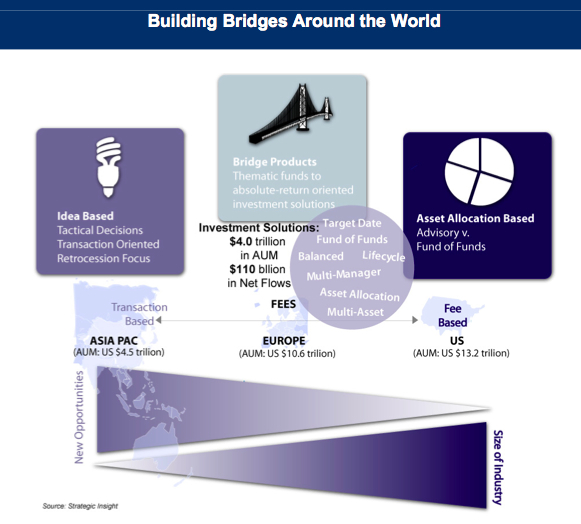
Investment Solutions – Bridge Products

Harden:  For us, thematic asset management allows us to have different capabilities across our groups come together to create a solution.  We just have to figure out which problems we are going to face globally and from a macro perspective to create some form of solution that customers have the choice to invest in.  BNY Mellon to that end recently sponsored an EIU thought leadership study on “the search for growth – opportunities and risk for institutional investors” that looked at a scenario heat map of probably future scenarios.

MULTI-CONVERGENCE AND BRAND

Enskat:  Multi-convergence, the blurring lines of demarcation between retail and institutional processes, the product convergence between traditional and alternative approaches, different investor mindsets between developed and emerging markets, and the interdependence and competition between local and global regulation is fundamentally changing the industry.  But it goes beyond just our industry.

Culture at large is converging and brands need to respond to it.

Interbrand in its 2011 analysis of the best global brands summed it up with “collaborate or die”.

Among the collaborations highlighted are BMW and Guggenheim (with their portable science labs), Coca-Cola and Heinz (the energy efficient PlantBottle), or Gucci and Unicef (high profile attention benefitting both brands).  From an asset management perspective, would you consider teaming up with another business in retail conscious approaches to raise the profile of your brand (or the industry)?

Harden:  If we continue to just do the same, we are never going to reach the levels of penetration necessary to provide innovative solutions to our customers.  It is our role to find new strategies or product structures that may exist in one part of the world, and bring them to other parts of the world – or different client segments.

That is the great benefit of this industry becoming more and more global.

At the same time, the complexity calls for partnering with different groups to find innovative ways of thinking through delivery. One of our team members last night taught us how to tweet and we now feel very modern.

Who wouldn’t want to join up for instance with Apple and develop an investment program.

Enskat: Especially since they announced earlier today that quarterly revenues from Asia doubled, to over $10 billion.

Harden: Exactly.
Posted in apps, asia, Brand, cash flows, Enskat, information delivery, Latin America, professional fund buyers | Tagged , , , , , , , , , , , , , , , , , , , , | 1 Comment

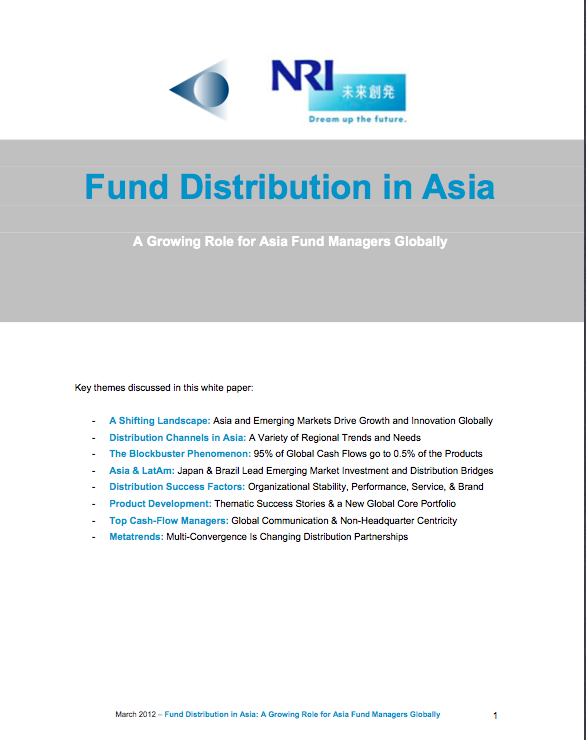
Whitepaper on Asia Fund Distribution with Nomura Research Institute (NRI)

For many years I have had the great pleasure of working closely with Nomura Research Institute’s head of research, Sadayuki Horie.  Taking turns between Tokyo and New York, Horie’s insights into the Japan asset management industry have helped us shape our views on this important market.

Taking our informal exchanges to a new and more formal level, last month we published a joint whitepaper on “Fund Distribution in Asia”.

The paper provides an overview of asset management in Asia over the last decade with country, manager and product case studies.  It is available both in English and Japanese and a few weeks ago Horie-san, Sakura Pineda, Jag Alexeyev, and I presented the key findings in a webcast to some 120 financial services firms around the world.

You can find a shorter summary of the hour long webcast in the video below. For a copy of the white paper, please contact Sakura-san (pineda@nria.com) or my assistant Brittany Keppel (bkeppel@sionline.com).

Horie-san is at the Fund Forum Asia in Hong Kong this week, and tomorrow will present this brand new research in the afternoon stream of the main conference, “Pinpointing Business & Investment Opportunities in Asian Markets“.  If you are in Hong Kong, don’t miss it.

Posted in asia, black swans, Brand, Brazil, cash flows, China, consulting, Enskat, Latin America, management, money, movement | Tagged , , , , , , , , , , , , , , , , , , , , , , , , | 1 Comment

Emerging Market M&A activities: Brazil – BTG Pactual’s IPO heavily oversubscribed

As I wrote in recent blogs on Brazil’s M&A activity, the country shows no signs of cooling down:

– “Latin America in Asset Management – Quantifying the Opportunities for Brazil and the region

– “Brazil takes the lead: Net cash flows, M&A, Joint Ventures and Latin America Opportunities

Andre Esteves, BTG Pactual

Now BTG Pactual and André Esteves are said to gather over $6.5 billion in the IPO – or three times more than originally targeted.  According to Bloomberg, this would give BTG a valuation of 30 billion reais (or 3.5 times book value).  BTG plans to close the books Monday instead of Tuesday, to have more time to go through the numbers and then price the units in Sao Paulo on Tuesday and Amsterdam on Thursday. Industry observers joke that the BTG in Pactual stands for “better than Goldman”, because the 160+ partners at the firm will go home with over $75 million each (some $25 million more than Goldman in 1999).

High profile investors like the Agnelli family (Fiat/Ferrari), the Rothschilds, or NY based PE firm JC Flowers are set to win big after investing close to $2 billion in BTG Pactual in late 2010.

JC Flowers

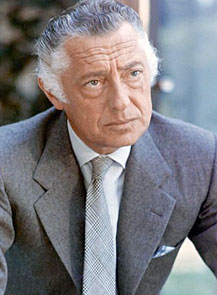
Gianni Agnelli

BTG might repeat the offering later in 2012.  As reported by the FT, the deal prospectus showed a “meritocratic partnership” for senior executives to sustain leadership as the transition to public markets occurs.  Partners according to the FT cannot sell shares in the public markets (they can, however, trade with each other at book value).

Group investors for the stake sold in late 2010 also included high profile names such as SWFs in Singapore, China and Abu Dhabi, who are expected to hold on to their positions.

All of this is excellent PR for both Brazil and BTG Pactual.

For a more in-depth analysis on Latin America and Brazil, including historical assets and cash flows by asset class, manager and product, please refer to my State of the Industry Latin America book or Strategic Insight’s Latin America cash flow database.

Go hard or go home.

Posted in asia, Brand, Brazil, cash flows, Chile, consulting, Enskat, LatAm, Latin America, management, wealth management | Tagged , , , , , , , , , , , , , , , , , , | 1 Comment

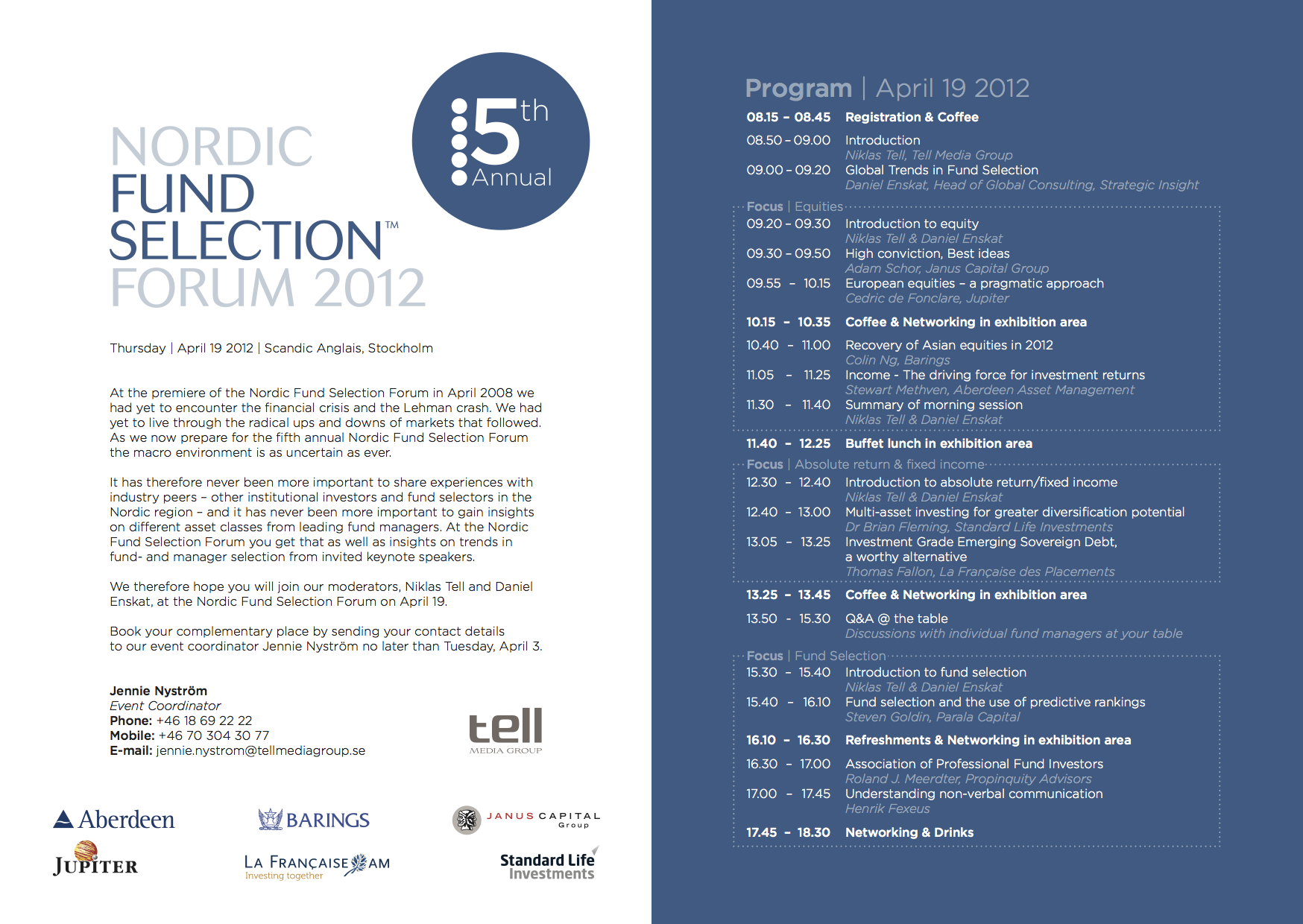
Keynote speech at Nordic Fund Selection Forum 2012 – Stockholm, Sweden

After the huge investor education event at Bocconi University in Milan – 10,000 people in three days, I left for Stockholm at night for the Nordic Fund Selection Forum.  As I wrote in a recent blog, the Nordics have been a hidden gem for asset managers in the last five years from a net cash flow perspective, and firms such as T Rowe Price successfully made the region their gateway into Europe and Asia.

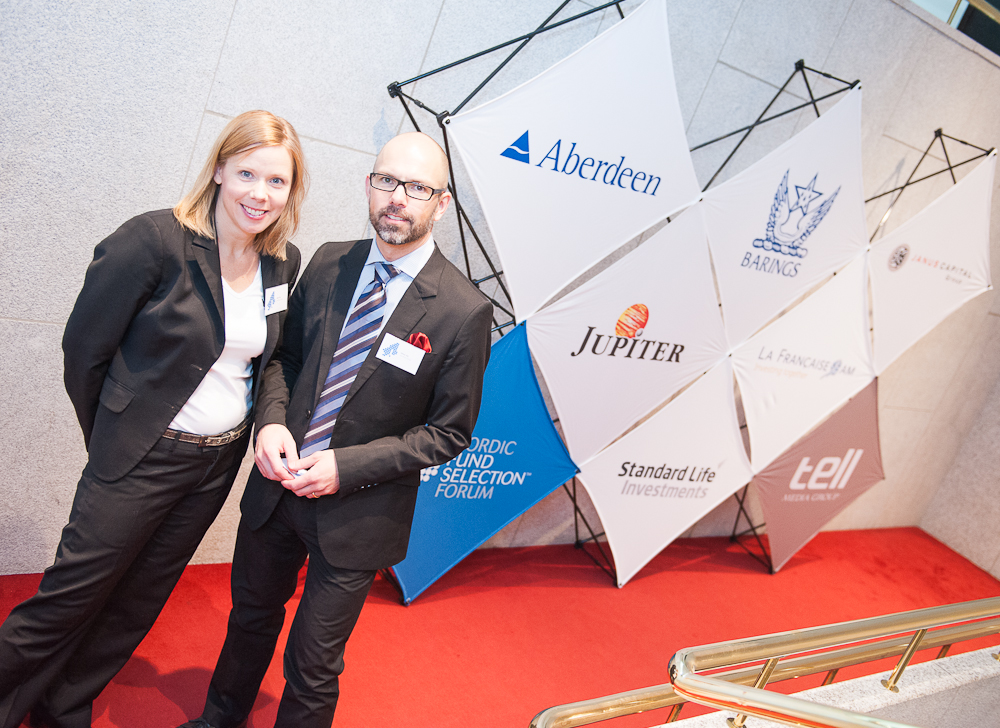
Malin & Niklas Tell - NFSF 2012 (c) Tell Media Group/Erik Björkelund

Tell Media Group’s NFSF draws a wide range of professional fund buyers as well as leading international asset managers.   Some 50 fund selectors represented individual countries and the region, including insurers, asset managers, pension funds, FOFs, wealth managers and more.

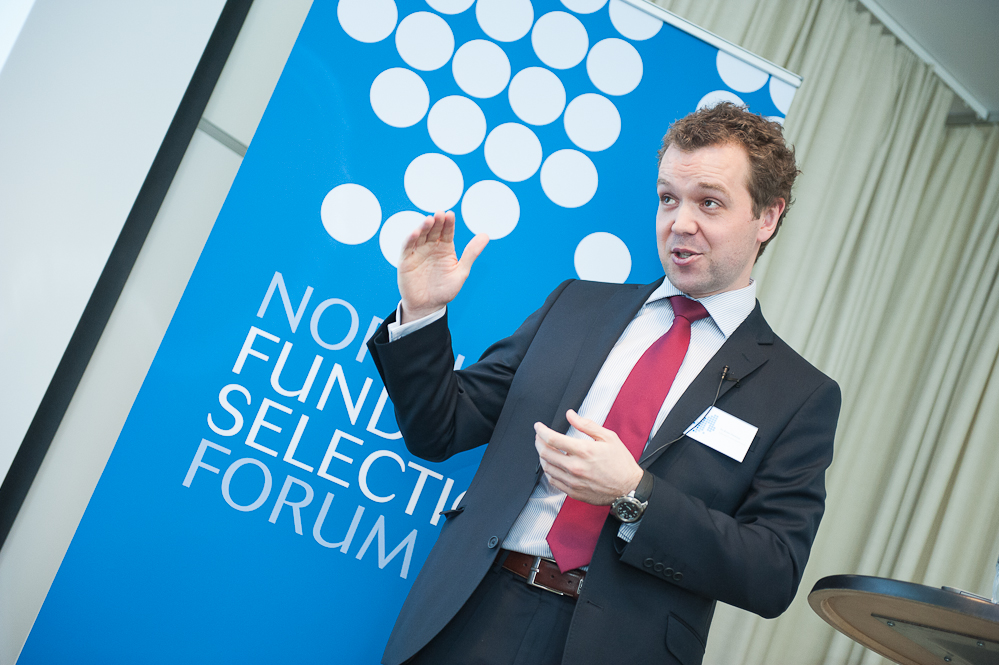
This being the fifth installment of the event, it was cause for celebration and I was honored to be invited as the keynote speaker on global trends in fund selection (drawing from AI/SI proprietary research and advisory work with some 1,200 key asset holders worldwide since 2008), as well as to co-chair the day with Niklas Tell.

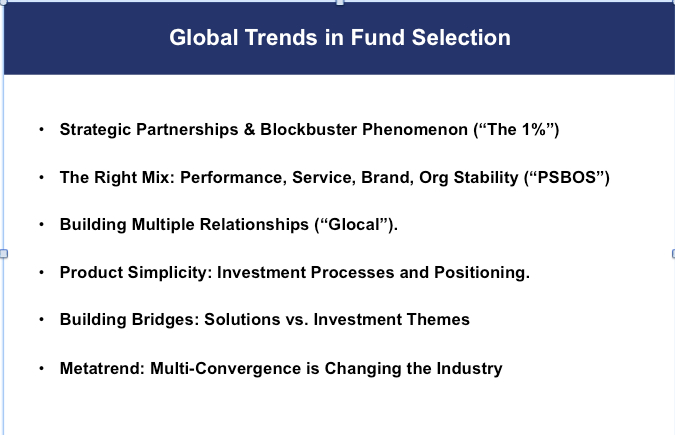
Setting the theme for the day, my opening speech focused on five core themes for global fund selection (plus multi-convergence as a metatrend):

"Global Trends in Fund Selection" - Enskat; (c) Tell Media Group/Erik Björkelund

An equity centric industry, but will flows come back?

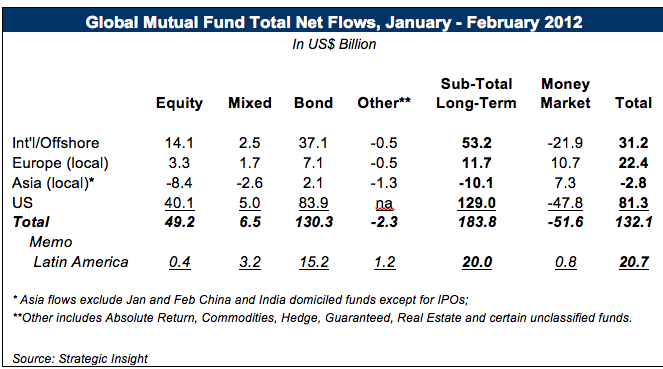
Then we went straight to the equity discussion.  After disappointing numbers for 2011, long-term cash flows for January and February 2012 combined already exceed $200 billion, with $60 billion of that total to equity products.

As outlined in Strategic Insight’s latest report, “Global Fund Review Q1 2012 – Recovering, with High Yield and Emerging Markets”, most cash flows year-to-date have gone to the US and emerging market themes.

Blockbuster product themes in our database year-to-date 2012 include equity income
(M&G Global Dividend, collecting $1 billion), Asia stocks (Templeton, Newton,
BNY Mellon), global diversified and thematic (Morgan Stanley Global Brands), and
asset allocation (Invesco Balanced Risk Allocation).

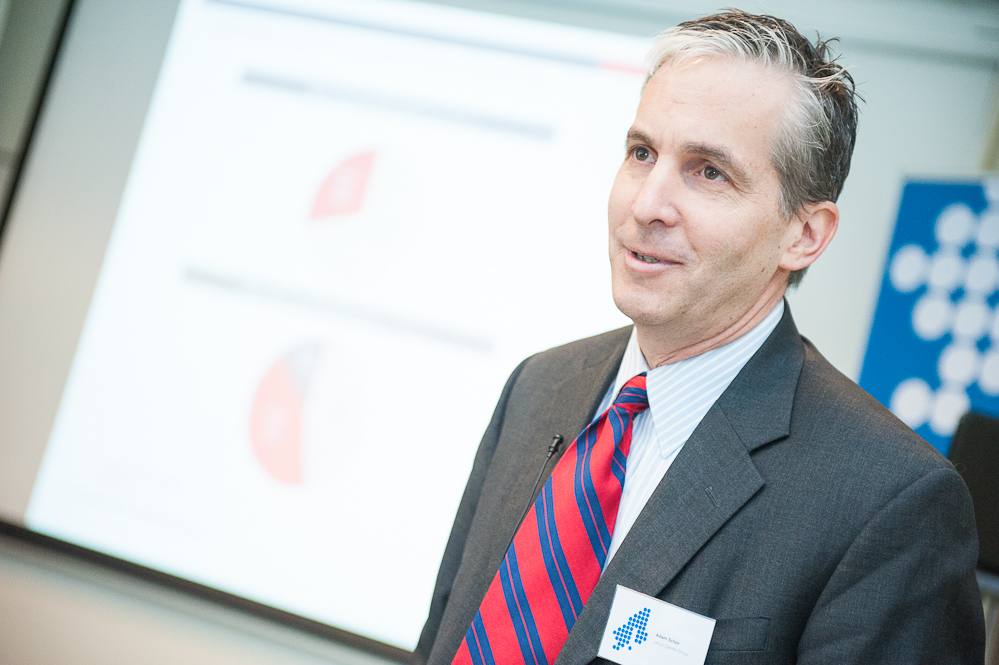
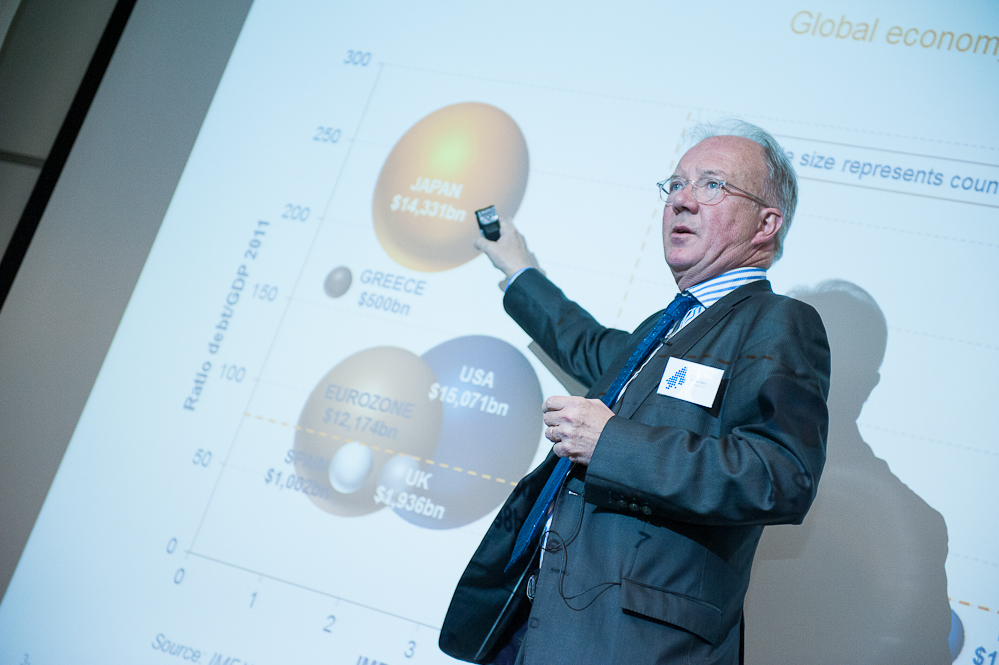
Janus’ Adam Schor (Director of Global Equity Strategies) started off the asset manager views with “high conviction, best ideas” and an overview of the Janus approach and opportunities in the global equity space.  One of his key themes was home country bias, which is an important industry theme globally.

Adam Schor, Janus - NFSF 2012 (c) Tell Media Group/Erik Björkelund

For Jupiter, Cedric de Fonclare (recipient of the Morningstar European Fund Manager 2011 Award) looked at European equities.  His focus was on the portfolio construction and global investment themes represented in his sector and country allocations, including Emerging Markets, Demographics, Globalization, Outsourcing, or Energy Efficiency.

Cedric de Fonclare, Jupiter - NFSF 2012 (c) Tell Media Group/Erik Björkelund

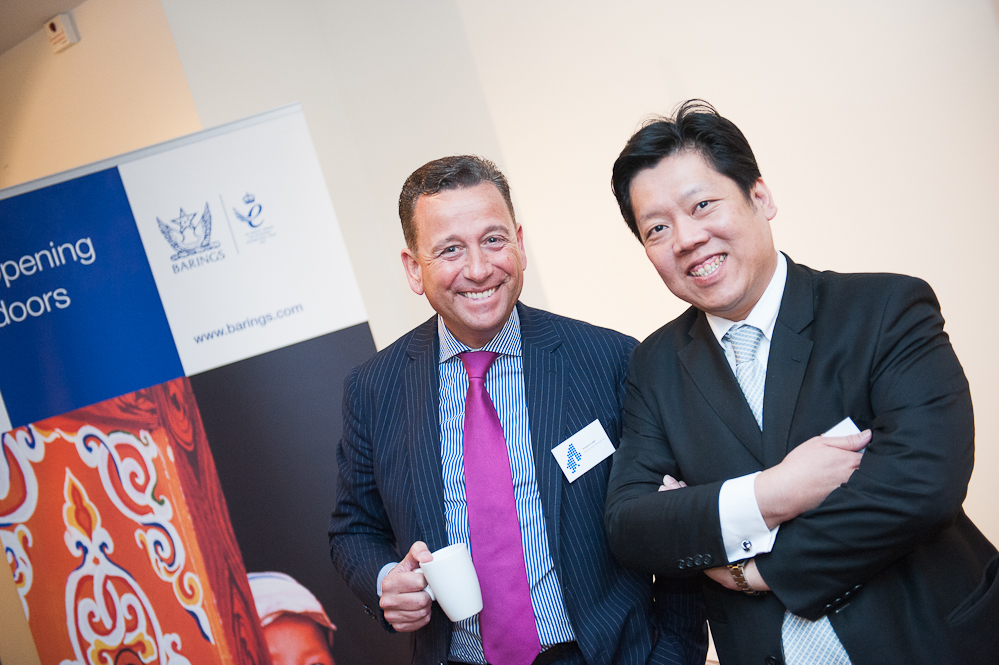
Asia followed, with Colin Ng (Head of Asian equities) explaining the Asia and ASEAN equity opportunities for Baring Asset Management. His focus was on current valuations versus the long-term history of the region, along with key themes such as asset allocation, key macro risks in Asia and the benefits of bottom up stock selection.
Howard Luder & Colin Ng, Barings - NFSF 2012 (c) Tell Media Group/Erik Björkelund

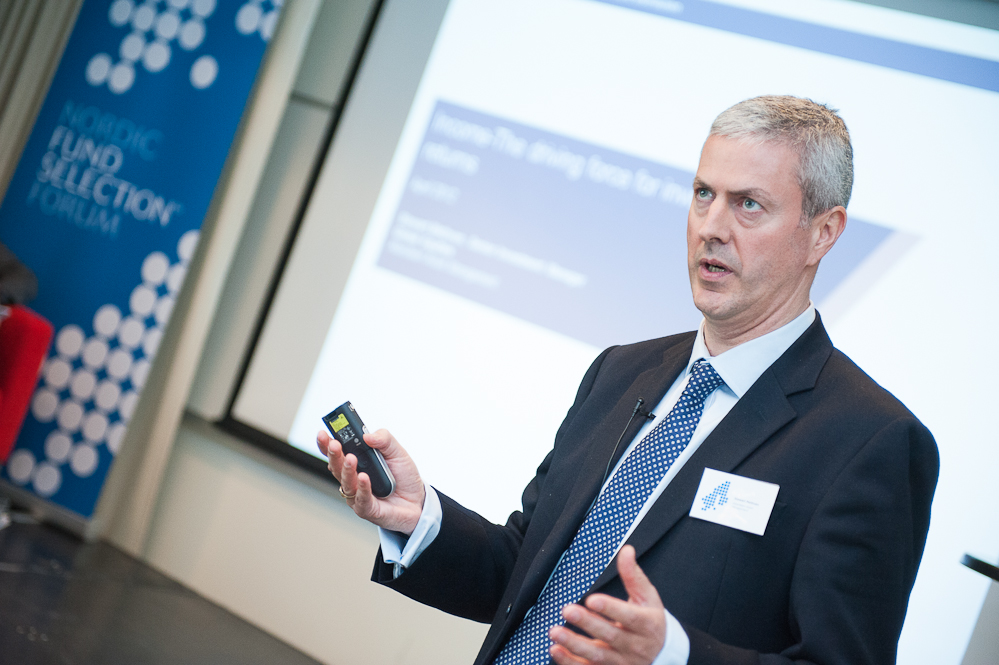
Concluding the morning sessions was Stewart Methven (Senior Investment Manager, Global Equities) for Aberdeen Asset Management, with an in-depth look at “income – the driving force for investment returns”.  Stewart broke down the importance of dividends in the current market environment and how to achieve dividend growth from an international portfolio of global equities.

Stewart Methven, Aberdeen - NFSF 2012 (c) Tell Media Group/Erik Björkelund

The early afternoon was dedicated to fixed-income and absolute return.  Bond fund flows have dominated the industry globally post-crisis, and managers such as Blackrock, Franklin Templeton, PIMCO and others have benefited greatly from strong cash flows.  Especially global bond and total return products have been selling well.  Moreover, absolute return themes, both for institutional and wholesale clients have returned with a vengeance.

Alternative UCITS funds in 2011 collected over $110 billion in cash flows according to Strategic Insight Global databases and alternative assets in the industry stand at 7.5%. One of the blockbusters in the space for 2011 and into 2012 was Standard Life’s Absolute Return bond fund.

Thus, Brian Fleming opened the afternoon with an overview for Standard Life Investments’ view on “multi-asset investing for greater diversification potential.” Brian holds a PhD in Mathematics and is the firm’s Head of Multi-Asset Risk and Structuring.  Multi-asset class investing has been gathering cash flow steam in 2011.  For example, Schroders best selling product last year was a Hong Kong domiciled multi-asset income product that now is being rolled out globally.

Dr. Brian Fleming, Standard Life Investments - NFSF 2012 (c) Tell Media Group/Erik Björkelund

Brian offered an overview of the current state for diversification potential and its implications for investors, especially inasmuch risk models are concerned.

Next up was Thomas Fallon, Head of Emerging Markets for La Francaise AM, with an overview of “investment grade emerging sovereign debt”, an area that has developed greatly in the last decade. Against the backdrop of seismic cultural shifts in the global economy, Thomas showed how EM sovereign debt climbed to investment grade levels.

Thomas Fallon, La Francaise AM - NFSF 2012 (c) Tell Media Group/Erik Björkelund

The next 90 minutes were among the most illuminating for both sides: Each asset manager went from one group of fund selectors to the next for 15 minutes of fund selection speed dating.  The discussion was remarkable both because of its candor as well as for how interactions, pitches and questions changed with each passing round.

Nina Krannila, Thomas Fallon - NFSF 2012 (c) Tell Media Group/Erik Björkelund

Fund Selection questions, themes and topics included:

–       Macro views of the portfolio managers

–       Portfolio details and questions around investment process and product lines

–       Questions on the team and organizational stability

–       Service elements and broad thought leadership

–       Challenges of investor education for fund selectors

–       Provision of choice

–       Partnership potential for specific investment themes and necessary ingredients

–       Changing manager and fund selection processes as asset allocation changes

Fund Selection "Speed Dating" - NFSF 2012 (c) Tell Media Group/Erik Björkelund

We then provided an introduction and a review of specific fund selection methodologies.

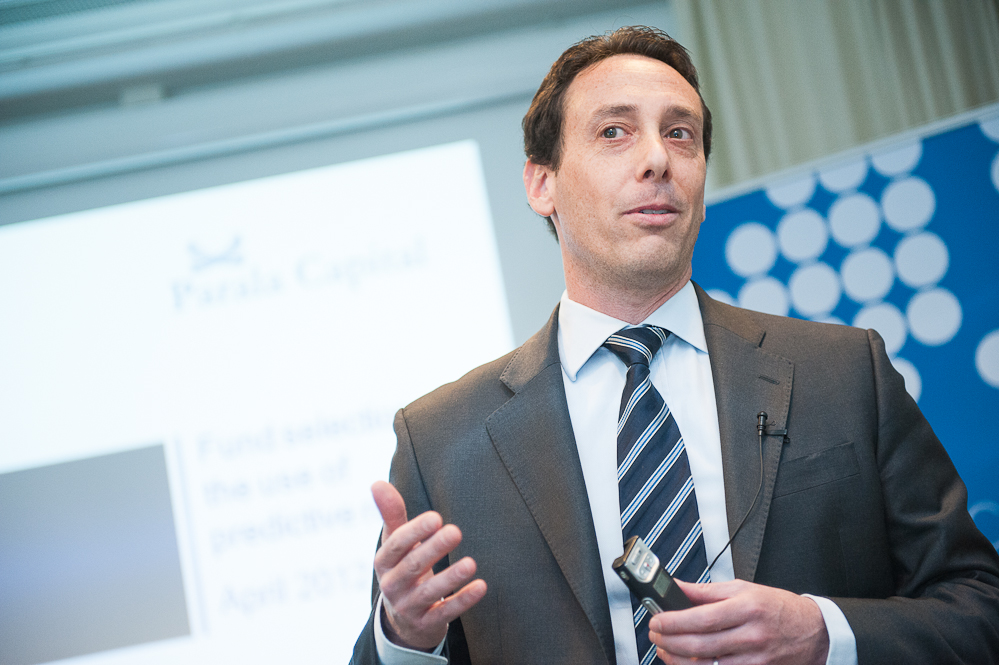
Parala Capital’s Steven Goldin (Founding Member) offered a fascinating overview of predictive rankings in fund selection, bridging the academic world and the necessities of forward looking parameters in the business world with a case study of Legg Mason Global Asset Management and Bill Miller.

Steven Goldin, Parala Capital - NFSF 2012 (c) Tell Media Group/Erik Björkelund

Next up was Roland Meerdter (Propinquity Advisors) with an introduction and invitation to the newly established association of professional fund investors.

The closing session was delivered by Henrik Fexeus.  Henrik is a Swedish author and television personality, and he broke down the basic elements of non-verbal communication, and how it can be improved upon in the context of fund and manager selection.

Roland Meerdter, Propinquity Advisors - NFSF 2012 (c) Tell Media Group/Erik Björkelund

As we have commented on in our research over the last few years, Scandinavia both for fund selection and SWFs has been on the forefront of many leading global processes (SRI, multi-manager, external asset managers, et al).

Henrik Fexeus - NFSF 2012 (c) Tell Media Group/Erik Björkelund

Furthermore, while Europe in the last five years had a difficult time from an aggregate cash flow perspective (and aggregate net redemptions), the Nordics have been in strong positive inflows.  The NFSF provided an in-depth look at what fund selectors are looking for today, in general and specifically for the Nordics, while also offering networking opportunities for fund selectors and asset managers.

Andreas Pfunder, Strategic Insight - NFSF 2012 (c) Tell Media Group/Erik Björkelund

I unfortunately had to leave beautiful Stockholm the next day for Beijing and Hong Kong, but Sweden reminded me to pencil in a return visit later this year.  A special thank you to the Tell Media Group team, especially Erik for his great art work.

Below are a few pictures from the event. For the full coverage of Erik’s art work, click here.

Selected Pictures NFSF 2012 (c) Tell Media Group/Erik Björkelund

Posted in Brand, consulting, distribution, Enskat, information delivery, management, nordics, pension funds, private banking, professional fund buyers, wealth management | Tagged , , , , , , , , , , , , , , , , , , , , , , , , , , , , , , , , , , , , , , , , , , | 1 Comment

Keynote speech and CEO panel on “Trends in Global Asset Management” – Il Salone del Risparmio 2012

After a short overnight flight from New York to Milan, I met up with Strategic Insight’s Europe MD Andreas Pfunder for lunch near Bocconi to go over two days of meetings in Milan and Stockholm. 

The Salone del Risparmio, hosted by Assogestioni, is now in its third year and growing fast.  Held at Bocconi University’s Grafton Building, the three-day investor event draws some 10,000 people and features stands and educational initiatives from all major domestic and international asset managers active in the Italian asset management business.

The Corriere della Sierra dedicates a special section of its paper entirely to the event and the combination of Bocconi’s academic clout, Assogestioni’s role in the industry for Italy and Europe, and all top firms represented for three full days in the heart of Milan makes the Salone one of the premier events in Europe.

Additional sponsors and participants include a number of local, national and international radio and television stations and government entities, e.g. Google, CNBC, RAI, Borsa Italiana, and many more.  The Salone also features a financial art exhibition.

Take a look on the left.

As mentioned in a blog last week, I was honored to be invited to give the keynote speech on global asset management trends, followed by a CEO panel moderated by Fabio Galli (Director General of Assogestioni) with distinguished Italian leaders Sergio Albarelli (Franklin Templeton), Sandro Pierri (Pioneer) and Vittorio Gaudio (Mediolanum).

To our surprise the lecture hall was filled to capacity prior to the official start and ended up with standing room only in the back and the audience sitting on the stairs on the side.

We had a great interactive discussion with the audience and the 75 minutes were decidedly too short.

CEO Panel - Enskat - Albarelli - Galli - Gaudio - Pierri - Salone del Risparmio 2012

Among the main topics covered:

– Flow compression for the fund industry in 2011, Comeback in 2012? Net cash flows to long-term funds worldwide reached $200 billion, down 80% from 2010 and 2009. Inflows in the US, Asia, and Latin America contrasted with outflows from Europe. However, January and February 2012 combined already saw $200 billion in new cash, with $60 billion to equities.

– Blockbuster phenomenon – $1 trillion to the 1%: The top 1% of products gathered $1 trillion in flows, including small and large firms, different global regions and a variety of themes. Common denominator was a mix of performance, service, brand and organizational stability.

– An equity centric global fund industry refocuses in 2012: While fixed income has dominated flow statistics in recent years, the fund industry from an asset perspective evolves around equities. Globally, 51% of all global fund assets are in equity/mixed funds.

– Towards investment solutions and ‘bridges’: Themes and simplicity still dominate the product landscape, but institutions and distributors are shifting towards ‘bridge’ products. Investment solutions and wrappers are approaching $4 trillion in assets, with $110 billion in 2011 cash flows.

– Alternatives (again) on the rise: After a move back-to-basics post 2008, alternative. absolute return products have accelerated exponentially. Alternative funds in 2011 combined gathered $100 billion in net new money and approach 7.5% of global fund assets.

– Multi-convergence in the asset management industry: Blurring lines of demarcation between traditional & alternative products; West & East and East & West trends; retail vs. inst’l demands; local vs. global regulation. These metatrends represent an inflection point for the industry from an era of self‐directed performance driven investing seen as fun, to an era of advisory‐ based investing around managing complexity and volatility.

– Guidance, advice and protection for 2012: Our proprietary surveys show investors more than ever seek guidance, advice and protection, with leading concerns in 2012 around portfolio diversification, volatility, income and inflation. For 2012, we see a recovery of long-term flows ($200 billion already in Jan/Feb); a gradual pick up of equity demand ($60 billion ytd), a comeback of retail investors; continued opportunities for independent asset managers; and sustained flows to alternatives and investment solution; all of which concentrated to the 1%.

Below is a slide show for both the panel and the Salone del Risparmio at large.

Bocconi University - Salone del Risparmio; CEO panel

Stay tuned for a more in-depth research paper featuring the full CEO panel as well as a short summary video of the event.

Enskat - Galli - Pfunder

Posted in Uncategorized | Tagged , , , , , , , , , , , , , , , , , , , , , , , , , , , , , , , | 2 Comments

Global Custodian Video Interview: Rethinking the Mutual Fund

A recent interview with Global Custodian on key trends in the asset management industry:

Posted in Uncategorized | Tagged , , , , , , , , , , , , , , , , , , , , , , | Leave a comment

Latin America in Asset Management – Quantifying the Opportunities for Brazil and the region

As I wrote in a recent M&A update on Brazil/LatAm, Brazil takes the lead: Net cash flows, M&A, Joint Ventures and Latin America Opportunities, Latin America as a region is gaining momentum for the global asset management industry.

DSE Brazil Keynote

Specifically, we see:

Increasing partnerships between Asia and Latin America, both from an investment and distribution perspective.

– A sustained competitive advantage for the US to expand in Latin America, including time zone proximity, brand and business models.

Notable HNW and Ultra-HNW opportunities for NRI centers in Miami or NY, but also in Europe (Spain, Portugal, Switzerland, Lux et al).

– Strong M&A activity to get access to local clients and offshore distribution.

The anecdotal evidence is powerful and pervasive.  However, without consistent and reliable data it is hard to quantify the size of the opportunity. Asset International/Strategic Insight’s teams have worked tirelessly to provide clients with access to such data, and now it is ready.

Below is a first glimpse of our Latin America database, part of the global databases offered by AI/SI.

Asset International - Strategic Insight Simfund Dash Latin America

The upward momentum for the key markets we track  – including Brazil, Mexico, Chile, Peru, Argentina – both from an asset and flow perspective is convincing. For the first two months of 2012, Latin America has added $20 billion in net cash contributions, mostly to fixed income vehicles, but with positive cash inflows across all asset classes. From a total global cash flow perspective, this translates into 15%.

AI/SI Simfund Global Dash - Latin America

The positive numbers from Latin America are strongly contributing to the revenues and profits for traditional US managers as well.

For example, Principal Group’s CEO Larry Zimpleman in a recent video interview with II stated that the group soon will see 25% of their earnings from outside of the US, with a focus on specifically Brazil and China.  Principal a few weeks ago announced the acquisition of Claritas in Brazil to expand its existing business in Latin America.

More details can be found in my recent book, State of the Industry – Latin America, written with the help of SI analysts Lise Carpenter, Bryan Liu and Marlon Valle.

Moreover, below are thoughts from leading Brazilian firms on the industry: Interviews in Sao Paulo, Brazil, on the Latin America Asset Management Industry.

Posted in Uncategorized | Tagged , , , , , , , , , , , , , , , , , , , , , | 3 Comments

Fund Forum Asia Interview with Alan Harden, Hong Kong 2012: The Importance of Brand in Asset Mgmt

After the speeches in Milan (Salone del Risparmio, Bocconi University) and Stockholm (Nordic Fund Selection Forum) next week, I am finally back in Hong Kong, to meet with clients and to conduct the “Fund Forum Asia Interview – Brand vs. Boutique“, with Alan J Harden, the Asia-Pacific CEO for BNY Mellon.

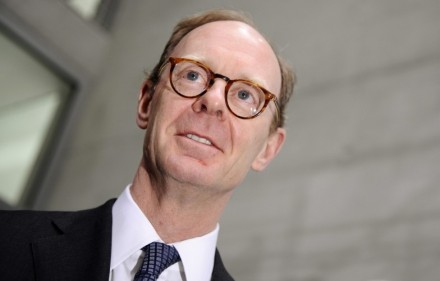
Alan J Harden, CEO Asia-Pacific BNY Mellon

Alan of course is a leader of the asset management industry in Asia. He decided to run BNY Mellon’s business in Asia Pacific after Asia CEO roles for ING, Alliance Trust and Citi.

BNY Mellon has been active in the Asia-Pacific region for five decades with 16 offices in 12 countries. We will discuss, among other things, whether there “is space for niche players in a brand-conscious market”?  BNY Mellon’s AUM globally were up by 8%, to $1.26 trillion – reflecting a 130% increase in net AUM flows for 2011.  The firm now has  a focus on optimizing the multi-boutique model by building out investment, distribution and infrastructure capabilities, particularly in Asia Pacific. Alan will be instrumental for the firm to build out both the retail and institutional business.

Based on Asset International/Strategic Insight proprietary research and surveys with asset holders in Asia-Pacific and worldwide, brand post-crisis has become a key decision criterion for them to choose managers and investment products.  As discussed in my 2011 book on manager and fund selection processes of global asset holders post-crisis, the right mix of investment performance, brand, service and organizational stability has enabled blockbuster firms to collect $1 trillion in net cash flows each year from 2009 through 2011.

Top cash flow firms that benefited from a powerful brand with institutional and wholesale clients in 2011 included large and small firms, including Blackrock, PIMCO, Franklin Templeton, Investec, Value Partners, Schroders, and others.  Please review David & Goliath in Asset Management … Star vs. Team Approach for details.

Last year I had the pleasure of interviewing Dr. Michael Hasenstab on the success of Franklin Templeton’s global bond fund and the business overall.

Interview Fund Forum Asia - Hasenstab / Enskat

One differentiating factor for the firm has been the use of global campaigns around key investment themes, e.g. “2020 Vision for Equities”, “Global is the new core”, “the case for yields”, and most recently, a global investor sentiment survey.  Investec on its website features a concise video overview of the firm’s key investment themes and senior managers, narrated by its CEO, Hendrik du Toit.  PIMCO of course with Bill Gross and Mohamed El-Erian has changed the way the industry speaks, with its “new normal”.

For a few more details on specific firms, please review Content, speed AND style of the message: The Secrets of Success for Franklin Templeton and Pimco/Allianz.

Building Bridges - Success Factors with Global Key Asset Holders

Of course, my 2011 book on “The Seven Secrets of Distribution” also features many case studies for specific firms, and specifically examines the importance of brand – here is a webcast and exexcutive summary of the book.

Seven Secrets of Distribution

All of this should make for a fascinating exchange with Alan in Hong Kong later this month.  Please send me your questions ahead of time and we will include them.

#NewNormalofBrandinAssetManagement.

Posted in Uncategorized | Tagged , , , , , , , , , , , , , , , , , , , , , , , , , , | Leave a comment

Brazil and the US… Politics as unusual

Interesting article in the NYT today… Obama met with Dilma Rousseff yesterday over lunch. 
image

What apparently stood out most to the media was the fact that it was lunch, instead of a state dinner. The UK, India and South Korea got a dinner date, so Brazil apparently was downgraded and is not seen yet as a global power.

Secondly, their eyes rarely met during the press conference. Really?

The US needs to do better with the premier BRIC member, if only to preserve the natural competitive advantage of physical proximity and time zone (on top of the appeal of US brands).

A few things to consider while the US learns to look into Brazilian women’s eyes when talking with them.

– Brazil is LatAm’s powerhouse. China knows that very well.

– Latin UHNW investors are spending lots of money in the US, especially with the strong Real. Bom dia, Miami.

– World cup, Olympics, oil.

– The US briefly surpassed China as Brazil’s top export market.

So, US, put a trade agreement in place and book a room at the Fasano to walk around Oscar Freire at night to get the full picture, Instagram style.

And while you are at it, support the UN bid.

Boa noite.

Posted in Uncategorized | Tagged | Leave a comment

Opening speech on Global Trends in Fund Selection – 5th Nordic Fund Selection Forum, Stockholm 2012

After Wednesday’s speech and panel at Milan’s Bocconi University for the “Salone del Risparmio”,  it is off to Stockholm for the 5th Nordic Fund Selection Forum 2012 on April 19th, for the opening speech on global trends in fund selection (drawing from AI/SI proprietary research and advisory work with some 1,200 key asset holders worldwide since 2008).

For the rest of the day, moderating with Niklas Tell, the discussion will incorporate investment themes, asset classes and selection criteria.

The equity discussion focus is on high conviction, Europe, Asia and income provision with expert contributions from Janus, Jupiter, Barings, and Aberdeen.

After equities the focus shifts to fixed-income and absolute return.  The multi-asset discussion will be presented by Standard Life (who in 2011 had one of the best selling absolute return funds worldwide from a cash flow perspective), and investment grade emerging sovereign debt by La Francaise des placements.

Last but not least is a review fund selection methodologies.  Parala Capital will provide an overview of predictive rankings in fund selection, followed by a review of FSU associations by Roland Meerdter, who a few years back founded Propinquity Advisors.  The closing session is on non-verbal communication.

Scandinavia both for fund selection and SWFs has been on the forefront of many leading global processes (SRI, multi-manager, external asset managers, et al). Interestingly, while Europe in the last five years had a difficult time from an aggregate cash flow perspective (and aggregate net redemptions), the Nordics have been in strong positive inflows.

T Rowe Price‘s success years ago of building the Europe business via the Nordics, implemented by President Todd Ruppert, has caught on.  Now many international fund managers are focusing on the region for their FSU approaches, wholesale, institutional and SWF businesses, making the region a gatekeeper in its own right.

My discussion with Todd at the Monaco Fund Forum in 2008 focused both on the firm’s success specifically as well as broader European trends.

Can’t wait to be back in Stockholm to discuss the latest developments.

Posted in Uncategorized | Tagged , , , , , , , , , , , , , , , , , , , , , , , , , , , , , , , , , | 2 Comments