
I wish I could hold this longer…

I wish I could hold this longer…
Last weekend I tore my ligaments and broke my ankle in a post workout accident. The silver lining is that this leaves me with more time to get work done, and experiment with new ways to elevate the foot.
Day three of RICE: Lat Flys – gotta open up that shoulder girdle.
After missing out on Sarasin to Brazil’s Safra group (more details: Emerging Market M&A), Julius Baer snatched up Merrill’s private banking business. Buying Merrill’s ex-US wealth management business will increase assets under management for key emerging regions including Asia, LatAm and the Middle East.

Julius Baer has strongly focused on building EM links and relationships, especially in Asia (more details: Asia Asset Management Trends). The firm refers to Singapore as its “second domestic market”.

JB last month struck a deal with BOC on client and investment referrals. As a result of the Merrill acquisition, half of Baer’s business will now be in emerging markets, up from a third, indicating a shift from developed to emerging.
I commented on this metatrend of “Multi-convergence” in many studies in the last few years: increasingly blurry lines of demarcation between developed and emerging (regions), retail and institutional (distribution channels), traditional and alternatives (product), and global/local regulation.
Capgemini with RBC (not Merrill any more) in its annual World Wealth Report noted that in 2011 Asia-Pacific for the first time in history had the highest number of wealthy investors, ahead of North America.
Collardi noted as much by pointing out that the deal with add a new growth dimension not only to growth markets, but also to Europe…. #EMbridges
Last weekend I tore my ligaments and broke my ankle in a post workout accident. The silver lining is that this leaves me with more time to get work done, and experiment with new ways to elevate the foot.
Day two of RICE: handstand wall runs… Olympic gymnasts apparently can do this for 10 minute… A long way to go.
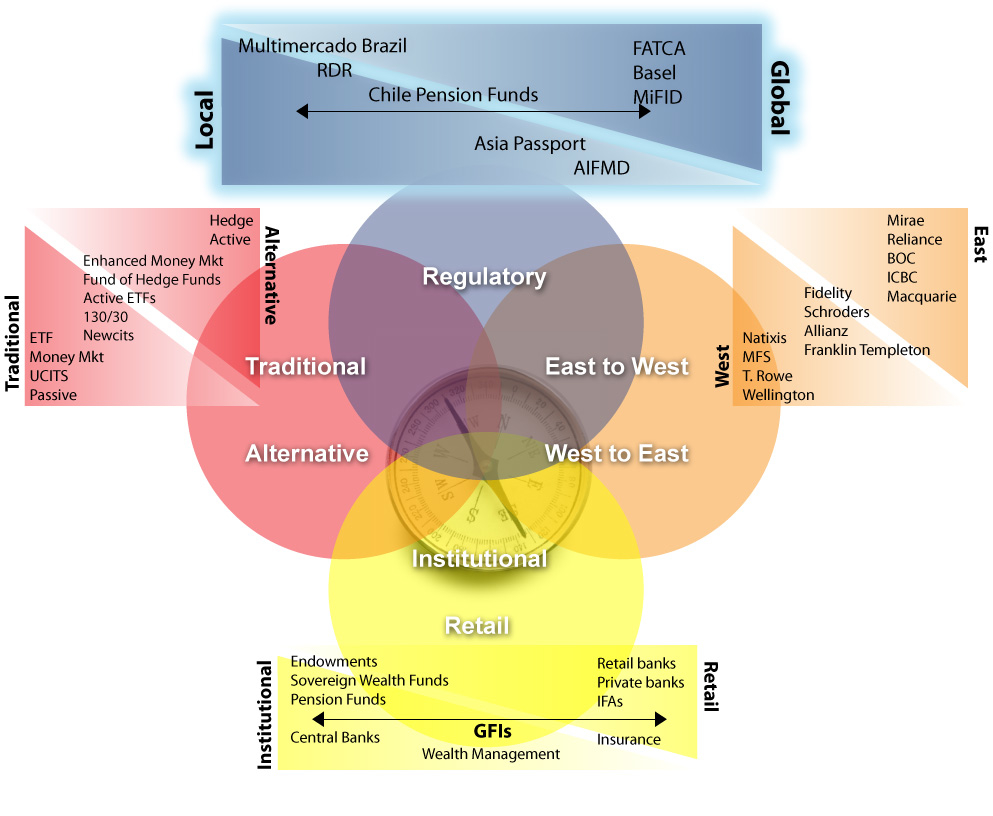
For the last few years, the global asset management industry has seen increasingly blurry lines of demarcation in key business areas previously treated as silos.
– On the product side, alternatives and traditional investments have been converging, both for individual investors and institutions;
– Geographically, competition between fast growing/emerging and developed markets has altered the competitive landscape;
– In distribution, the convergence of retail and institutional approaches with global financial institutions as powerful hybrids and gateways to either channel is creating an inflection point for the industry, impacting business models and brands.
– Lastly, we see a growing connectivity and impact of local and global regulation, enabling some firms to corner markets, while overall raising the operational costs for the global investment management industry.
Each of these metatrends alone is creating greater complexities for fund managers and how they grow their business – in combination, they represent an inflection point for the industry from an era of self-directed performance driven investing seen as fun, to an era of advisory-based investing around managing complexity and volatility, while preserving capital and providing stability and income.
I dubbed those four metatrends “multi-convergence” (MC), visually depicted above. Beyond the quantitative evidence of those trends from Strategic Insight’s global databases, over a thousand interviews and surveys with asset holders worldwide post-crisis reinforced the acceleration of MC.
Regulation in the spotlight for global asset management
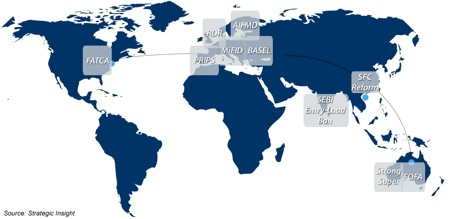
Regulatory changes in particular have been in the spotlight in recent years, and CEOs worldwide are seeing over-regulation as the key impediment to industry recovery and growth. And indeed, a cursory look around the world shows a variety of scandals and subsequent regulatory initiatives, e.g.:
– Hong Kong: accumulator and Lehman minibond scandals shift the balance between offshore and onshore vehicles; regulation fundamentally changes local sales practices;
– Chile: regulators following the local La Polar scandal disapprove Dublin UCITS in pension funds, shaking up a 30-year offshore fund business;
– India: SEBI in 2009 bans front-end load fees and over night changes the dynamics and business models for asset managers in the country;
– UK: wide ranging overhaul of the local fund industry with implementation of the retail distribution review (RDR);
– US: Fatca as part of the IRS’ efforts to crack down on tax evasion is costing investment managers huge amounts of money globally;
– Australia: waiting on the outcome of Future of Financial Advice (FOFA) and Stronger Super reforms;
– Europe: a mix of regulatory efforts including UCITS, AIFMD, PRIPS, Mifid, Basel, and more, is impacting both the region and the global cross-border business.
Strategic Insight has commented on these development in detail across numerous reports, books and case studies. Among them:
– Australia’s Fund Managers Look To The Future, analyzing Australia’s two major reforms;
– Building Bridges: Views from the leading regional institutions and distributors on how to build a successful Asia Pacific asset management business, focusing on distribution in different markets in Asia;
– State of the Asset Management Industry: Latin America, covering opportunities and developments in major Latin America markets along with Chile’s regulatory efforts and Brazil’s multi-mercado hedge fund business as case studies;
– Quo Vadis UCITS? The 25th Anniversary of an Increasingly Global Brand, an opinion piece co-written with former EFAMA president Jean-Baptiste de Franssu.

I also had the pleasure to be part of a CEPS (Center for European Policy Studies) task force chaired by J-B de Franssu in 2011. The task force published a 200+ page paper, Rethinking Asset Management: From Financial Stability to Investor Protection and Economic Growth, authored by Mirzha de Manuel and Karel Lannoo.

AI/SI CEO Dinner London
Last month, I was able to catch up with de Franssu at AI/SI’s CEO dinner in London, where our conversation largely focused on investor protection.
Highlighted below are some of de Franssu’s important thoughts on investor protection in Europe and how to address the regulatory challenges for the industry:

J-B de Franssu, Chairman Incipit
Investor protection has been the rallying call of regulators and policymakers since the financial crisis took hold. Failure to strengthen protection for investors will hamper economic growth dramatically, but so far most initiatives have missed the mark. In taking an approach mainly based on prudential regulation, and without fixing the day-to-day practical inefficiencies of the saving products market, the regulators and legislators risk addressing only part of the issue, and, worse, confusing the investors it is trying to protect.
In Europe, the Commission is drafting a set of regulations around investor protection.
Some, such as MiFID II, are advanced; others, however, are in an early stage, such as legislation relating to Packaged Retail Investment Products (PRIPs) and the Insurance Mediation Directive (IMD). We are told these different initiatives should take a harmonized view of relationships between providers, distributors, advisors and investors, to give investors the right balance of protection.
The reality is that the initiative overall has adopted a protracted piecemeal approach. Thus, for the foreseeable future protection and transparency rules will vary depending on both the product and the distribution channel an investor chooses. This patchwork structure will encourage regulatory arbitrage: the most transparent channels and products will be the most disadvantaged. This is hardly in line with fair competition ideals.
So what is the alternative?
The MiFID II proposals seek to address investor protection issues for some financial instruments by supplementing the existing regulatory framework of MiFID I. But current MiFID I already includes provisions which could significantly improve investor protection.
Sadly, these are not uniformly enforced across the EU and apply only to MiFID regulated products. Before establishing additional regulations, it would make sense to implement MiFID’s existing provisions effectively, especially when we are told that drafting new regulations is consuming Commission resources.
Additionally, more must be done to improve the relationship between investors and their advisors and providers. The Commission has focused on disclosure and inducements in MiFID II. It should take a broader approach embracing the definition of advice (and of independence), sales force training and qualification, and the product launch process.
When it comes to inducements, a full ban may not be the most efficient approach. Rather, hard disclosure at the point of sale and throughout the duration of the relationship between the product provider and the client may be more appropriate to ensure development of advice and of open architecture, as well as multiple choices for retail investors.
These ideas also need to extend into PRIPs to identify all products that should be regulated, as well as their distribution mechanisms, to ensure a level playing field.
Ultimately investors should be able to choose the product, advice model and cost structure that suits them best.
To do this they need to understand the options available, the product risk/reward profiles, and their potential outcomes.
Some retail investors might view derivatives with a negative connotation, but when used correctly they can deliver good results. They must, however, be explained and sold in a way that is transparent and competitive.
This new regulatory framework should also focus on governance standards for all PRIPs providers, to ensure best practice in product design, supervision, marketing and distribution across the single market.
All financial advisors, distributors and intermediaries should also be qualified to sell PRIPs via a Europe-wide certification regime. This, together with common disclosure standards (which must cover the total cost of investment), is fundamental to encourage investors to come back into the market. In the long-term, financial education is essential because no regulation can adequately address retail investors’ lack of knowledge.
We need investors to fund growth projects that bring benefits to the real economy and to secure their own long-term financial future.
Yet, the regulatory framework being devised today will neither bring investors back, nor adequately protect those that do return. Indeed, it risks adding costs through an overly complex set of mismatched rules that are limited to a few narrow initiatives.
Moreover, failing to act now is generating uncoordinated initiatives by individual European member states. The best example is the Retail Distribution Review in the UK as well as its equivalent in the Netherlands. So a dialogue with all relevant stakeholders to put forward proposals to align the regulation of financial instruments and insurance products must be enabled.
It would be refreshing to see the views of pan-European policymakers, regulators, PRIP providers, distributors and investor associations coalesce into a single investor protection blueprint. The resulting regulatory initiatives could go well beyond provisions contained in the current draft of MiFID II, and respond to the long-term need for a level playing field of investor protection that any fully functioning savings market requires.
Such a move would also demonstrate to European citizens that it is Brussels’ ambition to draw lessons from the financial crisis that go beyond addressing systemic risk issues, delivering concrete tangible improvements to their daily lives.
It is an honor for me to be on the board of Igal Perry’s Peridance Contemporary Dance Company. After attending the spring season 2012 last night I can only encourage you to cancel whatever plans you have for next weekend to make sure you catch PCDC on either May 12 or May 13 for one of their last evening performances at the Salvatore Capezio Theater, organized by executive director Yarden Ronen.

PCDC Spring Season 2012
The evening started with “I am you“, choreographed by Kristin Sudeikis with music by Ani DiFranco and Devotchka, followed by Igal Perry’s “Conflicted Terrain“, to ‘String Quartet No. 3’ by Henryk Gorecki.
After a short pause the audience had the pleasure of seeing guest star Manuel Carreno dance to Franz Schubert’s Ave Maria, breathtakingly choreographed by Igal.
Switching moods, the company performed “The Ungathered“, Sidra Bell’s work to a mix of Scanner, Paavoharju, Pan Sonic and ISAN.
The final piece after the admission was Igal Perry’s “El Amor Brujo“, to music by Manuel de Falla and with live Flamenco singer Marija Temo.
Below are Igal’s comments on choreographing “El Amor Brujo”: ‘Falla’s El Amor Brujo, with a libretto by Gregorio Martinez, is a Spanish Gypsy love tale, which revolves around three main characters: Candela, a young Gypsy woman; her lover Carmlo; and the spirit of her dead husband, Jose, which haunts the two lovers but is ultimately exorcised by a Gypsy Ritual Fire Dance.’
Make sure to see the program next weekend – you can get tickets here.
After speeches in Milan (Il Salone del Risparmio) and Stockholm (Nordic Fund Selector Forum), I spent last week in Asia to see clients and present at the Asia Fund Forum in Hong Kong. As usual, I stayed at the Upper House at Pacific Place.
The Upper House continues to take market share from older brand names like the Mandarin or Four Seasons, by offering more space, great service and a much more modern IT framework – not to mention the fantastic view at Cafe Gray for food or drinks (Old vs New In Emerging Markets) – it is a reflection of what the fund industry is seeing for fund and manager selection – an optimal mix of investment performance, client service, organizational stability and brand to stand out in a crowded marketplace where flows are either marginal or reach blockbuster status.
Asset International/Strategic Insight had a booth at the Asia Fund Forum 2012 with our local team for the region, as well as an overview of our various other subsidiaries, among them aiCIO, Global Custodian, and our newest addition, “Philanthropy Management“.
PRE-CONFERENCE DISTRIBUTION & EMERGING MARKET SUMMIT

AI/SI analysts at FF Asia 2012 – A. Siu; B. Liu; L. Carpenter
Monday started out with two summits: Asia Fund Selection & Distribution and Emerging Markets.
My video discussions for Monday were with two leaders in their respective fields – Mussie Kidane (Head of Fund Selection for Pictet in Geneva) and Jaime de la Barra (Founding Partner, Compass Group in Chile).

Kidane/Enskat – Global Trends in Fund Selection
The discussion with Mussie centered on trends in fund selection for private banks and wealth managers, including key selection criteria for manager and fund selection post-crisis.
Pictet is a unique example of global fund selection as it uses a wide range of managers and products in a partnership model to provide practice management and value-added services to its private bankers and wealth managers – with 47 funds by 45 managers in a long-term setup.
Moreover, Mussie has been leading fund selection efforts for well over a decade and thus is able to put many of the pre- and post-crisis trends into perspective. I have written books about global fund distribution since 2004 – the last two books in 2011 were “Building Bridges” and “Seven Secrets of Distribution“.
Enskat – SI: 7 Secrets of Distribution
One of the main changes post-crisis in terms of manager selection methodologies has been around the growing importance of organizational stability and brand, on top of outstanding client service and track records. Stay tuned for the video of our discussion.
The summit started out with two panels on fund selection, with representatives from Citibank, OCBC, Barclays, Bank of Singapore, Hang Seng, and AA Advisors.
Asset International/Strategic Insight in partnership with the Nomura Research Institute recently published a public whitepaper on “Asia Fund Distribution“, to provide an overview of regional and country trends for Asia, along with company and product case studies on who has been winning market share post-crisis.
The afternoon sessions focused on private banking, insurance, and advice models, as well as HNW research and a global view on manager selection. Firms presenting included Vontobel Group, Scorpio, Towers Watson, JP Morgan Private Wealth Management, Fubon Bank, HSBC Insurance, I-Pac Financial, Propinquity, Invesco, UBP Asset Management, and BlueBay.
For the Emerging Market summit, investment and distribution views included Henderson Global Investors, Lloyd George, Silk Invest, An Zhong, Credit Suissa Private Banking, Societe Generale Private Bank, Al Rahji, Kotak Mahindra, and more.
Jaime de la Barra presented a look at the Andean Three vs. Brazil and Mexico to put the region into perspective. My discussion with Jaime naturally focused on the increasing links between Asia and Latin America and how asset managers and distributors can take advantage of it. His firm, Compass, for 25 years has been representing a variety of leading fund managers in Chile and the region.
Importantly, a central theme of the Strategic Insight research on Latin America (both for our new monthly database as well as in my most recent book) is how heavily institutions for example in Chile, Peru and Colombia are invested in Asia and how much it has benefited international fund houses – often via local partnerships.
State of the Industry – Latin America
A good example of the success for these partnerships is the sub-advisory work between Compass and South Africa-based Investec. Investec under CEO Hendrik du Toit has became one of the top cash flow firms for cross-border funds worldwide, with 2011 flows matching much larger firms such as BlackRock, Franklin Templeton, JP Morgan or PIMCO.
MAIN CONFERENCE – DAY ONE: REDEFINING THE ASIAN INVESTMENT MANAGEMENT INDUSTRY

Barra/Enskat – Asia & Latin America
On Tuesday, John Calamos kicked off the main conference with an overview of global investing from 1970 to today.
Then the conference had a selection of panels to discuss the state of the asset management industry in Asia. Shiv Taneja laid out a framework and Steward Aldcroft then led a session on “Asian Asset Management at 20” with Steve Chiu (Bosera), Mark Konyn, and Jack Lin (Pioneer).
Mark Konyn has been a leader in the Asia asset management industry for decades, and most recently was CEO for RCM in the region with a focus on the institutional side of the business. He has written extensively on the region (including a book on investing in Mandarin) and has a regular column in the fund management section of the Financial Times (and today announced his new CEO role for Cathay Conning Asset Management).
My discussion with Mark focused mostly on the big picture for Asia and how the region has been doing in a global context. Moreover, we speculated on how the next decade could look like and how asset managers should position themselves to take advantage of the various growth opportunities (North vs. Southeast Asia, institutional vs.retail, HNW vs. middle class growth, local products vs. cross-border themes, et al). The video will be available soon.

Konyn/Enskat – Asia Institutional Asset Management Trends
The first CEO panel looked at the “Regionalisation of Domestic Asset Management“, with panelists Anthony Ho (China Asset Management), Peng-Wah Choy (Harvest), Gerard Lee (Lion), Charles Wang (E-Fund), and Dr King Lun Au (BOCHK) – moderated by RBC Dexia (Brent Reuter).
Part of the discussion centered on how to approach domestic power centers such as China and how to make the transition from a local fund firm to a regional house – organically or via acquisition.
Gerard Lee was in favor to just go out and buy someone, while the Chinese chief executives were a bit more hesitant from an integration standpoint.
Then the tables turned.
The second CEO panel looked at “the Globalisation of the Asian Investment Management Industry”, with Graham Mason (Eastspring), Oliver Bolitho (GS), Joanna Munro (HSBC), and Arne Lindman (Fidelity).
Main points of discussion included the recent frictions between global cross-border vs. local opportunities in the aftermath of accumulators and minibonds in HK, as well as how to transition from an institutional to a retail driven business. Undeniably, brand has started to play an integral part post-crisis, as asset holders in the region are looking more at the overall brand and name recognition of global asset managers.
Fidelity of course is unique inasmuch as it has built a direct name recognition and brand with end investors in the last 40 years, while for most others the business is dis-intermediated. But even for Goldman Sachs, Oliver highlighted the importance of brand when fund buyers are assessing new investment strategies and asset classes.
MAIN CONFERENCE DAY TWO – UNCOVERING INNOVATION IN THE ASIAN INVESTMENT MANAGEMENT INDUSTRY
After the first morning sessions on the future of the industry in Asia, presented by Navtej Nandra (Head of Morgan Stanley International), and a business model CEO panel with Tony Edwards (Robeco), Erich Gerth (Aviva), Grant Bailey (ING), and Mark Browning (Franklin Templeton), the head of investment funds for the SFC commented on “is regulation stifling the global industry in the long-term”?
Clearly, Alexa Lam sees the relationship between the SFC and the industry as a partnership, but the interplay between global and local vehicles and global and local regulation is becoming a crucial point for the future growth of asset management.
I then had the pleasure of discussing brand with BNY Mellon’s APAC CEO Alan Harden.

Harden Enskat – The Importance of Brand in Asia
Please review the full discussion in a separate blog here, “The Importance of Brand”.
The afternoon continued with a CEO thinktank on product innovation, with Gerry Ng (Barings), Andrew Lo (Invesco), Lennie Lim (Legg Mason), Lieven Debruyne (Schroders), and Ajay Bagga (Deutsche Bank).
Schroders in 2011 had a blockbuster local product in Hong Kong in a distribution partnership with HSBC. Its multi-asset income fund attracted over a billion in net cash flows in some six weeks, and is now rolled out globally – an example of reverse product engineering that could be come more commonplace in the industry should UCITS loose its competitive advantage as an accepted global vehicle and passport.
The final discussion for the day looked at the institutional landscape, with Young Chin (Pyramis), Stephen Roberts (Mercer), Eleanor Wan (BEA Union), and Kevin Hardy (Northern Trust).
Aberdeen Asset Management, one of the boutique investment management firms turned Goliath on the strength of their emerging market and global equity expertise (see the discussion with Alan Harden on Martin Gilbert and Aberdeen), on Wednesday night hosted an amazing wine pairing dinner at the China Club.

China Club HK, Aberdeen
MAIN CONFERENCE – DAY THREE: INVESTMENT & ASSET ALLOCATION IN A VOLATILE ENVIRONMENT
The last day of the conference focused more on the investment and asset allocation elements of financial services.
I was interviewed by Kalpana Fitzpatrick on portfolio construction and asset allocation for Asia/Emerging Market investors compared to Europe and the US. Our research, discussed as “metatrends” in my latest Strategic Insight book ‘State of the Industry’, suggests some $4 trillion in investment solutions worldwide and a growing trend towards fee-based advice and investment wrappers. Favorite themes globally are high yields, multi-assets, and absolute return wrappers.

SOTI 2012

State of the Asian Asset Management Industry
Lastly, my senior research analyst Lise Carpenter interviewed the head of business development for BNP Paribas’ FundQuest. Her focus in the interview was on the role of platforms both for portfolio construction as well as fund selection.

FundQuest / Strategic Insight – L. Carpenter
All in all, some 20-30 meetings with senior executives in Asia and a dozen discussions with Italian and Scandinavian fund buyers ended a busy two-week world tour.
 Warren Enskat Group
You must be logged in to post a comment.