Bill Gross’ damages: US needs to learn from Canada and Mexico

Yesterday, BG published his latest monthly musings, entitled “damages”. Bill discusses the pros and cons of losing his long-term memory, which on the financial side include the new normal, the US as the cleanest dirty shirt, Nemo’s ring of fire – Gross has a knack for creating catchy neologisms.

20121003-140424.jpg

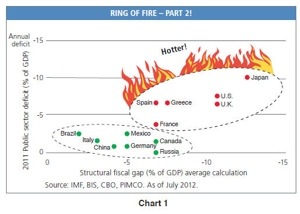
He does not expect Armageddon any time soon, but quoting from the annual reports of the IMF, CBO and BIS (hooray acronyms), he does foresee the US deficit and fiscal gap in bad shape. The institutions suggest spending cuts or tax hikes of 11% of GDP in the next decade, equaling $1.6 trillion per year; nowhere near what is being discussed politically at the moment.

20121003-140511.jpg

Overall, emerging markets in his ring of fire graph look much better than developed markets. As we see multi-convergence take shape worldwide, we are approaching a redefinition of what constitutes developed vs. emerging or fast vs. slow growth.

20121003-140554.jpg

Creating an imaginary bond around US liabilities, he sees it in the range of $16T (outstanding debt) plus $60T more (future liabilities), for a cool total of $76 trillion dollars.

20121003-140632.jpg

As Gross puts it, “IF we continue to close our eyes to existing 8% of GDP deficits, which when including Social Security, Medicaid and Medicare liabilities compose an average estimated 11% annual “fiscal gap,” then we will begin to resemble Greece before the turn of the next decade.”

20121003-140707.jpg

And Greek mythology used to be such a nice metaphor pool. The times are changing.

Worst offenders on budget and fiscal gaps: the U.S., Japan, Greece, the U.K., Spain and France – a “sort of a rogues’ gallery of debtors”.

Those that have budgets and gaps under relative control: Canada, Italy, Brazil, Mexico, China and a host of other developing as opposed to developed countries.

Lesson for the U.S. when it comes to budgets, health care, pensions and more: learn from Canada and Mexico. Ouch.

I invite you to follow me on twitter @danenskat

(c) Enskat Associates 2012

20121003-140842.jpg

Posted in alternatives | Tagged , , , , , , , , , , , , , , , , , , , , | Leave a comment

Metatrend #Emerging-To-Developed: Innovation led by emerging markets

I have written many posts about how much emerging markets are driving product innovation globally. Yes, the US with Google, Apple and Facebook are still on the forefront of new technologies, but we have seen a trend of “reverse engineering” for many years across industries.

As the U.S. sleeps…

Not survival of the fittest, but survival of the most adaptive: case study on transformation & Asia

Global asset management – will the US and Europe be left behind?

20121002-141155.jpg

For example, the new Jaguar F-type that was presented at the Paris Motor Show this week, was met with excitement and might revive the firm’s brand as an innovative classy leader of high-end vehicles. Fun fact: The F-type was being developed when Ford bought the firm in the 1990s, but Ford shut that down.

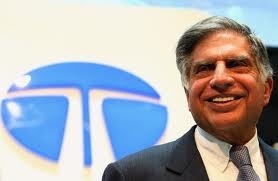
Jaguar of course after a couple of rounds of musical chairs post-2008 was sold by Ford to Tata for some $2.3 billion. Ratan Tata, aside from being a fan, got the Rover and other aspirational brands for emerging markets, as well as building market share in developed markets. East to west and west to east, a win win.
20121002-141356.jpg

Of course, Tata is not the only emerging market powerhouse taking advantage of the financial crisis to build market share abroad and in formerly known developed markets. We have seen many financial investments and acquisitions in the asset management industry. But let’s stick to cars. China’s Geely group in 2010 acquired Volvo from, you guessed it, Ford. In 2011, Volvo recorded global sales of some 450,000 cars, an increase of 20% year on year. Go figure.

20121002-142144.jpg

In a way, things are coming full circle. As I wrote in a blog in 2010 after the Geely acquisition, Porsche decided to play the game differently. I am not talking about the fascinating story about Porsche, as the BBC called it, as a “hedge fund with a carmaker attached“, that’s for another day,

Porsche, which went from consultant to carmakers to the most profitable automaker in the world, was in the middle of an extreme brand makeover – not an easy call for a company that only a few years ago received the title of most prestigious automobile brand in the world and year after year occupies a leading position in the 100 top brands globally.

Two metatrends convinced Porsche to undergo this painful and risky transition: wealth is now primarily driven by emerging markets (led by china), and sustainability is becoming a global force.

20121002-142323.jpg

Emerging wealth is changing the world: There are now more rich people in Asia than in the U.S. and more millionaires in Brazil than in Australia – for details, see my recent post on “Asia, Private Banking, and Brand“.

Sustainability beyond trash: Germans have long paid attention to recycling, but it was limited to penniless perennial students: now, across Europe and the world (even the U.S.), the wealthy ask about sustainability beyond trash. As discussed in a recent blog on sustainability, everything from food to investments and clothing is being looked at through an ethical screen. It is no surprise that an emerging superpower such as China in just a few years has become the world leader in renewable energy.

Combining the power of both trends, Porsche decided to act – quickly.

In 2009 it unveiled the Panamera. The Panamera was presented at the Shanghai motor show and was the first of its models completely redesigned with more space in the backseat area for its Chinese customers, who prefer to be driven by a chauffeur.

And in 2010 in Geneva it continued its makeover with the 918 Spyder, a plug-in-hybrid that is faster than the Porsche Carrera GT due to its combined 718 horsepower total power output. Porsche is not alone in embracing this sustainability trend (partially due to upcoming regulatory changes): Ferrari in Geneva presented its HY-KERS experimental vehicle, Volkswagen voiced its ambition to be the leading electric carmaker in the world by 2018 and Daimler announced a partnership with Chinese automaker BYD.

We are, as recently speculated by me based on our global data, at a great historical turning point, and many of the leading companies understand the urgency of change.

Kodak had to reinvent itself twice in the last few years, first when film died and digital took over (no more Kodak moments) and then when growth for the firm shifted to Asia (with heavy investments in emerging markets).

In an era where one company can collect $100 billion in net new cash in one year from investors to one product alone, brand matters.

Reinventing brand in the age of metatrends… a case study. .

Posted in alternatives, apps, asia | Tagged , , , , , , , , , | 1 Comment

Top 25 paid women in business – finance leads the way

After my post “womenomics – the end of men in finance?” earlier this week, let’s move away from just titles and see who brings home the bacon.

Fortune just published the list of the best paid 25 female powerhouses, and women in finance are taking center stage. What that tells us, and I will get back to the point in a minute, is that women are fine with having the men be on the cover and in the limelight, while they run things.

A few general comments:

1. Oracle’s Safra Katz leads the way with some $52 million in total 2011 comp. Yes, Larry Ellison has the yacht and the glory, but there are 52 million good reasons to run Oracle’s finances.

20120929-120059.jpg

2. Ever heard of Annaly Capital Management? No? Me neither. Well, Wellington Denahan-Norris (CFO/COO) with $35 million was second on the big buck list, Kathryn Fagan as treasurer with $13 million ranked 11th. Annaly, founded in 1997 as a Real Estate Investment Trust, is the largest mortgage REIT listed on the New York Stock Exchange.

3. Real estate pays really well: aside from Annaly, Debra Cafaro, Chairman and CEO of Ventas, ranked fourth wi $18.5 million. Ventas – I had no idea – is the leading seniors housing and healthcare real estate investment trust (REIT) in the United States, with a highly diversified portfolio of over 1,400 seniors housing and healthcare properties in 46 states, the District of Columbia and two Canadian provinces.

4. Mary Erdoes, who runs JP Morgan Asset Management (the only CEO among US asset management firms), ranked 8th with $15 million last year. Ina Drew at JP Morgan Chase took home a similar amount, but took the fall after the multi-billion dollar synthetic credit portfolio trading loss at the chief investment office (which she led). Ruth Porat, CFO for Morgan Stanley, came in at 15, with $11 million.

20120929-120209.jpg

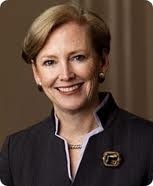
5. Other industries with women amongst the top earners were social media (Sheryl Sandberg/Facebook), technology (Meg Whitman/HP, Carol Bartz/Yahoo), food (Irene Rosenfeld/Kraft, Indra Nooyi/PepsiCo), health insurance (Angela Braly/WellPoint – she resigned last month though), oil (Ellen Kullman/DuPont), and fashion (Jackwyn L. Nemerov/Polo Ralph Lauren).

20120929-120244.jpg

Last but not least, Claressa Shields this summer won the first U.S. women’s boxing gold in Olympic history. The glass ceiling is officially punched through.

20120929-120314.jpg

So, men, in case you are being outearned, consider yourself lucky not be be knocked out… get in the ring.

I invite you to follow me on twitter @danenskat

(c) Enskat Associates 2012

Posted in alternatives, asia, black swans, Brand, cash flows, distribution, EFAMA, Enskat, Enskat Associates, information delivery, institutions, Latin America, management, multi-convergence, politics, private banking, professional fund buyers, regulation, SWFs, switzerland, traditional, UCITS, Uncategorized, wealth management | Tagged , , , , , , , , , , , , , , , , , , , , , , | Leave a comment

Key concerns for global institutional investors: volatility, risk and correlations

A new global survey of close to 500 institutional investors conducted by Natixis Global Asset Management – NGAM is keeping busy these days – points out a few common and a few not so common concerns for asset holders worldwide.

20120926-222755.jpg

Not surprisingly, volatility features high on the list of priorities: 80% of institutions think it’s here to stay, 84% think it’s an investment opportunity, but, 74% find it tough to adhere to asset allocation targets in times of heightened volatility.

20120926-223254.jpg

One third of respondents thinks it has had above average success in the past five years in constructing portfolios that reduced correlation among assets (aren’t we all above average?). Also, one third says their risk tolerance is lower than five years ago, one third says it’s higher, one third is the same (aka average).

What is interesting is that three out of four investors have changed their risk management approaches in the last five years. Nine out of ten institutions see increasing allocations to non-correlated assets and risk budgeting as an effective portfolio risk management strategy; other approaches include increased fixed income allocations (84%); global equities (79%); and currency hedging (76%).

Notably, two thirds of investors said the 2008 crisis has changed their investment philosophies and approaches.

Macro uncertainties are of great concern, but which ones? One third of global institutional investors see the contagion from the European debt crisis as the greatest source of market volatility over
the next two years (53% in the UK – might be the London weather). Other items keeping asset holders up at night are an uneven global economic recovery (16%) and political/regulatory gridlock in responding to sovereign debt levels (13%). 31% point to discovering unexpected sources of risk in their portfolio and 30% say it’s the inability to react quickly to volatile market conditions.

20120926-223556.jpg

Not surprisingly, some 85% of institutional investors in Europe, including the U.K., agree that the
regulations imposed by the Alternative Investment Fund Managers Directive (AIFMD) will affect
fund managers negatively due to their broad scope.

Similarly 86% of institutional investors in Asia along with 76% of investors in Europe
agree that the staggered pace of implementing financial reform around the world (e.g. the U.S.,
Europe, Hong Kong) is creating more, not less, systemic risk. Investors in the Middle East were
less concerned (68%).

Alternatives to the rescue:

Two thirds of asset holders believe it is essential to invest in alternative investments to diversify portfolio risk and/or to outperform the broad market (good luck telling that to hedge funds in the last few years). The US especially is on board with this, with 73% in agreement.

20120926-223833.jpg

For those that use alternatives (very few don’t, these days), 85% say they are pleased with the performance of those holdings, compared with 15% who are disappointed. Two thirds will keep the allocation as is, one quarter is likely to double it, and some 12% have buyers’ remorse. U.K. investors, at 44%, are the most likely to say they would raise their allocation to alternative investments (St. James is a nice area in London, can’t argue with that).

Get liquid.

Nine out of ten investors think increasing the use of liquid (more unconstrained) alternatives such as global macro or long/short equity strategies is an effective way of limiting portfolio risk. One third of them say their institution’s allocation to real estate is below target; 40% of investors in Asia and 39% in Europe report the same. 28% of global investors say their institution’s allocation to socially
responsible investing is below target.

Asked to select up to three priorities for the next 12 months, 27% say one of their institution’s top actions will be to pay more attention to correlations between asset classes. A quarter named increase holdings of safe cash-like investments as a top investment priority in the next year. A similar proportion chose use absolute strategies.

Amen.

I invite you to follow me on twitter @danenskat

(c) Enskat Associates 2012

Posted in alternatives, apps, asia, Brand, consulting, EFAMA, Enskat, Enskat Associates, information delivery, institutions, management, multi-convergence, pension funds, private banking, professional fund buyers, UCITS, wealth management | Tagged , , , , , , , , , , , | Leave a comment

Womenomics: The end of men in finance?

Fashion has Anna Wintour, Hollywood has Meryl Streep, Germany has Angela Merkel, PepsiCo has Indra Nooyi.

20120925-123316.jpg

With a new bestselling book out, “The end of men – the rise of women”, how pervasive is female leadership in the asset management industry, and what has the effect been?

20120925-123336.jpg

Of the top ten asset management firms in the U.S., only one is led by a female CEO—J.P. Morgan Asset Management, with Mary Callahan Erdoes at the helm. Four companies on the list have women among their key executives—Fidelity Investments, J.P. Morgan Asset Management, BlackRock, and Goldman Sachs Asset Management. In spite of earning 54% of all undergraduate and graduate accounting degrees, women hold only 18% of executive officer and board director positions at finance and insurance companies, alongside a meager 8.7 % of chief financial officer posts in America.

20120925-123326.jpg

Why does this matter?

Egalitarian questions of gender equality aside, research suggests that this lack of diversity may actually be detrimental to the bottom line.

Also, from an investment perspective, we are seeing phenomena like “Mrs. Watanabe”—a designation for Japanese housewife speculators powerful enough to shape markets, especially in foreign exchange. The transfer of financial influence is far-reaching, as even women in Saudi Arabia are becoming more empowered in dealing with their wealth. The Middle East Economic Digest estimated that Gulf women controlled assets of approximately USD 385 billion in 2011, as women continue to control an increasing number of brokerage accounts and family-run businesses—even if only as silent partners.

Kathy Matsui of Goldman Sachs—ranked as a top equity strategist in Japan by Institutional Investor, coined the term “womenomics” in a foundational report a little over a decade ago. Her research concluded that the companies with the highest proportion of female employees on the Japanese stock exchange performed nearly 50 percent better than those with the lowest.

20120925-123356.jpg

Her findings were complimented by Catalyst and BMO Financial Group in a 2004 study focused on the U.S. Catalyst examined 353 out of 500 of America’s largest companies from 1996-2000, and found that, on average, companies with the highest percentage of women among their top officers had an equity return that was 35% percent higher than those with fewest high-level women.

Shareholder total return was 34% higher for companies with the most executive women.

Of course, results in one country, region, or industry, are not always portable. However, awareness of these findings is essential because lack of gender diversity ultimately signals a company’s inability to mirror its clients.

As women now earn the vast majority of post-graduate degrees, not acknowledging their growing purchasing power will become an increasingly expensive mistake. Higher performance is not attributed to the idea that female executives are somehow more capable or intelligent than their male counterparts (although they might be). Rather, companies innovative enough to promote women are also more likely to be ahead of the curve, and thus better able to seize new business opportunities. Or, as Daniel Pink points out in “a whole new mind”: the MFA is the new MBA.

As I have discussed in prior blogs, the trend of a new era of right brain dominated business success around multi-tasking, holistic solutions and non-linear thinking is likely to give women a competitive advantage.

Maybe not the end of men just yet, but we better get our act together.

20120925-123347.jpg

I invite you to follow me on twitter @danenskat

(c) Enskat Associates 2012

Posted in alternatives, beauty, Brand, consulting, EFAMA, Enskat, Enskat Associates, information delivery, institutions, Middle East, money, private banking, professional fund buyers, Uncategorized | Tagged , , , , , , , , , , , , , | 2 Comments

Multi-Convergence – Products: Alternatives vs Traditional

In my last few posts I talked about risk on risk off (RORO), return optimization around volatility (ROVO), and Natixis’ new volatility team, all part of the industry metatrend of #MultiConvergence, which I will write about in my next global analyst column for aiCIO later this month.

20120920-220207.jpg

Let’s focus for a minute on the product convergence in the industry – the increasingly blurry lines of demarcation between traditional and alternative products, strategies, and managers.

20120920-220341.jpg

The top selling retail fund manager globally last year, Franklin Templeton (FT), today announced the acquisition of $10 billion fund of hedge fund manager K2 Advisors Holdings (not to be confused with PE firm K1 in Singapore that recently heavily invested in Guggenheim Partners to help them grow globally as they were looking to buy Deutsche’s US assets).

20120920-220556.jpg

Technically it’s only a majority stake for FT at the moment – the remainder will be purchased through 2016 -, but it clearly shows FT focusing on the ultra fast growth segment of alternatives and investment solutions.

Institutional investors globally in recent years have heavily shifted strategic allocations to alternative buckets and investment solutions, often at the expense of equity allocations. And with risk-based and factor-based investing catching fire of late, Greg Johnson sees “the new relationship with K2 as an important step in our overall plan to expand Franklin Templeton’s alternative strategies and solutions platform.”
He is not alone.

20120920-220545.jpg

Other asset management Goliaths such as BlackRock, PIMCO, or JP Morgan have acquired and/or built out alternative assets en masse, and others such as Schroders, Eaton Vance, Oppenheimer Funds et al have made investments as well, trying to alter the brand and message.

Of course, this goes both ways. As the latest Ucits framework and its product directive opened up the door to more sophisticated product construction, we have seen alternative asset managers move into the traditional space, creating “Newcits” for institutions in need of a globally accepted framework to invest with them.

And on a product level, we have seen many interesting permutations getting attention. American Funds earlier this year raised $3 billion in a new private equity fund, Pictet has been known to partner with hedge boutiques, and GAM or MAN are in a range of product partnerships around the world.

Overall, product convergence and a focus on alternatives and investment solutions across distribution channels, geographies and wealth levels will increasingly blur lines of demarcation and create more competition among investment managers.

E = MC2…..the Era of MultiConvergence2. Better be ready.

20120920-220821.jpg

I invite you to follow me on twitter @danenskat

(c) Enskat Associates 2012

Posted in alternatives, black swans, Brand, cash flows, consulting, distribution, EFAMA, Enskat, Enskat Associates, information delivery, management, multi-convergence, pension funds, professional fund buyers, regulation | Tagged , , , , , , , , , , , , , , , , , , | Leave a comment

Focus on Volatility – ROVO, Smart Beta and “Seeyond”

In my recent research I have focused on risk management. More precisely, in the post-crisis “risk on risk off” approaches seen in the industry, there is an additional component that I would call “ROVO” – Return Optimization around VOlatility.

Volatility considerations, both for macro issues as well as for portfolio construction and asset allocation, has seen greater attention. One of the latest examples of this focus is Natixis Global Asset Management, which this week unveiled a 32-people volatility management and structured product unit, called “Seeyond“.

20120918-160944.jpg

French managers of course for a long time have had an interest and expertise in quant management, VAR (remember Credit Agricole’s popular fund series roughly 2004-2007), and structured products (recall the retail focus of French banks on CGFs roughly 2001-2004).

Running some $20 billion in assets in a variety of volatility structures (long/short, flexible asset allocation, active vol, et al), the NGAM group focuses across retail and institutional channels and has four areas of expertise – structured beta & guarantee, smart beta, hedged beta, and flexible beta & volatility.

Stay tuned on others to follow suit.

Welcome to ROVO.

Posted in black swans, Brand, cash flows, consulting, distribution, Enskat Associates, information delivery, institutions, pension funds, professional fund buyers | Tagged , , , , , , , , , , , , , , , , , | 2 Comments

Asia, private banking, and brand

Things are in limbo in Asia.

Retail banking post-mini bonds and with FATCA have all but come to a standstill for fund distribution.

20120917-141956.jpg

Wealth is booming, but not for traditional mutual funds. Institutions are looking to alternatives to satisfy the demand for protection and yield. Private banking and wealth management, thus, is what many in the industry are focusing on.

20120917-142201.jpg

Pictet, for example, is one of the few firms in the last few years able to successfully realign and alter their brand – including their blockbuster product range.

20120917-142451.jpg

Multi-brand chameleon: Pictet in Switzerland is one of the oldest and most prestigious private banking brands worldwide, an asset to be leveraged worldwide by Swiss banks as their domestic business is facing significant challenges (see also Julius Baer, Sarasin, et al).

In Japan, Pictet has been able to build a retail brand around monthly income distribution as well as thematic products.

Pictetfunds internationally has established a series of diverse blockbusters sold cross order and locally, ranging from alternatives to themes, global multi-asset, and EM debt with a focus on local currencies. Now Asian Investor in an interview with partner Renaud de Planta announced greater expansion in Asia both for EMD and HK equities.

I am currently working on a white paper co-authored by Brown Brothers Harriman and Strategic Insight on private banking trends in Asia, with a few highlights recently shared in a column for Ignites Asia.

20120917-142808.jpg

With the massive opportunities for Asia private banking, the challenges are to create more uniform and efficient standards between private banks and investment funds in a multi-fragmented, multi-lingual, multi-cultural and multi-regulatory region of diverse approaches and infrastructures.

The paper discusses the challenges faced by private banks in Asia to select and administer funds in an open architecture environment with appropriate infrastructure as they monitor a greater number of managers and funds, but choose to work with fewer strategic partners.

As business and investment complexities increase, a myriad of factors impact private banking relationships and success in Asia: on the ground presence for ever more sophisticated and demanding clients, local commitment and specialist support, margin and cost pressures, changing operating models, regulatory overhaul, globalization of business models, multiple gatekeeper relationships, economies of scale and tailored information delivery.

Many firms are willing to take the plunge, either for the first time or to renew their vows.

A few examples:

– Interview with Jaime de la Barra on Asia-LatAm links and opportunities.

Julius Baer seeing Singapore as second home market and bulking up assets with Merrill deal.

Aberdeen emphasizing Asia investment and business opportunities during their Annual UK Investment Conference in Scotland,

Posted in asia, Brand, cash flows, China, consulting, distribution, EFAMA, Enskat, information delivery, iPad | 2 Comments

Aberdeen’s 14th Annual UK Investment Conference – September 2012

On the first weekend of September, I had the pleasure of being in Scotland to participate in Aberdeen Asset Management’s 14th Annual UK Investment Conference and Braemar Gathering 2012.

CEO Martin Gilbert welcomed the guests and introduced the theme, “Investing Despite Uncertainty“.  Next was the opening address by Rt Hon Alistair Darling MP, former Chancellor of the Exchequer, with an overview of the political landscape in and post 2008.  Prof. Stephane Garelli then looked at the future of the global economy.

After a short break, Anthony Hilton, editor of the Evening Standard, interviewed Hugh Young and Devan Kaloo on Emerging Markets trend, and I had the honor of discussing the “Risk-On/Risk-Off” financial environment of the last five years.  The last session was the Economics Debate chaired by broadcaster Andrew Neil, with Bob Janjuah (Nomura), Eamonn Butler (Adam Smith Institute), Doug McWilliams (CEBR) and Anne Applebaum (journalist/author), with a look at the major economic issues of the day.

The black tie dinner that night was splendid, but only a prelude to the phenomenal Braemar Gathering and a private reception at Martin Gilbert’s house. Aberdeen is one of the few global firms able to invest and operate globally while maintaining strong local roots.

The Games at The Braemar Gathering received royal approval from Queen Victoria in 1848. The Royal Family continues to attend each year and Her Majesty The Queen is patron of the Games. Pipe and drum competitions, highland dancing, caber tossing, shot putting, hammer throwing and other traditional events take place.  The Braemar Gathering remains the biggest and most prestigious Scottish Highland Games event, attracting a large crowd each year. It is famous for its friendship and hospitality and attracts pipers and dancers of the highest standard. Aberdeen Asset Management is sponsoring the piping competition which, as always, is a highlight of the Games.

Aberdeen Annual Inv Conf and Braemar Gathering 2012

Below are pictures from the event(s).

This slideshow requires JavaScript.

Posted in apps, asia, Brand, consulting, Enskat, information delivery | Tagged , , , , , , , , , , , , , , , , , , , , , , , , , | 2 Comments

The Times They Are A-Changing

Come mothers and fathers
Throughout the land
And don’t criticize
What you can’t understand
Your sons and your daughters
Are beyond your command
Your old road is
Rapidly agin’
Please get out of the new one
If you can’t lend your hand
For the times they are a-changin’.

Posted in Uncategorized | Leave a comment