Customized beta… Rethinking alpha creation around factor- and risk-based investing

In my keynote speech in Aberdeen this summer, I referred to my firm’s research around volatility and risk management as “ROVO” – Return Optimization around VOlatility. In the overall risk-on/risk-off approach by institutions and private wealth managers post-crisis, volatility considerations, both for macro issues as well as for portfolio construction and asset allocation, has seen greater attention. This is especially visible with pension plans as they try to straddle liability hedging versus return seeking in their dynamic asset allocation.

20121028-152016.jpg

Thus, Natixis created a new 32 people volatility management and structured product team called Seeyond around four areas of expertise – structured beta & guarantee, smart beta, hedged beta, and flexible beta & volatility.

Northern Trust earlier this year published a white paper with Greenwich Associates, “Customised Beta“. Addressing broader policy goals beyond just outperforming a benchmark, passive strategies have been restructured from traditional capital weighted to alternative and customized indices. To that end, the firm followed up its US TILT product on the FlexShares platform with one focused on developed markets and another one tilting emerging markets – part of the evolution of targeted sophisticated investment approaches.

Tilt investing moves portfolio allocations toward a specific factor to gain an excess return relative to traditional capitalization-weighting approaches, aiming to take advantage of market anomalies. New products in this field can be found also from giants BackRock and State Street, both on the forefront of mixing active and passive approaches for intelligent beta products, blends and hybrids.

State Street launched tilt ETFs (Value and Momentum) to the SPDR series. According to the SPDR university’s “case for tilt investing“, tilt investing has become increasingly popular among institutional investors. They are moving away from pure capitalization-weighted portfolios by introducing advanced indexing that tilts toward factors that have shown long-run outperformance in academic research (most notably by Fama and French). Factors away from market cap can include dividend yield, price earnings, price cash flows, price versus book or sales, ROE, EPS growth, and much more.

BlackRock under its BMACS platform (“Multi Asset Class Solutions”, not to be confused with Big Macs) has some 130 portfolio managers, researchers, investment strategists, economists, and actuaries creating solutions for clients. Nine investment strategies range from hedged equity to dynamic multi asset and target risk. Market advantage as a strategy constructs beta to a diversified set of asset classes in a single, efficiently-constructed portfolio to deliver global equity returns with less risk. In other words, identify a portfolio with the highest Sharpe ratio and leverage it up or down to desired return levels.

One of Lombard Odier‘s unlimited partners, Hubert Keller, thinks the industry needs to completely reinvent itself from a risk management perspective. The firm’s own pension fund has moved from traditional asset allocation managed externally to 30% illiquid assets and the other 70% in a risk budget with specific drawdown budgets (8% max drawdown with about 6% volatility), marketed to LODH clients as well.

Approaches of risk and factor based approaches rather than asset classes has been discussed a lot in the industry, especially with managers such as as Bridgewater or AQR accumulating tens of billions of dollars in client assets around risk management. Bridgewater’s All Weather fund in 1996 was the first official risk parity fund.

20121028-152145.jpg

European and Canadian along with leading US plans have increasingly implemented new investment approaches in recent years. For example, Denmark’s ATP in order to minimize large drawdowns in addition to risk parity first hedges all uncompensated risks (in this case interest rate risks vs. liabilities) through a separate hedging portfolio of ultra long duration interest rate swaps and government bonds. Next, tail risk is addressed by purchasing downside protection and, finally, a dynamic rule with specific risk budgets on reserves protects solvency ratios if all else fails.

The way I see it, the difficulty to balance risk and liabilities with maximum risk adjusted returns is further fueling the process of #Multi-Convergence in the investment management industry, an area of great focus for E&A and the main theme of EAQ3, coming out this week.

20121028-151515.jpg

Products: convergence between active and passive and traditional and alternatives

Distribution: convergence between institutional investors, global gatekeepers, wholesale, and retail

Regulation: convergence between global frameworks and local silos

Geographies: convergence between developed and emerging regions, aka fast and slow growth

Scale: convergence between core and satellite strategies and with it appeal of boutique specialist brands versus large global investment houses

Co-opetition: convergence between asset holders, asset managers, consultants and advisors, leading to competition, cooperation and conflicts of interests, which will benefit a selected few.

Concentration: all of these trends combined lead to increasing concentration of flows to strategic partners and strong brands, as due diligence, compliance and research efforts blow up budgets and investment resources.

Lots of challenging questions, but intellectually very appealing.

I invite you to follow me on twitter @danenskat

(c) Enskat Associates 2012

Posted in alternatives, apps, black swans, Brand, cash flows, Chile, consulting, distribution, EFAMA, Enskat, Enskat Associates, information delivery, institutions, Latin America, management, multi-convergence | Tagged , , , , , , , , , , , , , , , , , , , , , , , , , , , , , , , | Leave a comment

Earnings season: Blackstone reports record AUM and strong performance fee growth

Blackstone reported a 7% appreciation in its private equity funds and a 5% increase in real estate.

20121021-222823.jpg

Chairman and CEO Stephen Schwarzman confirmed “gross organic inflows of $38 billion over the last year, with $14 billion returned to our investors, driving us to record total assets under management of $205 billion.” $622 million of Economic Net Income (“ENI”) marked Blackstone’s third best quarter since going public.

20121021-222951.jpg

Highlights from the quarter for new funds and strategies:

– latest global real estate fund fundraising completed with a cap at $13.3 billion
– the firm’s first dedicated energy fund completed fundraising with $2.4 billion of total commitments
– Hedge Fund Solutions (HFS) had $1.7 billion of net inflows during the quarter
– Credit launched its third closed-end fund and priced two new CLOs raising about $2 billion
– $36 billion of committed undrawn capital (“dry powder”) at the end of Q3
– Agreement to acquire Capital Trust’s asset management platform ($2.4 billion of AUM; chairman is real estate magnate Sam Zell).

20121021-223320.jpg

Real estate and energy remain popular themes for the industry with Blackstone as a leader in the space for almost three decades. While many firms had trouble attracting new money to alternative investment solutions, Blackstone contradicted the trend with $1.7 billion in inflows. Notably, the decision to buy Capital Trust’s asset management platform shows the increased multi-convergence discussed in so many of my recent posts.

On the private equity side, revenues for Blackstone increased year on year with growing performance fees and investment income. Overall carrying value of assets was up over 7% for the quarter with appreciation across all contributed funds. Stronger market conditions drove the segment’s public holdings up 15.1% for the quarter, while private holdings increased 3.2%.

Significant Performance Fees were driven by BCP IV and the more recent BCP VI and Blackstone Energy Partners (“BEP”), both now above their hurdle rates to generate performance fees. Year-to-date total capital invested and committed reached $3.7 billion. Some $285 million of capital were returned to investors at an average of four and a half times multiple of the invested capital.

BEP, the firm’s first ever dedicated energy fund, completed fundraising with a total of $2.4 billion. Also, $1.4 billion raised for a new tactical opportunities fund commenced active marketing.

For real estate, strong performance fees pushed up revenues for the quarter materially compared to last year, reflecting the continued improvement of operating fundamentals across Blackstone’s office, retail and hotel portfolios.

Real estate investments of $34 billion were up 5% for the quarter and 12% year-to-date, similar to debt strategy drawdown funds. Hedge funds ($800 million) were up 6.2% for the quarter and 14.6% year-to-date. Significant performance fees generated by BREP V, VI, VII and EUR III, with $19 billion of invested equity, and year-to-date total capital deployed and committed reached $6.3 billion.

Fundraising for Blackstone’s most recent global real estate fund, BREP VII, has been completed at $2.2 billion in additional commitments in Q3, bringing total fund commitments to $13.3 billion. Furthermore, the firm announced the agreement to acquire the asset management platform of Capital Trust ($2.4 billion in AUM), a publicly traded real estate finance and investment management company. Blackstone will take over management of CT Investment Management Co LLC, as well as Capital Trust’s co-investment in the fund.

HFS revenues more than doubled from last year, driven by 17% fee-earning AUM growth and fund performance. Composite returns were up 3.3% net for the quarter and up 6.2% net year-to-date. As of quarter-end, $18.5 billion or 77% of Incentive Fee-Earning AUM was estimated above their respective High Water Mark and/or Hurdle, up from $9 billion or 41% last quarter.

Fee-Earning AUM grew 9% during the quarter, and 17% over the last twelve months, driven by strong net inflows primarily in customized and commingled investment products and market appreciation. Fee-Earning net inflows were $1.7 billion for the quarter and $3.2 billion year-to-date, not including October 1st subscriptions of $0.5 billion.

In Blackstone’s credit business, revenues improved due to a significant increase in performance fees. Total AUM grew 8% for the quarter , up 62% from last year to a record $55 billion. New product introductions, strong net inflows, market appreciation and the Harbourmaster acquisition in the first quarter all contributed to these record numbers.

Despite the volatility in the markets, fund returns held up. Hedge Funds were up 6.1% net for the quarter and up 9.2% net year-to-date, Mezzanine Funds saw 7.7% and 17.7%, respectively. Rescue Lending Funds added 4.6% net for the quarter and 12.4% to date.

$722 million of capital invested in the firm’s credit-oriented drawdown funds brought year-to-date total capital invested to $2.5 billion. During the quarter, Credit launched its third closed-end fund, raising $835 million of AUM, and priced two new CLOs totaling over $1 billion of AUM. Blackstone credit net flows over the last twelve months totaled $19 billion.

Financial Advisory revenues were down 29% from the same quarter last year, primarily from delays in deal closings, particularly in the strategic advisory business. Despite the slow quarter, activity levels remained largely in line with 2011. Restructuring maintained its top ranking for worldwide completed restructuring in the Thomson Reuters league tables for the first nine months of 2012; the pipeline remains steady across a broad set of mandates with revenue up year-to-date.

Blackstone Advisory Partners’ 2012 backlog was described as healthy against a difficult backdrop of M&A, as deal activity remained in line with 2011 levels and several high profile mandates recently announced.

Blackstone described Park Hill’s pipeline as solid, with challenging fundraising market conditions driving demand for placement services; revenues were down slightly year-over-year, reflecting timing activity levels.

Assets Under Management grew to a record $169 billion (fee earning), up 27% in the last twelve months, as $43 billion of gross inflows more than offset $11 billion of capital returned to investors during the same period. Including commitments, not yet earning fees, Blackstone’s Fee-Earning AUM would have been $179 billion, or 34% higher year-over-year.

Total AUM increased 30% to a record $205 billion, up 8% from last quarter driven by strong organic net inflows and market appreciation across all asset management segments.

I invite you to follow me on twitter @danenskat

(c) Enskat Associates 2012

Posted in alternatives, asia, black swans, Brand, cash flows, consulting, Enskat, Enskat Associates, information delivery, institutions, management, money, multi-convergence, pension funds, private banking, professional fund buyers, wealth management | Tagged , , , , , , , , , , , , , , , , , , , , | Leave a comment

Earnings season: Blackrock powers forward with iShares and equities

Blackrock this week reported an almost 25% increase in year on year quarterly earnings. Adjusted EPS stood at $3.47, with net income growth of 8% (17% as adjusted) from Q3 2011 on revenue of $2.3 billion.

20121021-124914.jpg

The most interesting statistic by far was the strongest quarter of iShares flows since 2009, with over $25 billion of net inflows, including $21 billion into equity products. The firm post-2008 has built out its leadership in creating customized investment solutions for different clients and channels, with a heavy focus on alternatives, regardless of market movements. Alternatives this quarter were in outflows, but still contributed a high proportion of performance fees to the bottom line.

20121021-144107.jpg

Chairman and CEO Larry Fink spoke of “record earnings per share up 23% from the prior year and margins over 40% through robust new business generation across each of our channels with particular strength in key growth areas on which we’ve focused, including Retail and iShares and our DC business“.

20121021-144252.jpg

The emphasis on fixed income products combined with yield strategies for retail clients translated in the highest retail bond flows in over a decade, with $6.2 billion.

As retirement trends accelerate and assets continue to shift from defined benefit to defined contribution plans, the appetite for broader investment solutions continues to increase, and BlackRock is capitalizing on it. Fink pointed out $10.4 billion in defined contribution business, with particular strength in outcome-oriented solutions such as the LifePath portfolios.

BlackRock Solutions, another key growth priority for the firms, achieved a 9% increase in revenue for the business overall, and 18% year-on-year for the Aladdin trading and operating system.

Building on the $25 billion in cash contributions to iShares, BlackRock last week unveiled a few new aces from its sleeve:

– a new iShares Core series for buy-and-hold investors;

– a revitalized iShares brand campaign;

integration of the U.S. iShares and BlackRock retail sales forces.

The initiatives are the first phase of a broader, global strategy to drive enhanced growth in the iShares platform.

A few other key points for the quarter:

– BlackRock had long-term inflows of $31 billion in Q3/2012. However, this excludes the effect of a single, low-fee, institutional index fixed income outflow of $74 billion, which BlackRock did not rebid on, citing extremely low fees.

Total assets stood at $3.7 trillion as of September 2012, up 10% from a year ago. Net inflows in long-term products totaled $31 billion (excluding the above mentioned $74 billion outflow), reflecting equity, fixed income and multi-asset class product net inflows of $22 billion, $9 billion and $3 billion, respectively, partially offset by alternatives net outflows of $2 billion.

– Total cash flows also included cash management net inflows of $7 billion and planned advisory distributions of $19 billion. AUM also reflected market valuation gains, investment performance and the acquisition in September 2012 of Swiss Re Private Equity Partners, the European private equity franchise of Swiss Re.

– Long-term net flows from clients in the Americas and EMEA of $21.6 billion and $14.2 billion, respectively, stood in contrast to net outflows of $4.5 billion from Asia-Pacific. At quarter end, BlackRock managed 61% of long- term AUM for investors in the Americas and 39% for international clients.

– Retail AUM of $400 billion reflected net inflows of $5 billion and market and investment performance gains of $19 billion. U.S. retail and high net worth inflows of $3.5 billion showed diversification across asset classes, and continued strength in income-oriented products, such as a high yield bond funds with net inflows of $1.4 billion. Net inflows of $0.2 billion into alternatives products demonstrated BlackRock’s commitment to building a leading alternatives retail franchise.

– International retail net inflows of $1 billion marked a return to positive flows for the first time since the second quarter 2011, with fixed income net inflows of $1.7 billion partially offset by net outflows of $0.4 billion and $0.2 billion from alternatives and equities, respectively.

– iShares net inflows of $25 billion reflected positive net inflows across all asset classes, including net inflows of $21 billion into equity funds, demonstrating strong renewed investor demand for U.S. equity offerings. Fixed income and alternatives products included net inflows of $3.2 billion and $1.4 billion, respectively.

– U.S. iShares net inflows into equity funds totaled $17 billion as domestic equity products benefited from a risk-on sentiment taking hold in the latter part of the quarter. International iShares similarly showed signs of building risk appetite with equity net inflows of $4 billion led by net inflows into emerging market and pan- European products.

Institutional active AUM increased 4%, or $31 billion, to $881 billion, including market and investment performance gains of $31.9 billion and $6.2 billion from the acquisition of Swiss Re Private Equity Partners. Multi-asset class products net inflows were $3.1 billion with continued growth from defined contribution plans generating strong inflows into target date and global asset allocation offerings.

Alternatives net outflows were $2.9 billion, with modest private equity fund of funds net inflows of $0.1 billion offset by net outflows of $1.9 billion across other core alternatives offerings and net outflows of $1.0 billion from active currency. Net outflows from core products included return of capital on closed-end funds of $0.6 billion. Equity net outflows totaled $5 billion, reflecting outflows from active fundamental and scientific active equity (“SAE”). Fixed income net outflows of $2.6 billion reflected outflows from U.S. sector specialty mandates as asset allocation shifted in the latter part of the quarter.

– Institutional index AUM totaled $1.4 trillion at September 30, 2012, reflecting net inflows of $8.8 billion and market and foreign exchange valuation gains of $72.7 billion. Equity net inflows of $7.8 billion showed signs of shifting investor sentiments, with flows of $6.1 billion into regional and country-specific mandates, including emerging markets. Fixed income net inflows of $1.9 billion primarily reflected net inflows into U.S. core mandates.

Cash management AUM increased 4%, or $8.9 billion, to $248 billion, with net inflows of $7.1 billion and market and foreign exchange gains of $1.8 billion.

Advisory AUM declined 28% to $46.6 billion, primarily due to disbursements of Maiden Lane residual assets, marking the return of U.S. taxpayer funds.

– BlackRock Solutions (“BRS”) added 18 net new assignments during the quarter, including 1 Aladdin assignment, 2 risk management mandates, 1 FMA assignment, and 14 non-recurring advisory engagements. BRS also completed 9 short-term advisory assignments during the quarter.

– Net new business pipeline totaled $45 billion at October 11, 2012, including $33 billion in institutional index mandates and $8 billion in active mandates expected to fund in future quarters. In addition, the pipeline contains $10 billion of mandates funded since September 30, 2012. The unfunded portion of the pipeline primarily represents institutional assets, which account for approximately two-thirds of long-term AUM but only one-third of base fees.

Performance fees were $103 million in Q3 2012 compared with $91 million in third quarter 2011, primarily reflecting higher performance fees from alternative products.

I invite you to follow me on twitter @danenskat

(c) Enskat Associates 2012

Posted in alternatives, asia, Brand, Brazil, cash flows, consulting, distribution, Enskat, Enskat Associates, information delivery, institutions, lifestyle, management, movement, multi-convergence, pension funds, private banking, professional fund buyers, UCITS, wealth management | Tagged , , , , , , , , , , , , , , , , , , | Leave a comment

Where is the industry going to grow? US/Europe vs Asia/Latam

Where is the industry going to grow most in the coming years. The answer varies for a number of the leading investment managers around the world.

Let’s take a look at a few examples.

Flipping assets away from home

Despite being London headquartered, Schroders in the last decade flipped its asset mix from 30% international and 70% UK-based to the opposite today (for a total of $305 billion). And, according to Vice Chairman Massimo Tosato, the firm sees the best opportunities for the next half decade in Asia, and, notably, the U.S. A quarter of total assets from Asia today are expected to reach one third in the next five years, driven by demographic trends and income growth.

A similar story can be seen for giant Franklin Templeton. Net cash flows in the last five years have been two thirds from outside of the United States, with UCITS vehicles outselling 1940 Act funds. Notably, the retail focused firm also has seen greater participation from institutional clients post-crisis, blurring lines of demarcation for channels. Blurring lines even further, the recent acquisition of fund of hedge fund manager K2 is indicating similarly blurred lines for products towards absolute return and investment solutions on an institutional level to shape up the house view.

And Swiss wealth and asset manager Julius Baer, faced with regulatory, investor and market uncertainties at home, considers Singapore its new home market, and recently acquired Merrill Lynch’s ex-US wealth management business to push hard into Asia.

Asia all the rage

Markets such as Taiwan have proven very profitable for international fund managers. Alliance Bernstein with its high yield product landed a blockbuster product, and firms ranging from UBS to Franklin Templeton, Pictet and Schroders see great growth on the intermediary business in the country, with tens of billions of dollars in flagship strategies. As such, a presumably tiny market such as Taiwan can be far more sustainable and profitable than other larger brethren, China for instance, where profitability has been hard to come by. Indonesia is another opportunity set, but competition is getting more intense as well.

20121019-102037.jpg

More broadly, most of the new middle class will come from emerging markets such as China, Indonesia or India, as well as Latin America. And on the high end of the market, Asia for the first time on record last year surpassed North America in terms of number of wealthy investors according to the World Wealth Report. As retail business has dried up post 2008, firms are focusing on the complex but lucrative demands of private wealth clients. Stay tuned for a detailed overview of private banking needs in Asia in an upcoming white paper between BBH and Strategic Insight.

As Asia is looking for income streams, Schroders last year was able to launch a top cash flow product for the year, a multi-asset income fund domiciled in Hong Kong sold in partnership with HSBC. This search for yield is one of the key growth drivers for Schroders in Asia, paired with the middle class demographic growth. Tosato has given the region the highest growth rate in the firm’s five year plan.

And the US.

On the other hand, the largest and most mature market for retirement and post-retirement investing, the US, is also high on the list of priorities for international firms, such as Schroders, HSBC, Aberdeen or UBS. Only a tiny slice of market share in a specific segment can make a big difference to the bottom line.

Schroders US assets for now stand at 10% of total AUM, creating big opportunities in trying to get a foot in the door. Aberdeen only recently with its Philadelphia acquisition started a period of fast growth from a low base especially in the underdeveloped EM space with institutions, and HSBC is as well only now is getting started, similarly with an emerging markets expertise.

What about Europe?

We still should not forget about Europe, both from an investment and distribution perspective. Franklin Templeton after a decade of building partnerships and commitments to a market like Italy, now has tens of billions in an environment where most domestic and international firms are struggling to make money.

20121019-101730.jpg

Investment opportunities for both intermediaries and institutions for 2013 are mostly expected in European equities and Greece after doing all the hard work of restructuring was the best place to invest in Q3 2012.

The ASE rose by 70% in Q3 2012 – the E&A Quarterly Asset Management Digest makes the case that it’s time to see it differently. To receive a copy or become a strategic partner, just send me an email.

20121019-101848.jpg

Don’t write the UK or the continent off, it seems. However, what definitely is needed is a sniper rather than shotgun approach, as many firms in Europe have been there for at least a decade and gatekeepers have become sophisticated. Moreover, global relationships anchored in Europe have become more complex as wealth needs in Asia and Latin America are markedly different.

Latin America considerations

Latin America is a top priority for most investment managers when it comes to building out investment capabilities and broadening product lines. However, many firms by the same token are looking to build out the opportunistic mandates they have seen in recent years.

As discussed in dozens of case studies and blog posting here this year, both European and US firms have made acquisitions, forged partnerships or set up third party marketing arrangements in Latin America. As wealth management and institutional business is flourishing in Brazil, Mexico, and the Andean Three, even the firms that are just starting to think about their LatAm strategy are making regular trips to the region to feel things out.

And a number of firms already manage tens of billions in Latin America. It’s a little bit like Asia a decade ago, when no international firm was able to show a commanding AUM lead to stand apart. But as we have seen in Asia, these numbers change quickly as growth occurs, and firms need to at least think through their potential objectives to not be left out later on.

The world is your oyster, just make sure to avoid food poisoning.

Where does that leave us? In an investment world searching for safety and yields, but at the same time faced with risk taking conundra to reach target returns, we see plenty of opportunities all over the globe. However, those opportunities are matched with potholes and landmines as single mistakes have become more costly for the overall franchise from a messaging and branding perspective.

I invite you to follow me on twitter @danenskat

(c) Enskat Associates 2012

20121019-104244.jpg

Posted in alternatives, asia, Brand, Brazil, Chile, consulting, Enskat, Enskat Associates, institutions, LatAm, Latin America, management, multi-convergence, pension funds, private banking, professional fund buyers, wealth management | Tagged , , , , , , , , , , , , , , , , , , , , , , , , , | Leave a comment

Learning from Chile: Principal buys AFP, the growth of Latin America retirement investing and Chile educating the US

Latin America is high on the list of priorities for asset managers. Mostly, that includes expanding investment management in and for the region to build out product ranges and investment capabilities, but we also see a much stronger business push into the Americas, across all channels.

Or, as the Economist said in an editorial this week: “in the war for talent, the US can learn a lot from Chile“.

But more on the strategic discussion on how #LatAm and #Asia are showing the developed world how it’s done later.

This week Principal Financial Group, one of the largest US providers of retirement solutions, announced the acquisition of one of the handful of Chile’s AFPs, Cuprum, for $1.5 billion.

Cuprum will give Principal a retirement platform in Latin America’s most developed retirement market, adding some 600,000 mandatory pension investors and over $32 billion in AUM to its existing business south of the border. Cuprum products include mandatory employee-funded pension plans, voluntary pension products (APV), and other long-term savings products.

From hire through retire

Luis Valdes, CEO of Principal International, called it offering “customers in Chile an unmatched line-up of pension savings and retirement income solutions from hire through retire.” A goal almost from the day the firm entered Chile in 1995, “this was really the one part of the system we had not been able to penetrate”, according to CEO Zimpleman.

Principal now has made half a dozen strategic acquisitions in the last 24 months, in Brazil, Mexico, and Chile, to build out the increasing retirement business in the region, as well as other channels. In March 2012 , as discussed in earlier posts, the firm bought Claritas in Brazil to complement the partnership with Banco do Brasil. And in 2011, Principal acquired a Mexican Afore from HSBC.

– Brazil takes the lead: Net cash flows, M&A, Joint Ventures and Latin America Opportunities

For Principal, as for many other international fund managers, LatAm expansion is part of a focus on fast grow emerging markets in general to expand regionally and by channel, while diversifying risks.

20121013-111424.jpg

Cuprum has a wide range of risk based and other products available and always been good a giving a simple message around basic investment strategies and ongoing education. Many international firms can learn from them in their latest annual report.

Chile pioneered the private pension system in Latin America in 1981, around the same time 401k was introduced in the United States (the Revenue Act of 1978 included a provision that became Internal Revenue Code (IRC) Sec. 401(k) (for which the plans are named), under which employees are not taxed on the portion of income they elect to receive as deferred compensation rather than as direct cash payments).

Since then, Chile has become the main attraction for many international fund firms trying to distribute global UCITS structures on an institutional basis. And indeed, tens of billions of dollars are allocated to primarily US and European fund managers by the AFPs, such as Franklin Templeton, JP Morgan, Aberdeen, Pimco, Investec, Fidelity and others. Witnessing this success, many others are creating five year plans to make a serious dent in the region.

– Latin America in Asset Management – Quantifying the Opportunities for the region

Fund managers, though, it seems, are not the only ones flocking to Chile and Latin America. America, as the Economist so eloquently out it this week, “for more than a decade has been choking off its supply of foreign talent, like a scuba diver squeezing his own breathing tube” (arguably not the smartest strategy).

Enter Start-Up Chile with an attempt to lure American entrepreneur visa rejects to its “Chilecon Valley”. Since 2010, some 500 firms have been founded by entrepreneurs from close to 40 countries. Chile clearly is not alone, following in the footsteps of northern neighbor Canada or the Switzerland of the East, Singapore, where visas are issued without much agony to attract talent.

20121013-113848.jpg

In all, it seems that going forward the US will have an even harder time to proudly proclaim “We built it”.

20121013-113946.jpg

Go hard or go home.

I invite you to follow me on twitter @danenskat

(c) Enskat Associates 2012

Posted in alternatives, asia, Brand, Brazil, cash flows, Chile, consulting, Enskat, Enskat Associates, information delivery, Latin America, lifestyle, management, Uncategorized | Tagged , , , , , , , , , , , , , , , , , , , | 2 Comments

#Offbe(t)a(t): Vodka, volatility… liquid strategies

I invite you to follow me on twitter @danenskat

(c) Enskat Associates 2012

Posted in alternatives, books, consulting, Enskat Associates, information delivery, lifestyle, management | Tagged , , , , , , , , | Leave a comment

4 hour work week? Balancing productivity perceptions: leadership, google, outliers, and Gangnam style work life balance

Who works the hardest and who works the smartest?

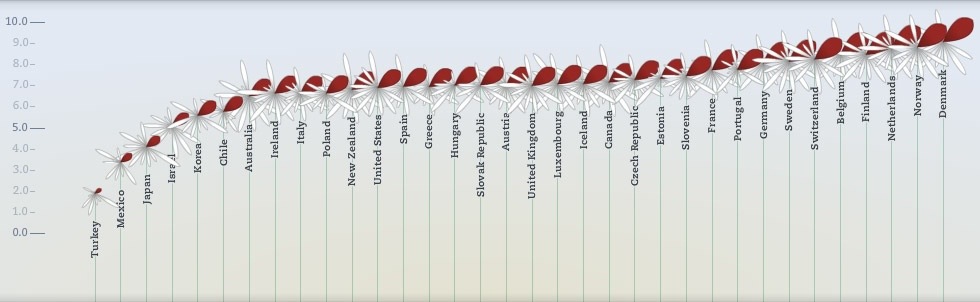
Comparing global average work hours from the OECD (not a complete data set, but the most complete available), shows that developing countries work a lot longer/harder than their US and European counterparts.

On top of the work hour list? Countries like South Korea, Chile, Greece (sic!), or Russia. Side note: aside from the bad reputation, Greece works longer than its European counterparts, by far.

Middle of the road? Japan, Canada, Iceland, U.S., Australia.

Work hour accumulation slackers? Netherlands, Germany, Norway and France.

20121007-120539.jpg

Number of hours worked, of course, does not mean that productivity numbers match up the same way. The US and the European slackers produce significantly more than the rest of the world. In general, Asian countries tend to work the longest, including working excessively long hours – same for Chile in Latin America.

The OECD in its “Better Life Index” and work-life balance research has important findings:

20121007-122709.jpg

People spend one-tenth to one-fifth of their time on unpaid work. Google was the first company to take advantage of this fact and gave its high skilled workers time to do things they are interested in while at work. The result: Google maps still kicks Apple’s behind. They also drive some impressive driverless cars.

Men spend more hours in paid work and the percentage of male employees working very long hours across OECD countries is 12%, compared with less than 5% for women. Of course, there are many reasons for these numbers and women are not going to run the world tomorrow, but it also shows how we men are slow to pick up on the new life-work balance and productivity gains associated with more balance.

It is worthwhile to click on each country report to get a better understanding of the differences across the world. The US, for example, is the only OECD country without a national paid parental leave policy, although some states do provide leave payments. Available parental leave is short (12 weeks), and only covers some employees (those in companies with 50+ workers).

Leave is short for a reason: US family well-being is strongly linked to employment because a significant proportion of public family support is delivered via tax breaks and credits (45% of total compared to 10% on average in the OECD).

Now, looking at this from a country level is interesting, but really just feeding national cliches.

As we are, as the MIT center for digital business on the future of work points out, entering an age of “micro-multinationals” – and E&A already now in its first year employs associates from the US, Europe, Asia, the Middle East and Latin America – it is much more instructive to look at it on a micro level.

A group of researchers from the University of California and North Carolina post-crisis looked at the effects of workers that just show up and sit in their office or meeting rooms : “How passive ‘face time’ affects perceptions of employees: Evidence of spontaneous trait inference

Sadly, managers intuitively recognized those employees sitting passively from nine to five as hard working and reliable, creating a feedback loop where others are forced to stay longer in the office just waiting for everyone to leave or just showing up on the weekend so the log shows they were at the office. The researchers concluded: “Put in the broader context of performance management, passive face time can affect employees’ status, performance evaluations, raises, promotions, and job security – even though being observed at the work site may not be linked to actual productivity.”

Indeed, just showing up is not winning the battle.

My view is it is best to find a balance between the following approaches:

– “Outlier“: spend ten thousand hours on becoming an expert in something to reach the inflection point of standing out with what you do

– “Race against the machine“: harness the power of information technology and groups to make yourself more competitive

– “Lifestyle Design“: Books like the four hour work week or the mobile wave are not quite as high on my list of books or convictions as Outlier or Race, but they still make an excellent case to re-balance your life in light of the new era of connectivity we live in. The whole Instagram $1 billion to a few people two years after starting a business also adds to the argument’s appeal.

Finally, let’s go back to the beginning. South Korea tops the list of longest working hours globally as per the OECD. Korean rapper PSY lucked out with Justing Bieber’s manager taking him on and blowing up his global reach sort of proves the new era we live in as well. He now has the chance to go from hardest working to smartest working.

20121007-132543.jpg
In case you have no idea what I am talking about right now, below is his audience in Seoul captured earlier this week.

Productivity, Gangnam style.

20121007-131055.jpg

Not to be confused with executive chairman for Google, Eric Schmidt, showing his dance leadership in Seoul as well.

I invite you to follow me on twitter @danenskat

(c) Enskat Associates 2012

Posted in alternatives, asia, books, Brand, Chile, consulting, distribution, Enskat Associates, information delivery, Latin America, lifestyle, management, multi-convergence | Tagged , , , , , , , , , , , , , | Leave a comment

Multi-convergence: Apple creates largest hedge fund worldwide

Design does pay off.

Steve Jobs did not only create the iPhone and iPad, his relentless focus on design and simplicity also created the largest company by market capitalization in the world. Being the most valuable company in the world has the nice side effect of having cash, lots of cash.

20121005-121319.jpg

In order to manage this cash pile Apple in 2006 created Braeburn Capital, in Nevada. Since then,
Apple has earned more than $2.5 billion in interest and dividend income on its cash reserves and investments around the globe from Braeburn.

With almost $120 billion in total assets, Braeburn last quarter moved past Ray Dalio’s Bridgewater. Not much is known about the asset allocation or investment strategies, but Zero Hedge last week published an insightful article on “the world’s biggest hedge fund you have never heard of.

#Multi-Convergence.

20121005-121621.jpg

I invite you to follow me on twitter @danenskat

(c) Enskat Associates 2012

Posted in alternatives, apps, black swans, books, Brand, cash flows, distribution, Enskat Associates, iPad, lifestyle, management | Tagged , , , , , , , , | Leave a comment

Hotel of the quarter – Bowery Hotel, NY

Robert Warren always introduces new and exciting things into my life.

The Bowery Hotel a few blocks from my place is not exactly new, but it is a noteworthy hotel and hidden gem for business travelers.

20121004-212538.jpg

Situated on Bowery and Great Jones, the hotel features dozens of amazing little and large terraces that are a refuge from the city and feel like a private apartment. Of course, there is much much more.

20121004-212609.jpg

The lobby looks like a gothic lounge, where on a typical week (i.e. last week when I last visited) you will see Daniel Craig, Ron Burkle, or Peter Dinklage. Don’t ask them about artist Domingo Zapato. Celebrated as the new Andy Warhol, the NY Post this week featured him in his Bowery hotel studio, explaining how stars like Lady Gaga, Angelina Jolie, Kim Kardashian or Sofia Vergara are lining up for a sitting.

20121004-212741.jpg

Gemma’s restaurant manager Karim and his staff will greet you by name and many business executives will cut deals in the back area of the restaurant. Aside from the great Italian food, Gemma has free wireless and one of the best baristas in town.

Make sure to check it out on your next trip to NY, but, please, don’t tell anyone.

20121004-212835.jpg

I invite you to follow me on twitter @danenskat

(c) Enskat Associates 2012

Posted in black swans, Brand, cash flows, consulting, distribution, Enskat Associates, hotels, lifestyle, management, movement | Tagged , , , , , , , , , , , , , | Leave a comment

Noteworthy books of the quarter

Many CEOs ask me for book recommendations for their long-haul flights. Here is a selection of the ones I am currently reading and would definitely recommend (in no particular order):

– The Mobile Wave, Michael Saylor: a great overview of how the internet and social connectivity is changing the way we live and do business by the CEO of MicroStrategy. Many of the ideas are common sense, but the history and summary of them makes it a worthwhile read. And, some of his ideas on business, education, commerce and communication are quite unique.

20121004-195828.jpg

– Megachange 2050, The Economist: I love books that try to imagine the future and the thoughtful overview from key economist writers on how the world will look like some forty years from now is truly insightful. It being the Economist, there is also a great selection of data and research to back up each hypothesis.

20121004-200230.jpg

– A Whole New Mind, Daniel Pink: Pink is an engaging and influential writer, and here he makes the case that right-brainers will rule the future. While finance in the past has focused on spreadsheets, linear thinking and details, he argues – successfully, I think – that those skills will not be sufficient in the future. They need to be supplemented with empathy, story, design, meaning, and big picture thinking. The MFA as the new MBA.

20121004-200939.jpg

– Race Against the Machine, Erik Brynjolfsson/Andrew McAffee: a fascinating and very short hypothesis by the director of MIT’s Center for Digital Business on why the future due to Asia, automation, and abundance, will depend on teamwork with computers. It is what the authors call a bold effort to make sense of the future of work. I especially like their thoughts on innovation by so-called “micro-multinationals” – like Enskat & Associates 🙂 Oh, it also is available free online.

20121004-201814.jpg

I invite you to follow me on twitter @danenskat

(c) Enskat Associates 2012

Posted in beauty, black swans, books, Brand, consulting, Enskat Associates, information delivery, management | Tagged , , , , , , , , , , , , , | Leave a comment