
Who works the hardest and who works the smartest?
Comparing global average work hours from the OECD (not a complete data set, but the most complete available), shows that developing countries work a lot longer/harder than their US and European counterparts.
On top of the work hour list? Countries like South Korea, Chile, Greece (sic!), or Russia. Side note: aside from the bad reputation, Greece works longer than its European counterparts, by far.
Middle of the road? Japan, Canada, Iceland, U.S., Australia.
Work hour accumulation slackers? Netherlands, Germany, Norway and France.

Number of hours worked, of course, does not mean that productivity numbers match up the same way. The US and the European slackers produce significantly more than the rest of the world. In general, Asian countries tend to work the longest, including working excessively long hours – same for Chile in Latin America.
The OECD in its “Better Life Index” and work-life balance research has important findings:
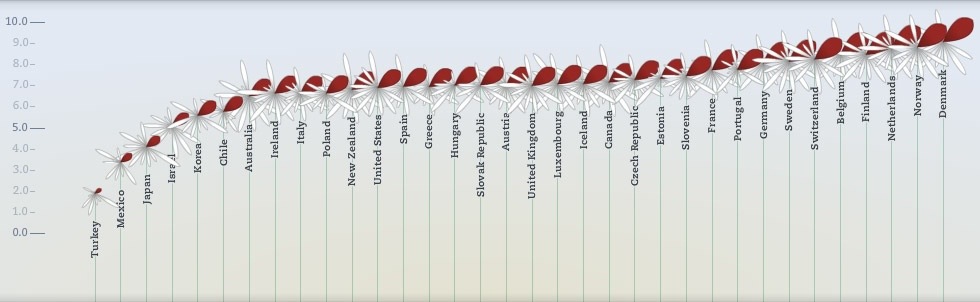
– People spend one-tenth to one-fifth of their time on unpaid work. Google was the first company to take advantage of this fact and gave its high skilled workers time to do things they are interested in while at work. The result: Google maps still kicks Apple’s behind. They also drive some impressive driverless cars.
– Men spend more hours in paid work and the percentage of male employees working very long hours across OECD countries is 12%, compared with less than 5% for women. Of course, there are many reasons for these numbers and women are not going to run the world tomorrow, but it also shows how we men are slow to pick up on the new life-work balance and productivity gains associated with more balance.
It is worthwhile to click on each country report to get a better understanding of the differences across the world. The US, for example, is the only OECD country without a national paid parental leave policy, although some states do provide leave payments. Available parental leave is short (12 weeks), and only covers some employees (those in companies with 50+ workers).
Leave is short for a reason: US family well-being is strongly linked to employment because a significant proportion of public family support is delivered via tax breaks and credits (45% of total compared to 10% on average in the OECD).
Now, looking at this from a country level is interesting, but really just feeding national cliches.
As we are, as the MIT center for digital business on the future of work points out, entering an age of “micro-multinationals” – and E&A already now in its first year employs associates from the US, Europe, Asia, the Middle East and Latin America – it is much more instructive to look at it on a micro level.
A group of researchers from the University of California and North Carolina post-crisis looked at the effects of workers that just show up and sit in their office or meeting rooms : “How passive ‘face time’ affects perceptions of employees: Evidence of spontaneous trait inference”
Sadly, managers intuitively recognized those employees sitting passively from nine to five as hard working and reliable, creating a feedback loop where others are forced to stay longer in the office just waiting for everyone to leave or just showing up on the weekend so the log shows they were at the office. The researchers concluded: “Put in the broader context of performance management, passive face time can affect employees’ status, performance evaluations, raises, promotions, and job security – even though being observed at the work site may not be linked to actual productivity.”
Indeed, just showing up is not winning the battle.
My view is it is best to find a balance between the following approaches:
– “Outlier“: spend ten thousand hours on becoming an expert in something to reach the inflection point of standing out with what you do
– “Race against the machine“: harness the power of information technology and groups to make yourself more competitive
– “Lifestyle Design“: Books like the four hour work week or the mobile wave are not quite as high on my list of books or convictions as Outlier or Race, but they still make an excellent case to re-balance your life in light of the new era of connectivity we live in. The whole Instagram $1 billion to a few people two years after starting a business also adds to the argument’s appeal.
Finally, let’s go back to the beginning. South Korea tops the list of longest working hours globally as per the OECD. Korean rapper PSY lucked out with Justing Bieber’s manager taking him on and blowing up his global reach sort of proves the new era we live in as well. He now has the chance to go from hardest working to smartest working.

In case you have no idea what I am talking about right now, below is his audience in Seoul captured earlier this week.
Productivity, Gangnam style.

Not to be confused with executive chairman for Google, Eric Schmidt, showing his dance leadership in Seoul as well.
I invite you to follow me on twitter @danenskat
(c) Enskat Associates 2012

 Warren Enskat Group