
Yesterday, BG published his latest monthly musings, entitled “damages”. Bill discusses the pros and cons of losing his long-term memory, which on the financial side include the new normal, the US as the cleanest dirty shirt, Nemo’s ring of fire – Gross has a knack for creating catchy neologisms.

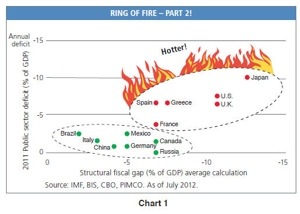
He does not expect Armageddon any time soon, but quoting from the annual reports of the IMF, CBO and BIS (hooray acronyms), he does foresee the US deficit and fiscal gap in bad shape. The institutions suggest spending cuts or tax hikes of 11% of GDP in the next decade, equaling $1.6 trillion per year; nowhere near what is being discussed politically at the moment.
Overall, emerging markets in his ring of fire graph look much better than developed markets. As we see multi-convergence take shape worldwide, we are approaching a redefinition of what constitutes developed vs. emerging or fast vs. slow growth.

Creating an imaginary bond around US liabilities, he sees it in the range of $16T (outstanding debt) plus $60T more (future liabilities), for a cool total of $76 trillion dollars.
As Gross puts it, “IF we continue to close our eyes to existing 8% of GDP deficits, which when including Social Security, Medicaid and Medicare liabilities compose an average estimated 11% annual “fiscal gap,” then we will begin to resemble Greece before the turn of the next decade.”
And Greek mythology used to be such a nice metaphor pool. The times are changing.
Worst offenders on budget and fiscal gaps: the U.S., Japan, Greece, the U.K., Spain and France – a “sort of a rogues’ gallery of debtors”.
Those that have budgets and gaps under relative control: Canada, Italy, Brazil, Mexico, China and a host of other developing as opposed to developed countries.
Lesson for the U.S. when it comes to budgets, health care, pensions and more: learn from Canada and Mexico. Ouch.
I invite you to follow me on twitter @danenskat
(c) Enskat Associates 2012


 Warren Enskat Group