
When it comes to information delivery, the size of the global asset management industry ($30 trillion in total AUM) stands in stark contrast to the outdated ways to deliver information – both in terms of speed (compliance issues) and content (think Apple versus RIM) of the message.
As long as your core business is stable and your product performs well, who cares about the perceived non-essential elements of your business?
Well, the times are a-changing – Bob Dylan is touring China, Vietnam and the rest of Asia with a censored playlist, and institutions and intermediaries around the world post-crisis very much care about the content, speed AND style of fund managers’ marketing and information delivery efforts.
Strategic Insight in the last six months interviewed close to 300 leading intermediary and institutional investors across Asia-Pacific and the world about their evolving selection criteria, brand and product preferences and what matters most to them post-crisis in regard to marketing and information delivery (we are currently writing a book about it, available in May 2011).
Below are a few summary quotes from our discussions:
– “Information delivery is not only about the content anymore, but also about the form. Are there more innovative ways to deliver information than a pfd document?”
– “From a marketing standpoint, we are borrowing the brands of the fund managers we are using.”
– “In fact the digital space is high on our agenda. We have our own iPhone app and as an organization feel the digital space is important across all business lines.”
– “Very few houses are doing a good job on general topics or timely updates and unique market views.”
So how important are information delivery and holistic marketing for the bottom line?
Let’s look at the information delivery secrets for the two best-selling fund firms since the crisis, Franklin Templeton and Pimco/Allianz.
Franklin Templeton was the best selling cross-border fund house globally last year, and Pimco with Bill Gross post-crisis had the best selling (and now biggest) mutual fund in the world.
1. Franklin Templeton
A few weeks ago in Hong Kong I interviewed Dr. Michael Hasenstab, manager of the global bond fund and head of the fixed income department for Franklin Templeton, at the Asia Fund Forum’s thought leader fireside chat.
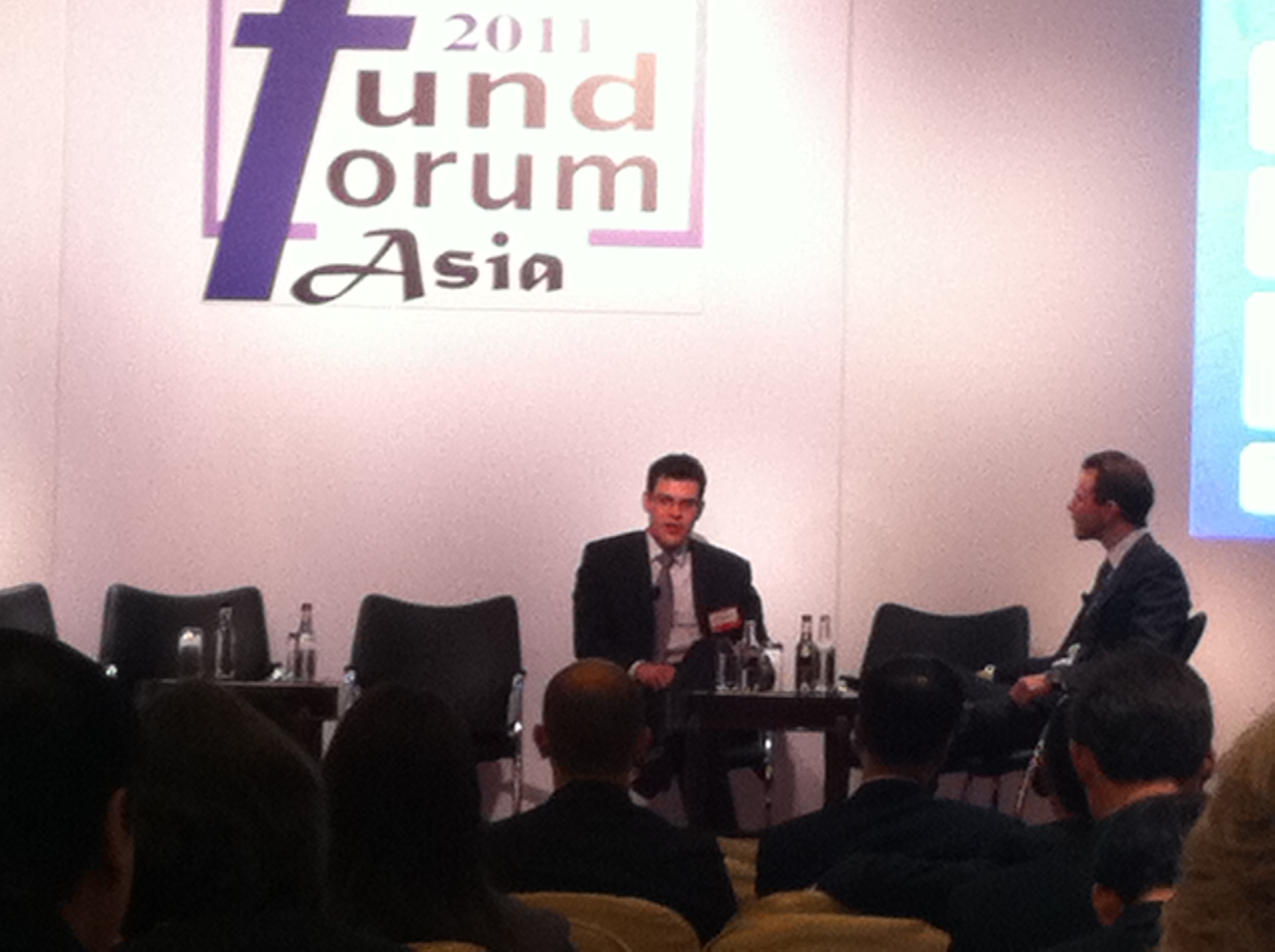
Michael oversees in excess of $100 billion in assets and the firm’s non-US UCITS products in the last few quarters have outsold their US-domiciled 40 act fund brethren. In addition to the appeal of the non-benchmark oriented product away from developed markets, Michael has been instrumental in strategic and tactical information delivery for clients, especially with short videos and bullet points for example on developments in Japan or the Middle East, as well as with long-term portfolio construction and strategic market views for the next decade.
Michael Hasenstab on the crisis in Japan

Dr. Michael Hasenstab on the crisis in Japan
The latter also ties in with the firm’s global thought leadership campaign around a “case for equities”, which has helped establish certain flagship equity products in parallel to Franklin Templeton’s fixed income blockbusters. We discussed the “case for equity” campaign in detail in our recent book on “the seven secrets of distribution”.
2. Pimco/Allianz
Bill Gross has always been a thought leader and early adopter of new technologies to deliver his market and portfolio views (his IO was the first to appear on the Kindle and in Spanish, years ago) – in fact, he considers marketing as important as performance since “even the best performance in the world is meaningless if nobody knows about it”.
Bill Gross April 2011 Investment Outlook, featuring Pepe Le Pew

Bill Gross' Investment Outlook April 2011, Skunked
This week Allianz was one of the first global money manager to release its Allianz Group Annual Report 2010 as an interactive iPad app.
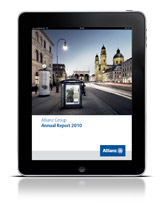
Allianz Group iPad App
And it is one stylish application: aside from easy access to all key data points for the group globally, it features the “One” campaign, with images of public ads for the global campaign in iconic places around the world.
A few other highlights:
– an in-depth visual look at the international executive committee.
– interactive graphs, tables and footnotes embedded in the executive summary.
– links to appendix tables to jump back and forth between commentary and data.
– a sharing function in the menu selection that let’s you email portions of the report.
The bottom line:
1. Institutional investors are looking for a knowledge exchange with asset managers.
2. Distributors are borrowing the brand of strategic partners.
3. Effectively linking brand, client service, product, and support via marketing/information delivery 2.0 impacts the bottom line.
4. Industry leaders have always been thought leaders.
5. The concentration of flows to a few managers and products raises the stakes for the industry: blockbuster or blacklisted.
6. The digital space is moving front and center for global financial institutions as they are rebuilding client trust post crisis.
7. Quality, speed AND style of your messages determine your success.
A more detailed discussion of these themes with Strategic Insight data can be found at http://www.globalfunddistribution.com.

 Warren Enskat Group
Pingback: Fund Forum Asia Interview with Alan Harden, Hong Kong 2012: The Importance of Brand in Asset Mgmt « Daniel S. Enskat